Department of Pediatrics, Mackay Memorial Hospital, Taipei, Taiwan.
PLoS One. 2013 May 29;8(5):e64012. doi: 10.1371/journal.pone.0064012. Print 2013.
The glycoprotein (G protein) and fusion protein (F protein) of respiratory syncytial virus (RSV) both show genetic variability, but few studies have examined the F protein gene. This study aimed to characterize the molecular epidemiology and phylodynamics of the F protein gene in clinical RSV strains isolated in northern Taiwan from 2000-2011.
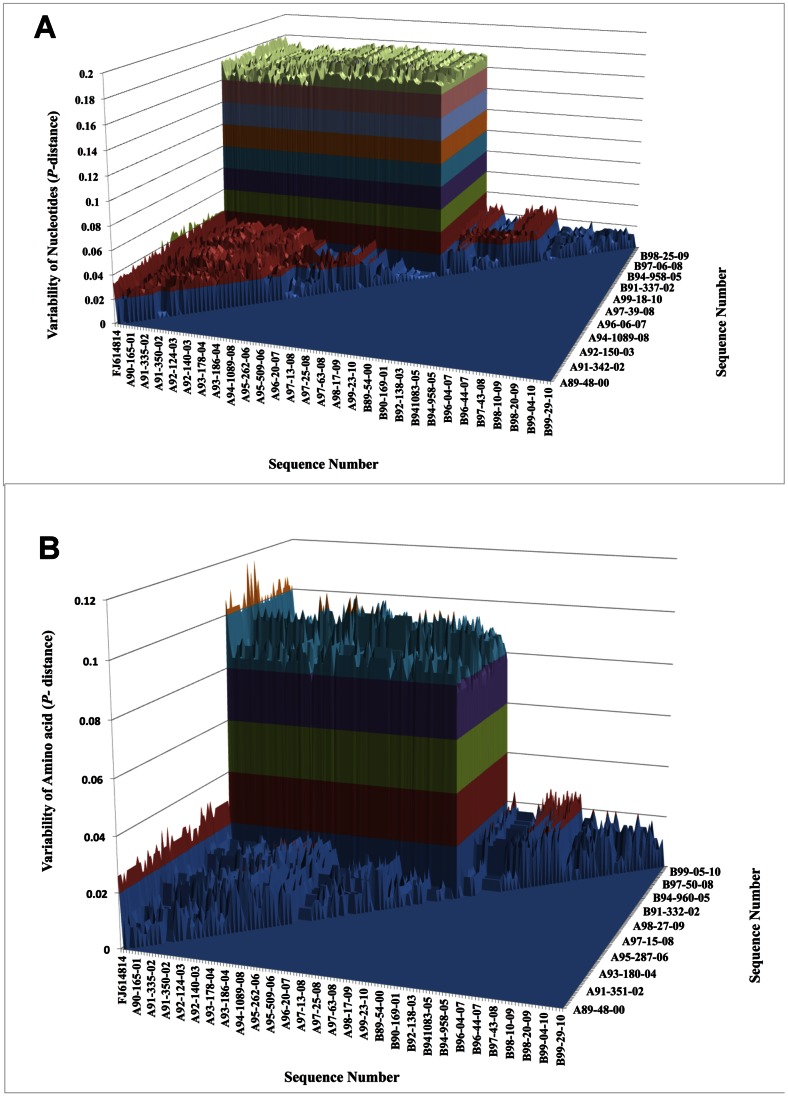
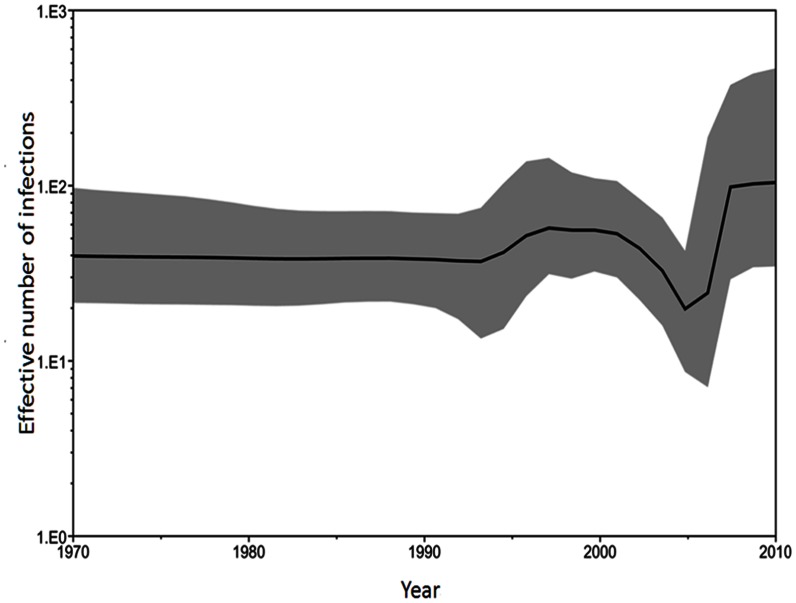
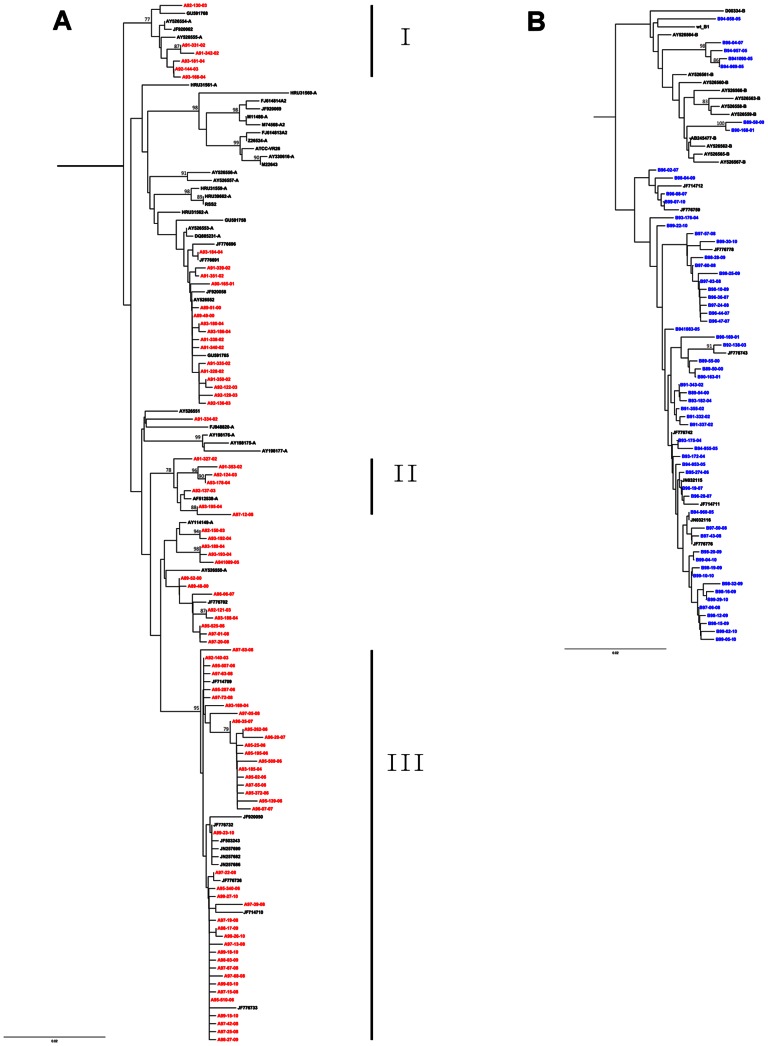
RSV isolates from children presenting with acute respiratory symptoms between July 2000 and June 2011 were typed based on F protein gene sequences. Phylogeny construction and evaluation were performed using the neighbor-joining (NJ) and maximum likelihood (ML) methods. Phylodynamic patterns in RSV F protein genes were analyzed using the Bayesian Markov Chain Monte Carlo framework. Selection pressure on the F protein gene was detected using the Datamonkey website interface.
From a total of 325 clinical RSV strains studied, phylogenetic analysis showed that 83 subgroup A strains (RSV-A) could be further divided into three clusters, whereas 58 subgroup B strains (RSV-B) had no significant clustering. Three amino acids were observed to differ between RSV-A and -B (positions 111, 113, and 114) in CTL HLA-B57- and HLA-A01-restricted epitopes. One positive selection site was observed in RSV-B, while none was observed in RSV-A. The evolution rate of the virus had very little change before 2000, then slowed down between 2000 and 2005, and evolved significantly faster after 2005. The dominant subtypes of RSV-A in each epidemic were replaced by different subtypes in the subsequent epidemic.
Before 2004, RSV-A infections were involved in several small epidemics and only very limited numbers of strains evolved and re-emerged in subsequent years. After 2005, the circulating RSV-A strains were different from those of the previous years and continued evolving through 2010. Phylodynamic pattern showed the evolutionary divergence of RSV increased significantly in the recent 5 years in northern Taiwan.
呼吸道合胞病毒(RSV)的糖蛋白(G 蛋白)和融合蛋白(F 蛋白)均表现出遗传变异性,但对 F 蛋白基因的研究较少。本研究旨在分析 2000-2011 年台湾北部临床分离的 RSV 株 F 蛋白基因的分子流行病学和系统发育动力学特征。
对 2000 年 7 月至 2011 年 6 月期间因急性呼吸道症状就诊的儿童中分离的 RSV 株,根据 F 蛋白基因序列进行分型。采用邻接法(NJ)和最大似然法(ML)构建系统发育树并进行评估。采用贝叶斯马尔可夫链蒙特卡罗框架分析 RSV F 蛋白基因的系统发育模式。利用 Datamonkey 网站界面检测 F 蛋白基因的选择压力。
共分析了 325 株临床 RSV 株,系统发育分析显示 83 株 A 亚群(RSV-A)株可进一步分为 3 个聚类,而 58 株 B 亚群(RSV-B)株无明显聚类。在 CTL HLA-B57-和 HLA-A01 限制性表位中,RSV-A 和 -B 株有 3 个氨基酸不同(位置 111、113 和 114)。在 RSV-B 中观察到 1 个正选择位点,而在 RSV-A 中未观察到。病毒的进化速率在 2000 年之前变化很小,2000-2005 年减慢,2005 年后明显加快。每次流行的 RSV-A 优势亚群在随后的流行中被不同的亚群取代。
2004 年之前,RSV-A 感染涉及几次小流行,仅有少量病毒株在随后几年中进化和再次出现。2005 年后,流行的 RSV-A 株与前几年不同,并持续进化至 2010 年。系统发育模式显示,台湾北部 RSV 的进化分歧在最近 5 年显著增加。