Ahn Jinsoo, Park Yoo-Jin, Chen Paula, Lee Tae Jin, Jeon Young-Jun, Croce Carlo M, Suh Yeunsu, Hwang Seongsoo, Kwon Woo-Sung, Pang Myung-Geol, Kim Cheorl-Ho, Lee Sang Suk, Lee Kichoon
Department of Animal Sciences, The Ohio State University, Columbus, Ohio, United States of America.
Center for Systems Biology, Program in Membrane Biology/Nephrology Division, Massachusetts General Hospital, Boston, MA and Harvard Medical School, Boston, Massachusetts, United States of America.
PLoS One. 2017 Apr 17;12(4):e0175787. doi: 10.1371/journal.pone.0175787. eCollection 2017.
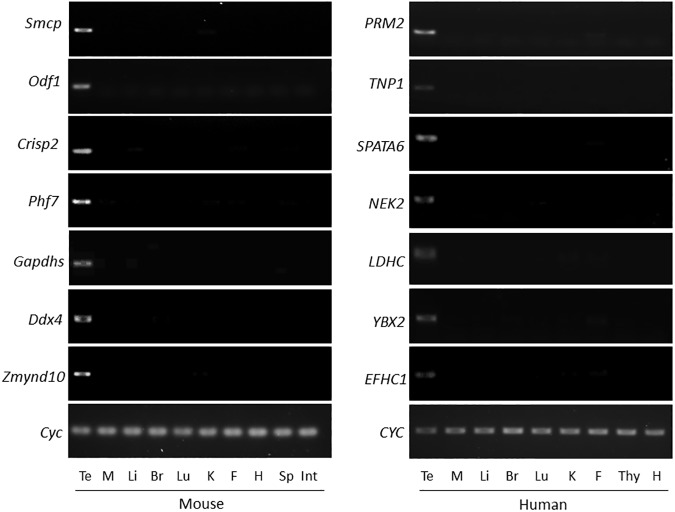
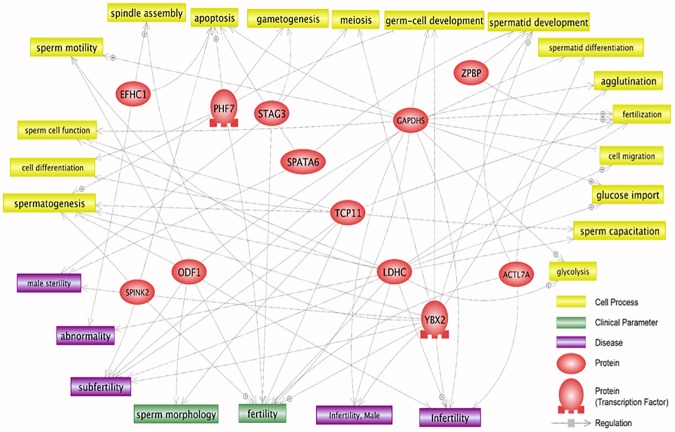
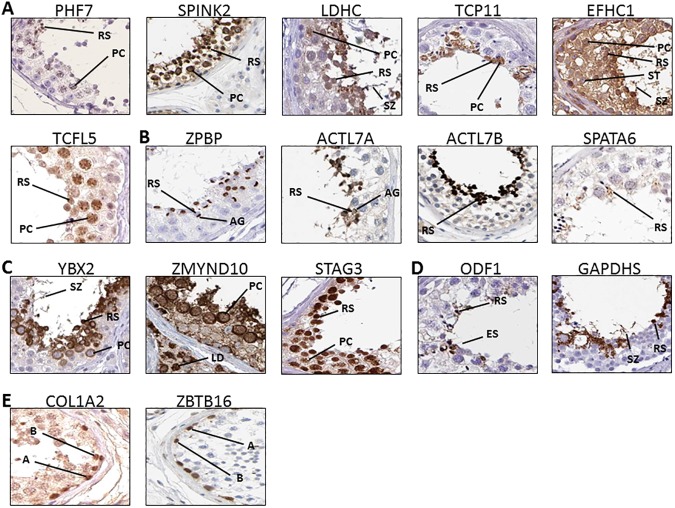
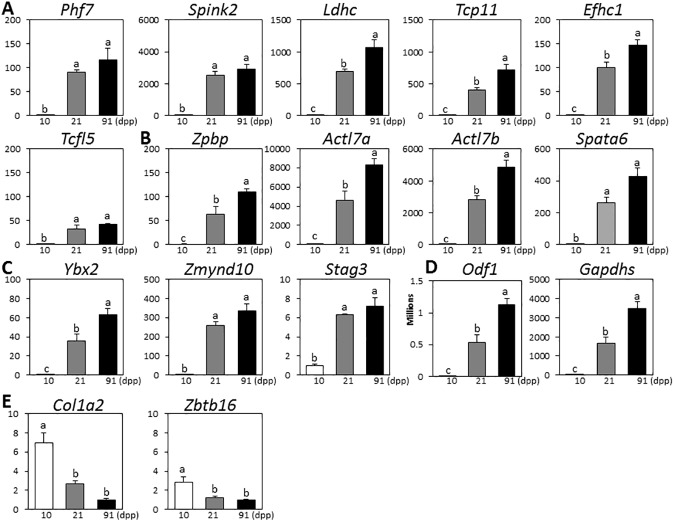
The testis has been identified as the organ in which a large number of tissue-enriched genes are present. However, a large portion of transcripts related to each stage or cell type in the testis still remains unknown. In this study, databases combined with confirmatory measurements were used to investigate testis-enriched genes, localization in the testis, developmental regulation, gene expression profiles of testicular disease, and signaling pathways. Our comparative analysis of GEO DataSets showed that 24 genes are predominantly expressed in testis. Cellular locations of 15 testis-enriched proteins in human testis have been identified and most of them were located in spermatocytes and round spermatids. Real-time PCR revealed that expressions of these 15 genes are significantly increased during testis development. Also, an analysis of GEO DataSets indicated that expressions of these 15 genes were significantly decreased in teratozoospermic patients and polyubiquitin knockout mice, suggesting their involvement in normal testis development. Pathway analysis revealed that most of those 15 genes are implicated in various sperm-related cell processes and disease conditions. This approach provides effective strategies for discovering novel testis-enriched genes and their expression patterns, paving the way for future characterization of their functions regarding infertility and providing new biomarkers for specific stages of spematogenesis.
睾丸已被确定为存在大量组织特异性富集基因的器官。然而,与睾丸中每个阶段或细胞类型相关的大部分转录本仍不清楚。在本研究中,结合确证性测量的数据库被用于研究睾丸特异性富集基因、在睾丸中的定位、发育调控、睾丸疾病的基因表达谱以及信号通路。我们对基因表达综合数据库(GEO)数据集的比较分析表明,有24个基因主要在睾丸中表达。已确定了15种睾丸特异性富集蛋白在人类睾丸中的细胞定位,其中大多数位于精母细胞和圆形精子细胞中。实时定量聚合酶链反应(Real-time PCR)显示,这15个基因的表达在睾丸发育过程中显著增加。此外,对GEO数据集的分析表明,这15个基因的表达在畸形精子症患者和多聚泛素基因敲除小鼠中显著降低,表明它们参与正常睾丸发育。通路分析显示,这15个基因中的大多数与各种精子相关的细胞过程和疾病状况有关。这种方法为发现新的睾丸特异性富集基因及其表达模式提供了有效的策略,为未来研究它们在不育症方面的功能特征铺平了道路,并为精子发生的特定阶段提供了新的生物标志物。