Sim Yun Su, Lee Ji-Hyun, Lee Won-Yeon, Suh Dong In, Oh Yeon-Mok, Yoon Jong-Seo, Lee Jin Hwa, Cho Jae Hwa, Kwon Cheol Seok, Chang Jung Hyun
Division of Pulmonary, Allergy and Critical Care Medicine, Department of Internal Medicine, Hallym University Kangnam Sacred Heart Hospital, Seoul, Korea.
Department of Allergy, Pulmonary and Critical Care Medicine, CHA Bundang Medical Center, CHA University, Seongnam, Korea.
Tuberc Respir Dis (Seoul). 2017 Apr;80(2):105-112. doi: 10.4046/trd.2017.80.2.105. Epub 2017 Mar 31.
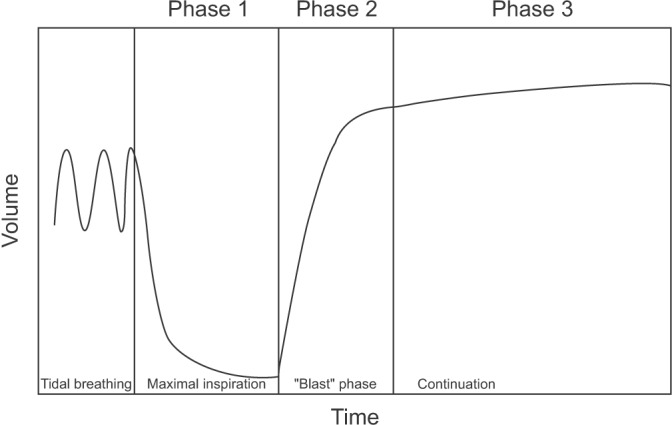
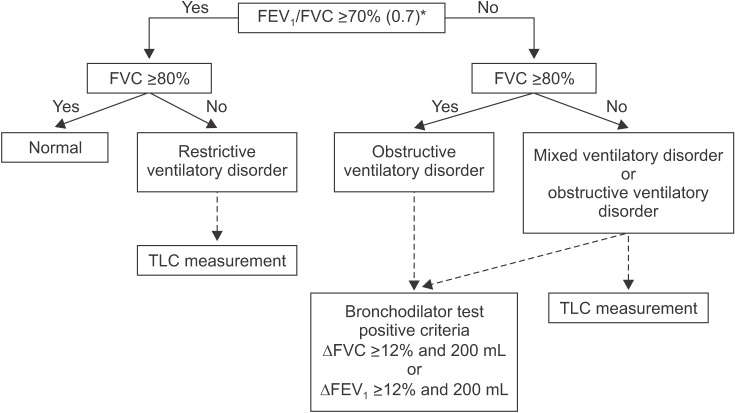
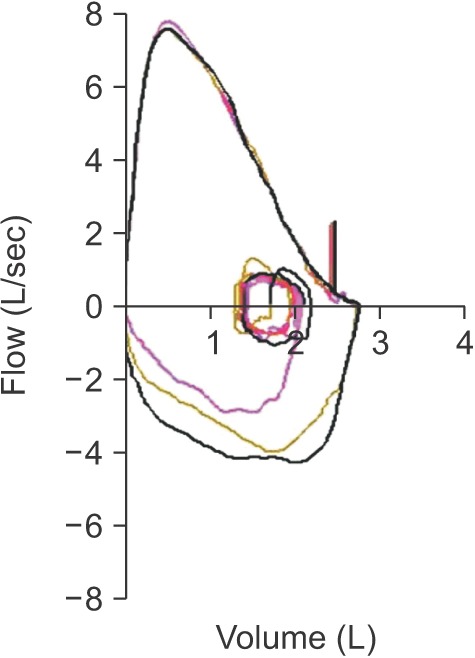
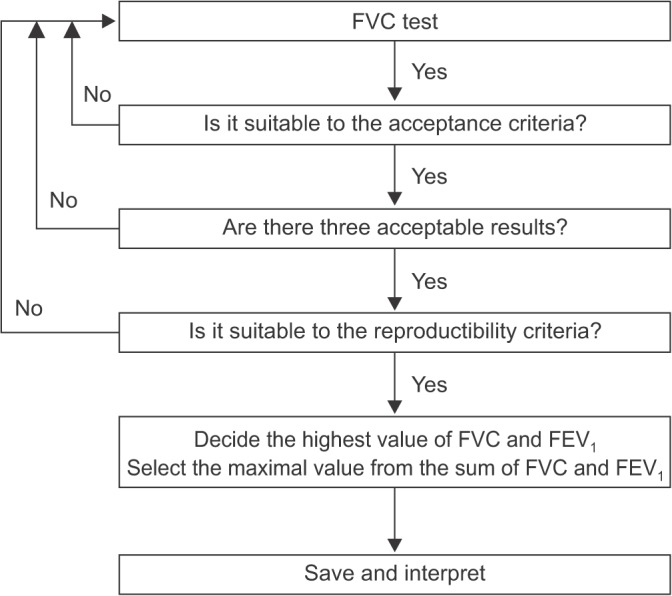
Spirometry is a physiological test for assessing the functional aspect of the lungs using an objective indicator to measure the maximum amount of air that a patient can inhale and exhale. Acceptable spirometry testing needs to be conducted three times by an acceptable and reproducible method for determining forced vital capacity (FVC). Until the results of three tests meet the criteria of reproducibility, the test should be repeated up to eight times. Interpretation of spirometry should be clear, concise, and informative. Additionally, spirometry should guarantee optimal quality prior to the interpreting spirometry results. Our guideline adopts a fixed normal predictive value instead of the lower limit of normal as the reference value because fixed value is more convenient and also accepts FVC instead of vital capacity (VC) because measurement of VC using a spirometer is impossible. The bronchodilator test is a method for measuring the changes in lung capacity after inhaling a short-acting β-agonist that dilates the airway. When an obstructive ventilatory defect is observed, this test helps to diagnose and evaluate asthma and chronic obstructive pulmonary disease by measuring reversibility with the use of an inhaled bronchodilator. A positive response to a bronchodilator is generally defined as an increase of ≥12% and ≥200 mL as an absolute value compared with a baseline in either forced expiratory volume at 1 second or FVC.
肺活量测定是一种生理学测试,通过使用客观指标来测量患者能够吸入和呼出的最大空气量,以评估肺部的功能状况。需要采用可接受且可重复的方法对用力肺活量(FVC)进行三次可接受的肺活量测定测试。在三次测试结果符合可重复性标准之前,该测试应重复进行多达八次。肺活量测定的解读应清晰、简洁且信息丰富。此外,在解读肺活量测定结果之前,肺活量测定应保证最佳质量。我们的指南采用固定的正常预测值而非正常下限作为参考值,因为固定值更方便,并且采用FVC而非肺活量(VC),因为使用肺活量计无法测量VC。支气管扩张试验是一种测量吸入短效β受体激动剂(可扩张气道)后肺容量变化的方法。当观察到阻塞性通气功能障碍时,该测试通过使用吸入性支气管扩张剂测量可逆性,有助于诊断和评估哮喘及慢性阻塞性肺疾病。支气管扩张剂的阳性反应通常定义为与1秒用力呼气量或FVC的基线相比,绝对值增加≥12%且≥200 mL。