Cui Fuqiang, Shen Lipin, Li Li, Wang Huaqing, Wang Fuzhen, Bi Shengli, Liu Jianhua, Zhang Guomin, Wang Feng, Zheng Hui, Sun Xiaojin, Miao Ning, Yin Zundong, Feng Zijian, Liang Xiaofeng, Wang Yu
Emerg Infect Dis. 2017 May;23(5):765-772. doi: 10.3201/eid2305.161477.
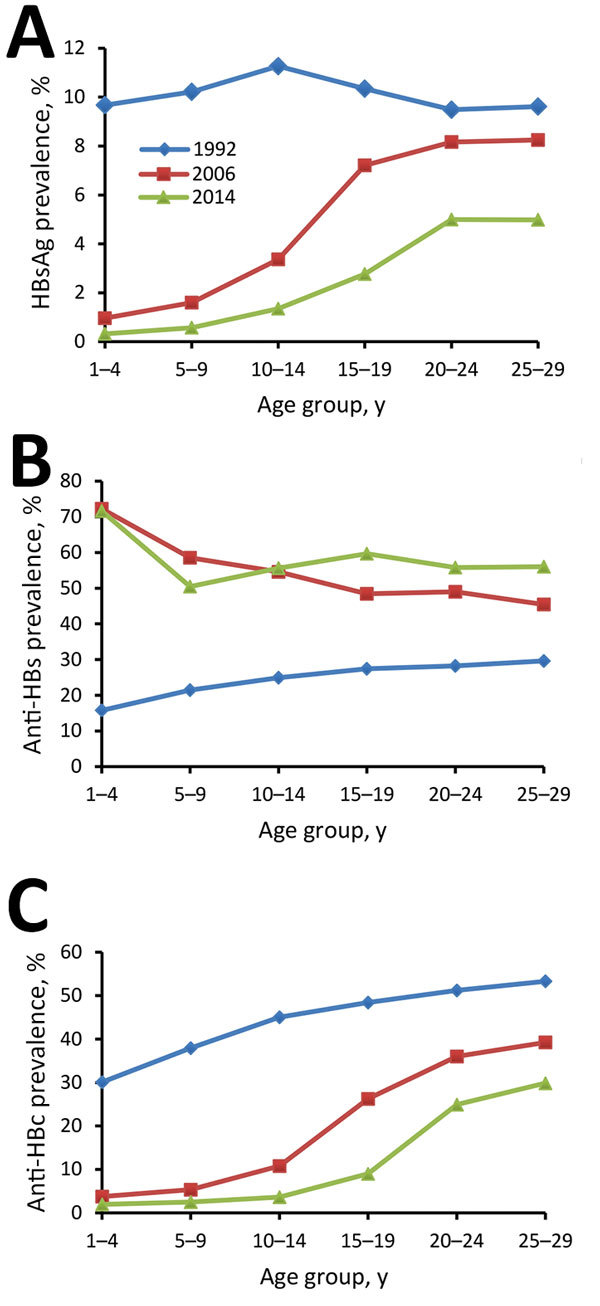
China's hepatitis B virus (HBV) prevention policy has been evaluated through nationally representative serologic surveys conducted in 1992 and 2006. We report results of a 2014 serologic survey and reanalysis of the 1992 and 2006 surveys in the context of program policy. The 2014 survey used a 2-stage sample strategy in which townships were selected from 160 longstanding, nationally representative, county-level disease surveillance points, and persons 1-29 years of age were invited to participate. The 2014 sample size was 31,713; the response rate was 83.3%. Compared with the 1992 pre-recombinant vaccine survey, HBV surface antigen prevalence declined 46% by 2006 and by 52% by 2014. Among children <5 years of age, the decline was 97%. China's HBV prevention program, targeted toward interrupting perinatal transmission, has been highly successful and increasingly effective. However, this progress must be sustained for decades to come, and elimination of HBV transmission will require augmented strategies.
中国的乙肝病毒(HBV)预防政策已通过1992年和2006年开展的全国代表性血清学调查进行了评估。我们报告了2014年血清学调查的结果,并在项目政策背景下对1992年和2006年的调查进行了重新分析。2014年的调查采用了两阶段抽样策略,从160个长期具有全国代表性的县级疾病监测点中选取乡镇,并邀请1至29岁的人员参与。2014年的样本量为31,713;应答率为83.3%。与1992年重组疫苗接种前的调查相比,乙肝表面抗原流行率到2006年下降了46%,到2014年下降了52%。在5岁以下儿童中,下降幅度为97%。中国针对阻断围产期传播的乙肝预防项目非常成功且效果日益显著。然而,这一进展必须在未来几十年持续下去,消除乙肝传播将需要强化策略。