Poorolajal Jalal, Zeraati Fatemeh, Soltanian Ali Reza, Sheikh Vida, Hooshmand Elham, Maleki Akram
Department of Epidemiology, School of Public Health, Hamadan University of Medical Sciences, Hamadan, Iran.
Research Center for Health Sciences, Hamadan University of Medical Sciences, Hamadan, Iran.
PLoS One. 2017 Apr 18;12(4):e0174967. doi: 10.1371/journal.pone.0174967. eCollection 2017.
Increased dietary potassium intake is thought to be associated with low blood pressure (BP). Whether potassium supplementation may be used as an antihypertensive agent is a question that should be answered.
To assess the effect of oral potassium supplementation on blood pressure in patients with primary hypertension.
We searched Medline, Web of Science, Scopus, Cochrane Central Register of Controlled Trials until October 2016. We also screened reference lists of articles and previous reviews. We applied no language restrictions.
We included randomized placebo-controlled clinical trials addressing the effect of potassium supplementation on primary hypertension for a minimum of 4 weeks.
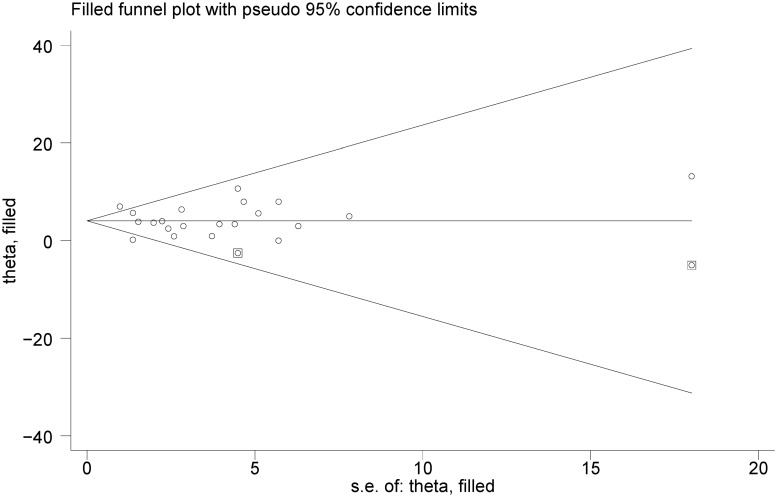
We extracted data on systolic and diastolic BP (SBP and DBP) at the final follow-up. We explored the heterogeneity across studies using Cochran's test and I2 statistic and assessed the probability of publication bias using Begg's and Egger's tests. We reported the mean difference (MD) of SBP and DBP in a random-effects model.
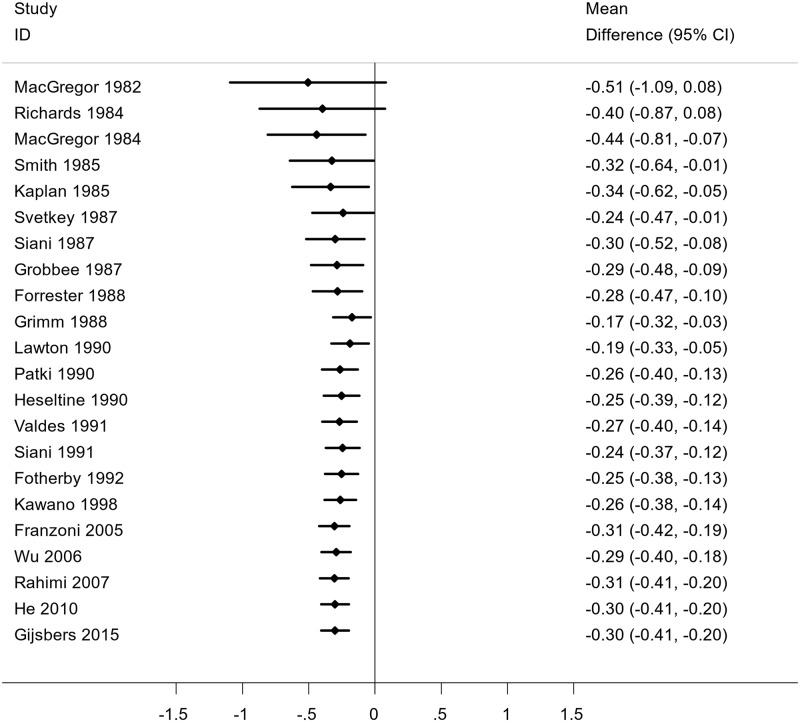
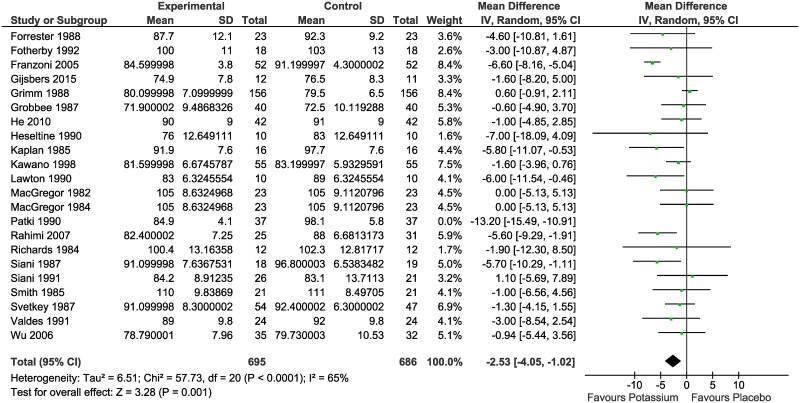
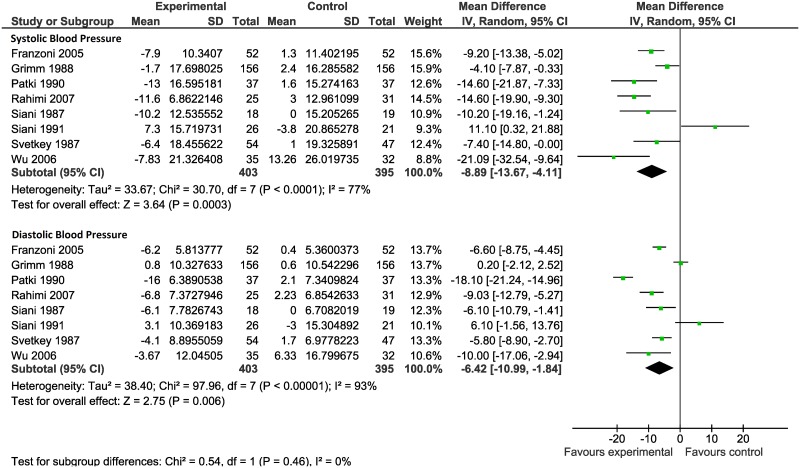
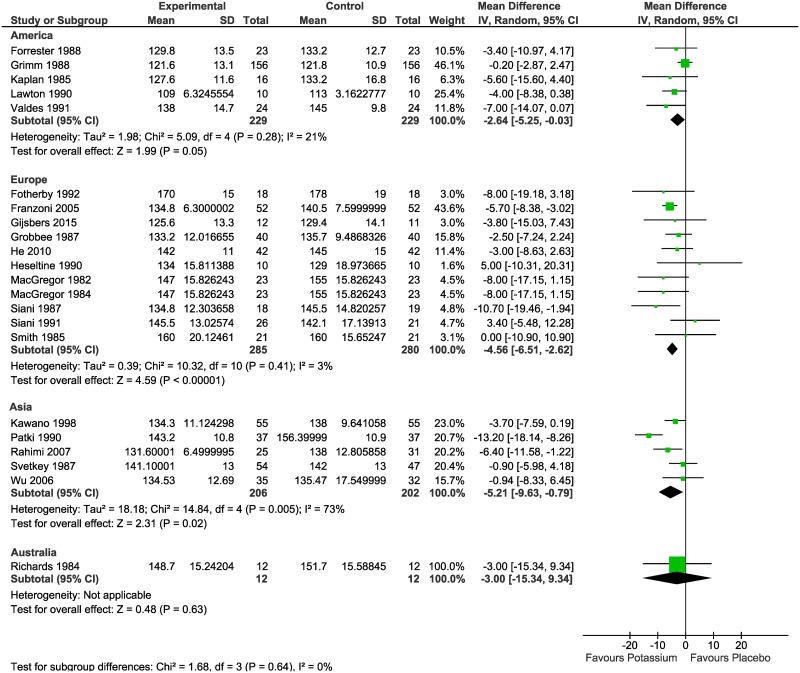
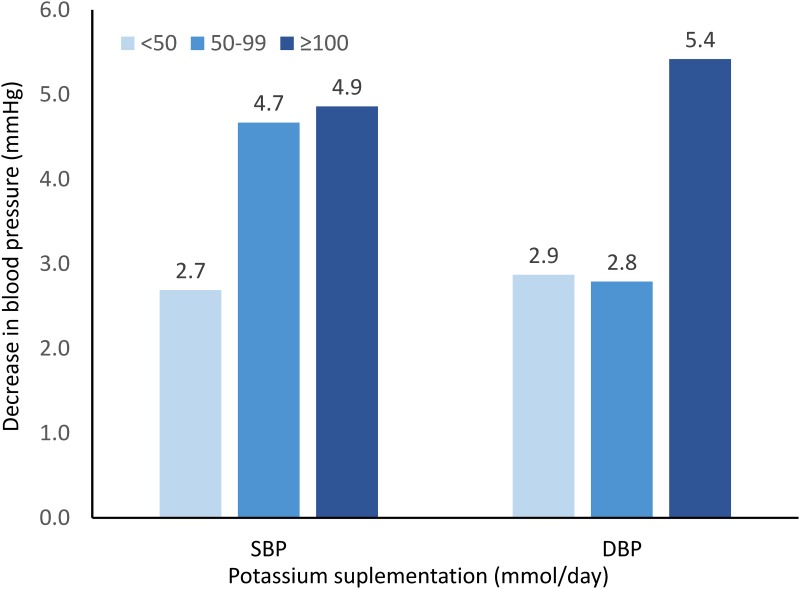
We found a total of 9059 articles and included 23 trials with 1213 participants. Compared to placebo, potassium supplementation resulted in modest but significant reductions in both SBP (MD -4.25 mmHg; 95% CI: -5.96 to -2.53; I2 = 41%) and DBP (MD -2.53 mmHg; 95% CI: -4.05 to -1.02; I2 = 65%). According to the change-score analysis, based on 8 out of 23 trials, compared to baseline, the mean changes in SBP (MD -8.89 mmHg; 95% CI: -13.67 to -4.11) and DBP (MD -6.42 mmHg; 95% CI: -10.99 to -1.84) was significantly higher in the intervention group than the control group.
Our findings indicated that potassium supplementation is a safe medication with no important adverse effects that has a modest but significant impact BP and may be recommended as an adjuvant antihypertensive agent for patients with essential hypertension.
饮食中钾摄入量增加被认为与低血压有关。补充钾是否可用作抗高血压药物是一个有待回答的问题。
评估口服补钾对原发性高血压患者血压的影响。
我们检索了截至2016年10月的Medline、科学网、Scopus、Cochrane对照试验中央注册库。我们还筛选了文章的参考文献列表和先前的综述。我们没有设置语言限制。
我们纳入了至少为期4周的关于补钾对原发性高血压影响的随机安慰剂对照临床试验。
我们提取了最终随访时的收缩压和舒张压(SBP和DBP)数据。我们使用 Cochr an检验和I2统计量探索研究间的异质性,并使用Begg检验和Egger检验评估发表偏倚的可能性。我们在随机效应模型中报告了SBP和DBP的平均差异(MD)。
我们共找到9059篇文章,纳入了23项试验,共1213名参与者。与安慰剂相比,补钾导致SBP(MD -4.25 mmHg;95%CI:-5.96至-2.53;I2 = 41%)和DBP(MD -2.53 mmHg;95%CI:-4.05至-1.02;I2 = 65%)均有适度但显著的降低。根据变化分数分析,基于23项试验中的8项,与基线相比,干预组的SBP(MD -8.89 mmHg;95%CI:-13.67至-4.11)和DBP(MD -6.42 mmHg;95%CI:-10.99至-1.84)的平均变化显著高于对照组。
我们的研究结果表明,补钾是一种安全的药物,没有重要的不良反应,对血压有适度但显著的影响,可推荐作为原发性高血压患者的辅助抗高血压药物。