Wang Yuan-Yuan, He Wen-Wen, Liu Yan-Chun, Lin Yi-Feng, Hong Lu-Fei
Department of Physics, Harbin University, Harbin 150086, China.
Cardio-Cerebrovascular Control and Research Center, Institute of Basic Medicine, Shandong Academy of Medical Sciences, Jinan 250062, China.
Nutrients. 2017 Apr 14;9(4):389. doi: 10.3390/nu9040389.
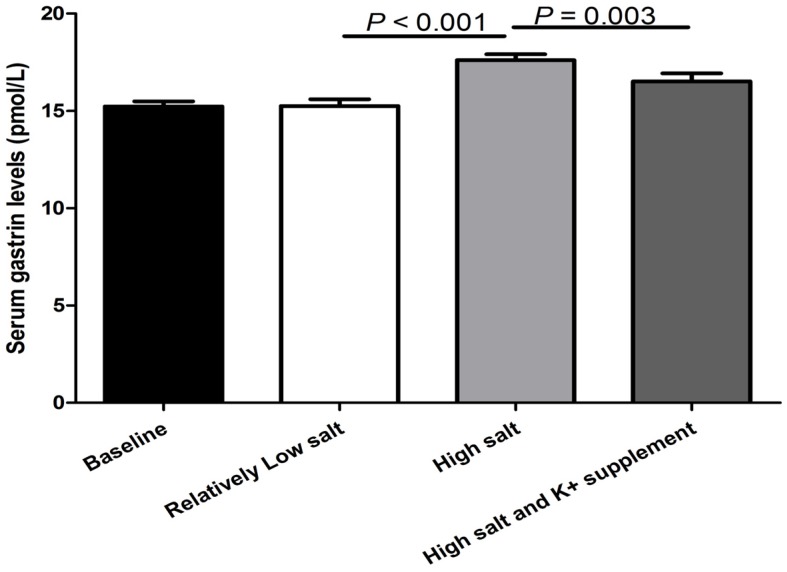
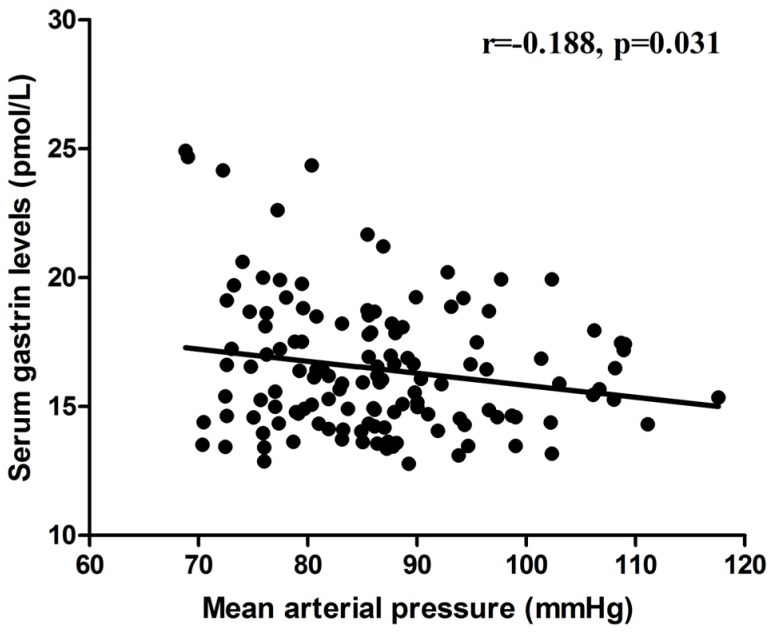
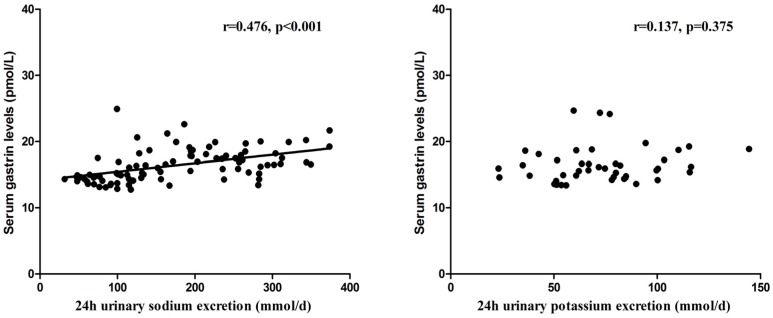
Excess dietary salt is strongly correlated with cardiovascular disease, morbidity, and mortality. Conversely, potassium likely elicits favorable effects against cardiovascular disorders. Gastrin, which is produced by the G-cells of the stomach and duodenum, can increase renal sodium excretion and regulate blood pressure by acting on the cholecystokinin B receptor. The aim of our study was to assess the effects of altered salt and potassium supplementation on serum gastrin levels in humans. A total of 44 subjects (38-65 years old) were selected from a rural community in northern China. All subjects were sequentially maintained on a relatively low-salt diet for 7 days (3.0 g/day of NaCl), a high-salt diet for 7 days (18.0 g/day of NaCl), and then a high-salt diet supplemented with potassium for another 7 days (18.0 g/day of NaCl + 4.5 g/day of KCl). The high-salt intake significantly increased serum gastrin levels (15.3 ± 0.3 vs. 17.6 ± 0.3 pmol/L). This phenomenon was alleviated through potassium supplementation (17.6 ± 0.3 vs. 16.5 ± 0.4 pmol/L). Further analyses revealed that serum gastrin was positively correlated with 24 h urinary sodium excretion ( = 0.476, < 0.001). By contrast, gastrin level was negatively correlated with blood pressure in all dietary interventions ( = -0.188, = 0.031). The present study indicated that variations in dietary salt and potassium supplementation affected the serum gastrin concentrations in the Chinese subjects.
过量的膳食盐与心血管疾病、发病率和死亡率密切相关。相反,钾可能对心血管疾病产生有益影响。胃泌素由胃和十二指肠的G细胞产生,可通过作用于胆囊收缩素B受体增加肾钠排泄并调节血压。我们研究的目的是评估改变盐和钾的摄入量对人体血清胃泌素水平的影响。从中国北方的一个农村社区选取了44名受试者(38 - 65岁)。所有受试者依次维持7天相对低盐饮食(氯化钠3.0克/天)、7天高盐饮食(氯化钠18.0克/天),然后再进行7天高盐饮食并补充钾(氯化钠18.0克/天 + 氯化钾4.5克/天)。高盐摄入显著增加了血清胃泌素水平(15.3 ± 0.3对17.6 ± 0.3皮摩尔/升)。通过补充钾这种现象得到缓解(17.6 ± 0.3对16.5 ± 0.4皮摩尔/升)。进一步分析显示血清胃泌素与24小时尿钠排泄呈正相关(r = 0.476,P < 0.001)。相比之下,在所有饮食干预中胃泌素水平与血压呈负相关(r = -0.188,P = 0.031)。本研究表明,饮食中盐和钾摄入量的变化影响了中国受试者的血清胃泌素浓度。