Agboola Stephen, Golas Sara, Fischer Nils, Nikolova-Simons Mariana, Op den Buijs Jorn, Schertzer Linda, Kvedar Joseph, Jethwani Kamal
Partners Connected Health, Partner Healthcare, 25 New Chardon St., Suite 300, Boston, MA, 02114, USA.
Massachusetts General Hospital, Boston, USA.
BMC Health Serv Res. 2017 Apr 18;17(1):282. doi: 10.1186/s12913-017-2196-1.
Personal Emergency Response Systems (PERS) are traditionally used as fall alert systems for older adults, a population that contributes an overwhelming proportion of healthcare costs in the United States. Previous studies focused mainly on qualitative evaluations of PERS without a longitudinal quantitative evaluation of healthcare utilization in users. To address this gap and better understand the needs of older patients on PERS, we analyzed longitudinal healthcare utilization trends in patients using PERS through the home care management service of a large healthcare organization.
Retrospective, longitudinal analyses of healthcare and PERS utilization records of older patients over a 5-years period from 2011-2015. The primary outcome was to characterize the healthcare utilization of PERS patients. This outcome was assessed by 30-, 90-, and 180-day readmission rates, frequency of principal admitting diagnoses, and prevalence of conditions leading to potentially avoidable admissions based on Centers for Medicare and Medicaid Services classification criteria.
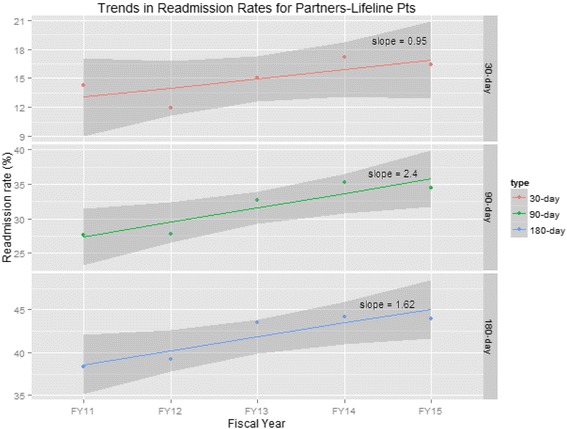
The overall 30-day readmission rate was 14.2%, 90-days readmission rate was 34.4%, and 180-days readmission rate was 42.2%. While 30-day readmission rates did not increase significantly (p = 0.16) over the study period, 90-days (p = 0.03) and 180-days (p = 0.04) readmission rates did increase significantly. The top 5 most frequent principal diagnoses for inpatient admissions included congestive heart failure (5.7%), chronic obstructive pulmonary disease (4.6%), dysrhythmias (4.3%), septicemia (4.1%), and pneumonia (4.1%). Additionally, 21% of all admissions were due to conditions leading to potentially avoidable admissions in either institutional or non-institutional settings (16% in institutional settings only).
Chronic medical conditions account for the majority of healthcare utilization in older patients using PERS. Results suggest that PERS data combined with electronic medical records data can provide useful insights that can be used to improve health outcomes in older patients.
个人应急响应系统(PERS)传统上用作老年人的跌倒警报系统,在美国,老年人群体产生了绝大部分医疗费用。以往研究主要聚焦于PERS的定性评估,而未对用户的医疗保健利用情况进行纵向定量评估。为填补这一空白并更好地了解使用PERS的老年患者的需求,我们通过一家大型医疗保健机构的家庭护理管理服务,分析了使用PERS的患者的纵向医疗保健利用趋势。
对2011年至2015年期间老年患者的医疗保健和PERS使用记录进行回顾性纵向分析。主要结果是描述PERS患者的医疗保健利用情况。该结果通过30天、90天和180天再入院率、主要入院诊断频率以及根据医疗保险和医疗补助服务中心分类标准导致潜在可避免入院的疾病患病率进行评估。
总体30天再入院率为14.2%,90天再入院率为34.4%,180天再入院率为42.2%。虽然在研究期间30天再入院率没有显著增加(p = 0.16),但90天(p = 0.03)和180天(p = 0.04)再入院率确实显著增加。住院患者最常见的前5种主要诊断包括充血性心力衰竭(5.7%)、慢性阻塞性肺疾病(4.6%)、心律失常(4.3%)、败血症(4.1%)和肺炎(4.1%)。此外,所有入院病例中有21%是由机构或非机构环境中导致潜在可避免入院的疾病引起的(仅机构环境中为16%)。
慢性疾病占使用PERS的老年患者医疗保健利用的大部分。结果表明,PERS数据与电子病历数据相结合可以提供有用的见解,可用于改善老年患者的健康状况。