Salkovic Dina, Hobert Markus A, Bellut Carolin, Funer Florian, Renno Sarah, Haertner Linda, Hasmann Sandra E, Staebler Jana, Geritz Johanna, Suenkel Ulrike, Fallgatter Andreas J, Eschweiler Gerhard W, Berg Daniela, Maetzler Walter
Department of Neurodegenerative Diseases, Center for Neurology, Hertie Institute for Clinical Brain Research, University of TuebingenTuebingen, Germany.
German Center for Neurodegenerative DiseasesTuebingen, Germany.
Front Aging Neurosci. 2017 Apr 4;9:75. doi: 10.3389/fnagi.2017.00075. eCollection 2017.
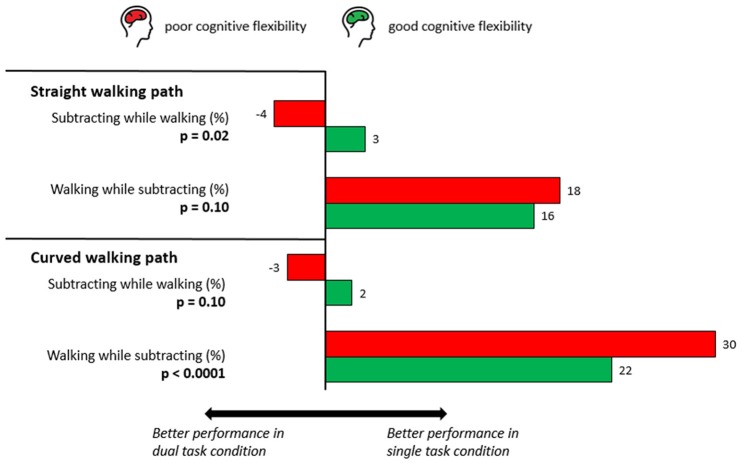
Older adults have increased risks of balance issues and falls when walking and performing turns in daily situations. Changes of prioritization during different walking situations associated with dual tasking may contribute to these deficits. The objective of this study was therefore to investigate whether older adults demonstrate changes of prioritization during different walking paths. In total, 1,054 subjects with an age range from 50 to 83 years were selected from the first follow-up visit of the TREND (Tuebinger evaluation of Risk factors for Early detection of Neurodegenerative Disorders) study. They were classified according to their performance on the Trail Making Test (TMT) into good and poor TMT performers (based on recent results showing that cognitive flexibility affects prioritization strategies during straight walking). Absolute dual-task performance and relative dual-task costs (DTC, relative performance under dual-task conditions compared with single-task conditions) were assessed in two paradigms: walking while subtracting serial 7 s and walking while checking boxes on a clipboard. Both tasks were performed on straight and curved paths. Overall, the poor TMT performers group performed worse in all single and dual tasks. Interestingly, the relative change in performance measured by dual-task costs differed in the groups between the two walking paths. On straight paths, poor TMT performers had a similar DTC of walking to that of good performers ( = 0.10) but had a significantly lower DTC of subtracting ( = 0.02). On curved paths, poor performers had a similar DTC of subtracting ( = 0.10), but their DTC of walking was significantly higher ( < 0.0001). Given that walking on curved paths is considered more difficult than that on straight paths and that the serial subtracting dual task is more difficult than the box checking dual task, this study in older adults provides evidence for the existence of a (walking) situation-dependent change of prioritization. If confirmed in other studies, situation-dependent change of prioritization should be included as a potential factor contributing to gait and balance impairments, and increased fall risk in older adults.
老年人在日常行走和转弯时出现平衡问题和跌倒的风险增加。与双重任务相关的不同行走情境下的优先级变化可能导致这些缺陷。因此,本研究的目的是调查老年人在不同行走路径上是否表现出优先级的变化。总共从TREND(图宾根神经退行性疾病早期检测风险因素评估)研究的首次随访中选取了1054名年龄在50至83岁之间的受试者。根据他们在连线测验(TMT)中的表现分为TMT表现良好者和表现不佳者(基于最近的结果表明认知灵活性会影响直线行走时的优先级策略)。在两种范式中评估绝对双重任务表现和相对双重任务成本(DTC,双重任务条件下与单任务条件下的相对表现):一边连续减7一边行走以及一边在剪贴板上勾选方框一边行走。两项任务均在直线和弯曲路径上进行。总体而言,TMT表现不佳者组在所有单任务和双重任务中的表现都更差。有趣的是,通过双重任务成本衡量的表现相对变化在两组的两条行走路径之间有所不同。在直线路径上,TMT表现不佳者的行走DTC与表现良好者相似(=0.10),但减法运算的DTC显著更低(=0.02)。在弯曲路径上,表现不佳者的减法运算DTC相似(=0.10),但他们的行走DTC显著更高(<0.0001)。鉴于在弯曲路径上行走被认为比在直线路径上更困难,并且连续减法双重任务比勾选方框双重任务更困难,这项针对老年人的研究为存在(行走)情境依赖的优先级变化提供了证据。如果在其他研究中得到证实,情境依赖的优先级变化应作为导致老年人步态和平衡受损以及跌倒风险增加的潜在因素纳入考虑。