Functional Neuroimaging Unit, Centre de Recherche de l'institut Universitaire de Gériatrie de Montréal, Montréal, Quebec, Canada.
Department of Psychology, University of Montreal, Montreal, Quebec, Canada.
PLoS One. 2017 Apr 19;12(4):e0174755. doi: 10.1371/journal.pone.0174755. eCollection 2017.
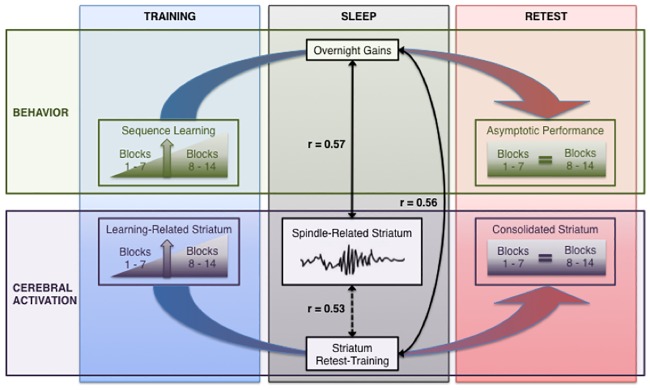
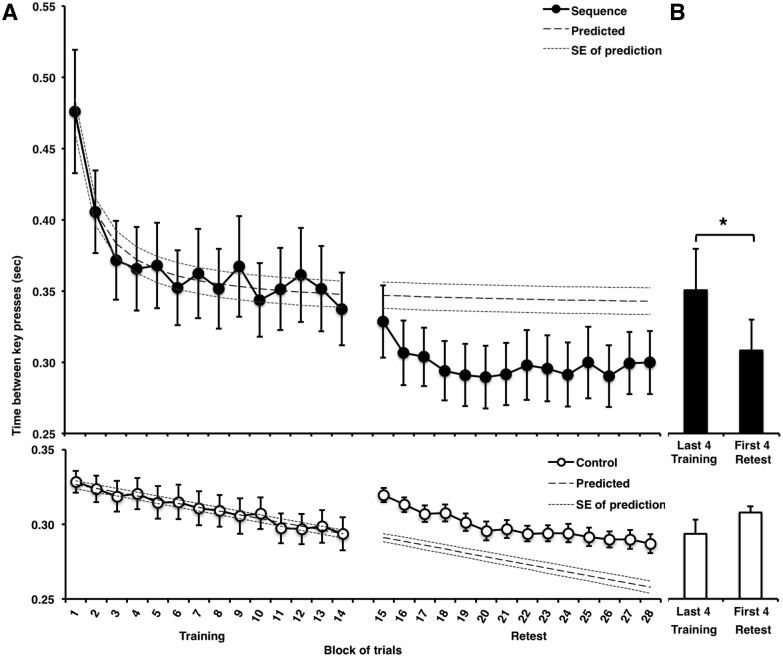
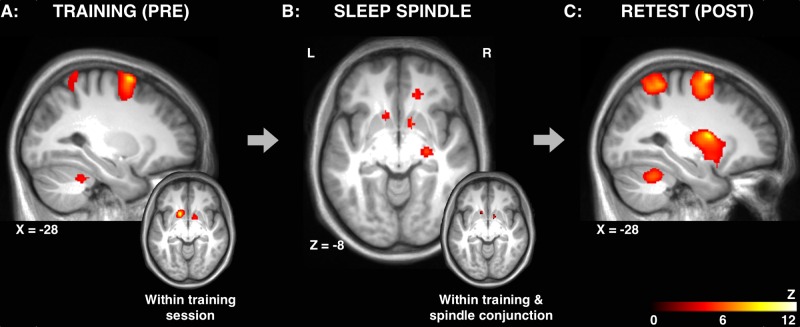
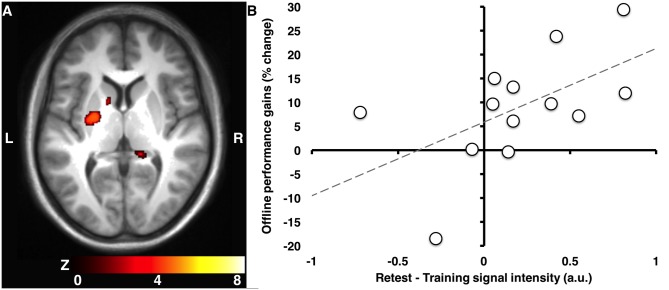
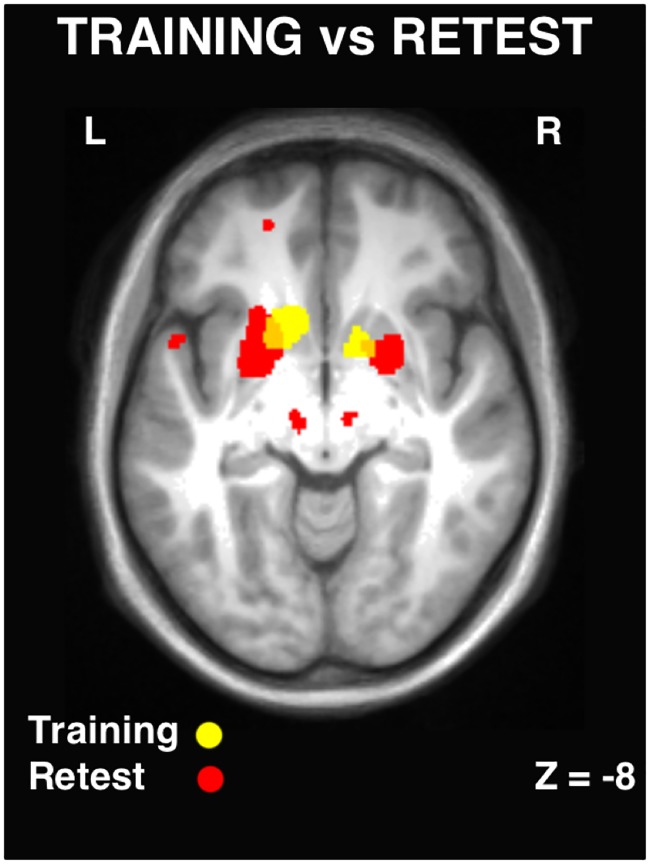
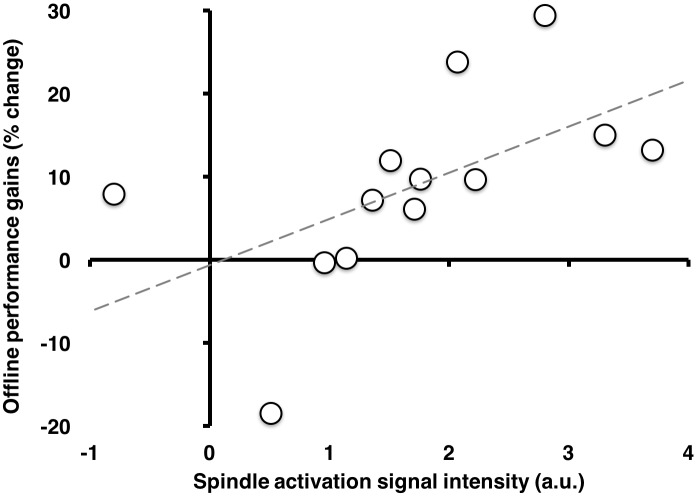
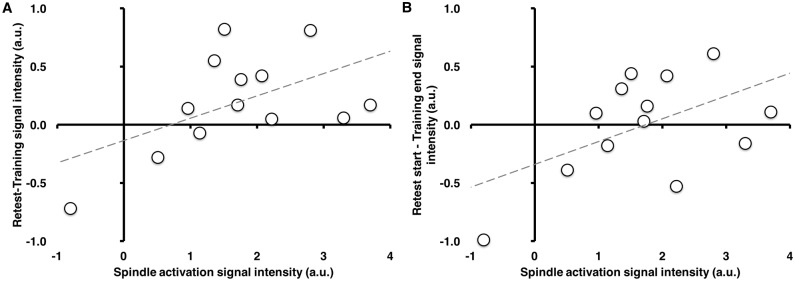
Motor memory consolidation is thought to depend on sleep-dependent reactivation of brain areas recruited during learning. However, up to this point, there has been no direct evidence to support this assertion in humans, and the physiological processes supporting such reactivation are unknown. Here, simultaneous electroencephalographic and functional magnetic resonance imaging (EEG-fMRI) recordings were conducted during post-learning sleep to directly investigate the spindle-related reactivation of a memory trace formed during motor sequence learning (MSL), and its relationship to overnight enhancement in performance (reflecting consolidation). We show that brain regions within the striato-cerebello-cortical network recruited during training on the MSL task, and in particular the striatum, were also activated during sleep, time-locked to spindles. Interestingly, the consolidated trace in the striatum was not simply strengthened, but was transformed/reorganized from rostrodorsal (associative) to caudoventral (sensorimotor) subregions. Moreover, the degree of the reactivation was correlated with overnight improvements in performance. Altogether, the present findings demonstrate that striatal reactivation linked to sleep spindles in the post-learning night, is related to motor memory consolidation.
运动记忆巩固被认为依赖于睡眠时学习过程中被招募的大脑区域的再激活。然而,到目前为止,还没有直接的证据支持这一在人类中的说法,而且支持这种再激活的生理过程尚不清楚。在这里,在学习后的睡眠期间同时进行脑电图和功能磁共振成像(EEG-fMRI)记录,以直接研究运动序列学习(MSL)过程中形成的记忆痕迹的纺锤波相关再激活及其与夜间表现增强(反映巩固)的关系。我们表明,在 MSL 任务训练期间被招募的纹状体-小脑-皮质网络内的大脑区域,特别是纹状体,在睡眠期间也被激活,与纺锤波时间锁定。有趣的是,纹状体中的巩固痕迹不是简单地增强,而是从背侧(联想)到腹侧(感觉运动)亚区进行了转换/重组。此外,再激活的程度与夜间表现的改善程度相关。总之,本研究结果表明,与学习后夜间睡眠纺锤波相关的纹状体再激活与运动记忆巩固有关。