Jiao Runsheng, Cui Dan, Wang Stephani C, Li Dongyang, Wang Yu-Feng
Department of Physiology, School of Basic Medical Sciences, Harbin Medical UniversityHarbin, China.
Department of Internal Medicine, Albany Medical CollegeAlbany, NY, USA.
Front Mol Neurosci. 2017 Apr 5;10:96. doi: 10.3389/fnmol.2017.00096. eCollection 2017.
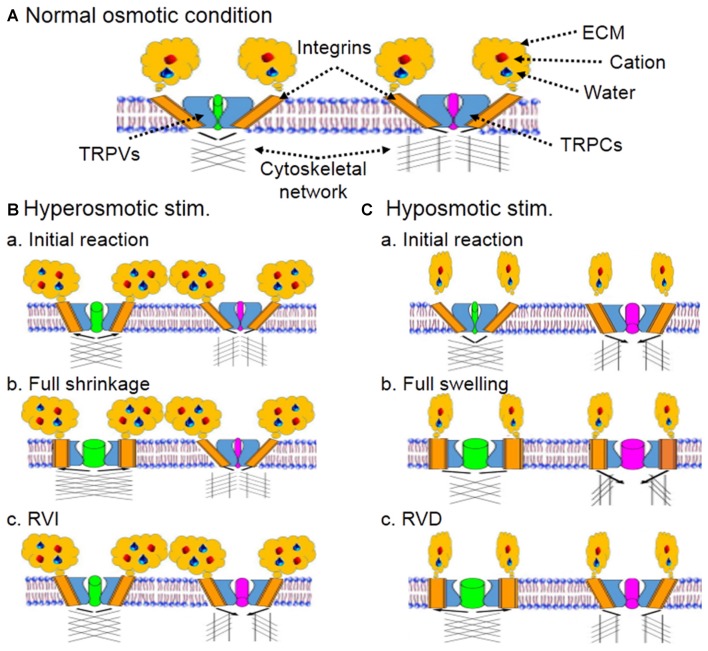
Life is maintained in a sea water-like internal environment. The homeostasis of this environment is dependent on osmosensory system translation of hydromineral information into osmotic regulatory machinery at system, tissue and cell levels. In the osmosensation, hydromineral information can be converted into cellular reactions through osmoreceptors, which changes thirst and drinking, secretion of antidiuretic vasopressin (VP), reabsorption of water and salt in the kidneys at systemic level as well as cellular metabolic activity and survival status at tissue level. The key feature of osmosensation is the activation of mechanoreceptors or mechanosensors, particularly transient receptor potential vallinoid (TRPV) and canonical (TRPC) family channels, which increases cytosolic Ca levels, activates osmosensory cells including VP neurons and triggers a series of secondary reactions. TRPV channels are sensitive to both hyperosmotic and hyposmotic stimuli while TRPC channels are more sensitive to hyposmotic challenge in neurons. The activation of TRP channels relies on changes in cell volume, membrane stretch and cytoskeletal reorganization as well as hydration status of extracellular matrix (ECM) and activity of integrins. Different families of TRP channels could be activated differently in response to hyperosmotic and hyposmotic stimuli in different spatiotemporal orders, leading to differential reactions of osmosensory cells. Together, they constitute the osmosensory machinery. The activation of this osmoreceptor complex is also associated with the activity of other osmolarity-regulating organelles, such as water channel protein aquaporins, Na-K-2Cl cotransporters, volume-sensitive anion channels, sodium pump and purinergic receptors in addition to intercellular interactions, typically astrocytic neuronal interactions. In this article, we review our current understandings of the composition of osmoreceptors and the processes of osmosensation.
生命维持在类似海水的内环境中。这种环境的稳态依赖于渗透感觉系统将水盐信息转化为系统、组织和细胞水平的渗透调节机制。在渗透感觉过程中,水盐信息可通过渗透压感受器转化为细胞反应,这在系统水平上改变口渴和饮水、抗利尿血管加压素(VP)的分泌、肾脏对水和盐的重吸收,在组织水平上改变细胞代谢活动和存活状态。渗透感觉的关键特征是机械感受器或机械传感器的激活,特别是瞬时受体电位香草酸(TRPV)和典型(TRPC)家族通道,这会增加细胞质Ca水平,激活包括VP神经元在内的渗透感觉细胞并引发一系列次级反应。TRPV通道对高渗和低渗刺激均敏感,而TRPC通道在神经元中对低渗挑战更敏感。TRP通道的激活依赖于细胞体积、膜拉伸和细胞骨架重组的变化以及细胞外基质(ECM)的水合状态和整合素的活性。不同家族的TRP通道在不同的时空顺序下对高渗和低渗刺激的反应可能不同,导致渗透感觉细胞的不同反应。它们共同构成了渗透感觉机制。这种渗透压感受器复合体的激活还与其他渗透压调节细胞器的活性有关,如除细胞间相互作用(通常是星形胶质细胞与神经元的相互作用)外的水通道蛋白水通道、Na-K-2Cl共转运体、容积敏感阴离子通道、钠泵和嘌呤能受体。在本文中,我们综述了目前对渗透压感受器组成和渗透感觉过程的理解。