Zand Martin S, Trayhan Melissa, Farooq Samir A, Fucile Christopher, Ghoshal Gourab, White Robert J, Quill Caroline M, Rosenberg Alexander, Barbosa Hugo Serrano, Bush Kristen, Chafi Hassan, Boudreau Timothy
Rochester Center for Health Informatics, University of Rochester Medical Center, Rochester, NY, United States of America.
Clinical Translational Science Institute, University of Rochester Medical Center, Rochester, NY, United States of America.
PLoS One. 2017 Apr 20;12(4):e0175876. doi: 10.1371/journal.pone.0175876. eCollection 2017.
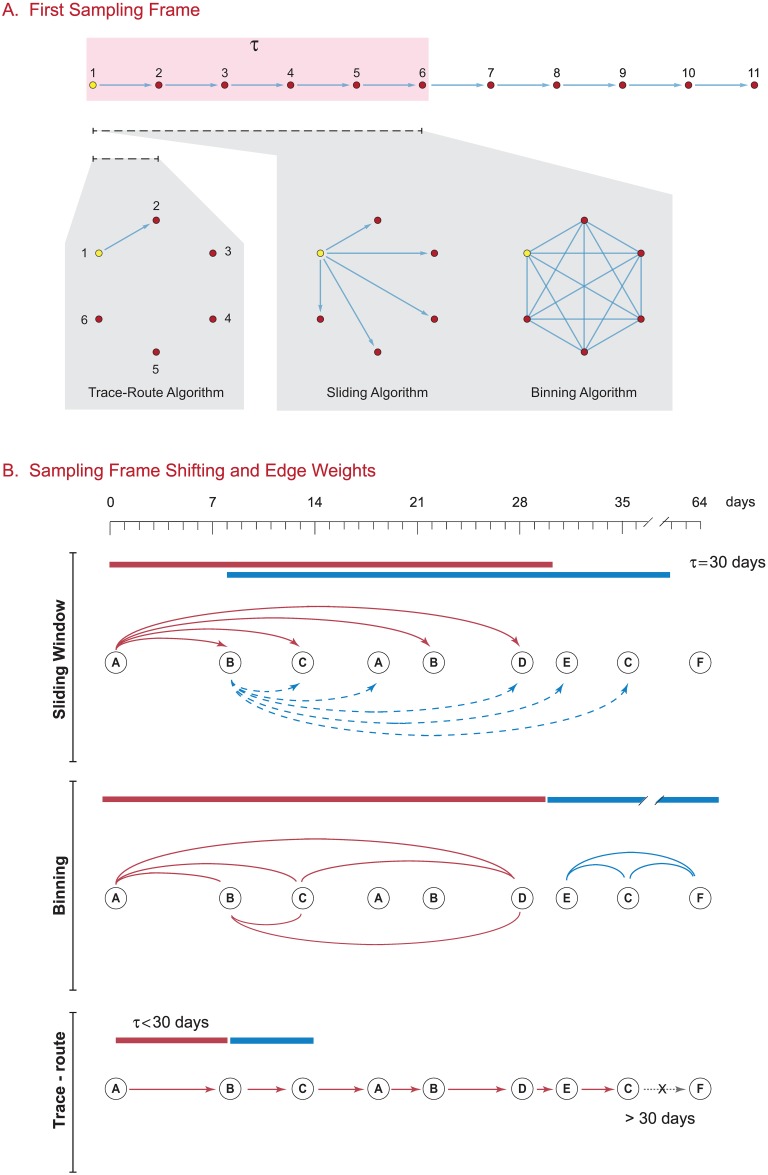
Network models of healthcare systems can be used to examine how providers collaborate, communicate, refer patients to each other, and to map how patients traverse the network of providers. Most healthcare service network models have been constructed from patient claims data, using billing claims to link a patient with a specific provider in time. The data sets can be quite large (106-108 individual claims per year), making standard methods for network construction computationally challenging and thus requiring the use of alternate construction algorithms. While these alternate methods have seen increasing use in generating healthcare networks, there is little to no literature comparing the differences in the structural properties of the generated networks, which as we demonstrate, can be dramatically different. To address this issue, we compared the properties of healthcare networks constructed using different algorithms from 2013 Medicare Part B outpatient claims data. Three different algorithms were compared: binning, sliding frame, and trace-route. Unipartite networks linking either providers or healthcare organizations by shared patients were built using each method. We find that each algorithm produced networks with substantially different topological properties, as reflected by numbers of edges, network density, assortativity, clustering coefficients and other structural measures. Provider networks adhered to a power law, while organization networks were best fit by a power law with exponential cutoff. Censoring networks to exclude edges with less than 11 shared patients, a common de-identification practice for healthcare network data, markedly reduced edge numbers and network density, and greatly altered measures of vertex prominence such as the betweenness centrality. Data analysis identified patterns in the distance patients travel between network providers, and a striking set of teaming relationships between providers in the Northeast United States and Florida, likely due to seasonal residence patterns of Medicare beneficiaries. We conclude that the choice of network construction algorithm is critical for healthcare network analysis, and discuss the implications of our findings for selecting the algorithm best suited to the type of analysis to be performed.
医疗保健系统的网络模型可用于研究医疗服务提供者如何协作、沟通、相互转诊患者,以及描绘患者如何在医疗服务提供者网络中穿梭。大多数医疗服务网络模型是根据患者理赔数据构建的,利用计费理赔记录在特定时间将患者与特定医疗服务提供者联系起来。数据集可能非常庞大(每年有106 - 108条个人理赔记录),这使得网络构建的标准方法在计算上具有挑战性,因此需要使用替代构建算法。虽然这些替代方法在生成医疗保健网络方面的应用越来越广泛,但几乎没有文献比较所生成网络的结构特性差异,而正如我们所证明的,这些差异可能非常显著。为解决这个问题,我们比较了使用不同算法从2013年医疗保险B部分门诊理赔数据构建的医疗保健网络的特性。比较了三种不同的算法:分箱法、滑动窗口法和追踪路由法。使用每种方法构建了通过共享患者连接医疗服务提供者或医疗保健组织的单部分网络。我们发现,每种算法生成的网络具有显著不同的拓扑特性,这通过边的数量、网络密度、 assortativity、聚类系数和其他结构度量得以体现。医疗服务提供者网络遵循幂律,而组织网络最适合用带有指数截断的幂律来拟合。对网络进行审查以排除共享患者少于11人的边,这是医疗保健网络数据常见的去识别做法,显著减少了边的数量和网络密度,并极大地改变了顶点突出性的度量,如中介中心性。数据分析确定了患者在网络医疗服务提供者之间的行程距离模式,以及美国东北部和佛罗里达州医疗服务提供者之间一组引人注目的合作关系,这可能归因于医疗保险受益人的季节性居住模式。我们得出结论,网络构建算法的选择对于医疗保健网络分析至关重要,并讨论了我们的研究结果对于选择最适合要执行的分析类型的算法的意义。