Hiitiö Heidi, Vakkamäki Johanna, Simojoki Heli, Autio Tiina, Junnila Jouni, Pelkonen Sinikka, Pyörälä Satu
Department of Production Animal Medicine, Faculty of Veterinary Medicine, University of Helsinki, Paroninkuja 20, 04920, Saarentaus, Finland.
Veterinary Bacteriology Research Unit, Finnish Food Safety Authority Evira, Neulaniementie 4, 70210, Kuopio, Finland.
Acta Vet Scand. 2017 Apr 20;59(1):22. doi: 10.1186/s13028-017-0288-x.
The dairy industry has undergone substantial structural changes as intensive farming has developed during recent decades. Mastitis continues to be the most common production disease of dairy cows. Nationwide surveys of mastitis prevalence are useful in monitoring udder health of dairy herds and to study the impact of structural changes on the dairy industry. This survey on bovine subclinical mastitis was the first based on cow composite milk somatic cell count (SCC) data from the Finnish national health monitoring and milk recording database. A cow with composite milk SCC ≥200,000 cells/ml in at least one of the four test milkings during the year was considered to have subclinical mastitis and a cow with composite milk SCC ≥200,000 cells/ml in three or in all four test milkings during the year to have chronic subclinical mastitis. The aim of the study was to determine the prevalence of subclinical mastitis and chronic subclinical mastitis in Finland in 1991, 2001 and 2010 and to investigate cow and herd factors associated with elevated SCC.
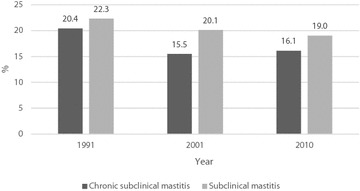
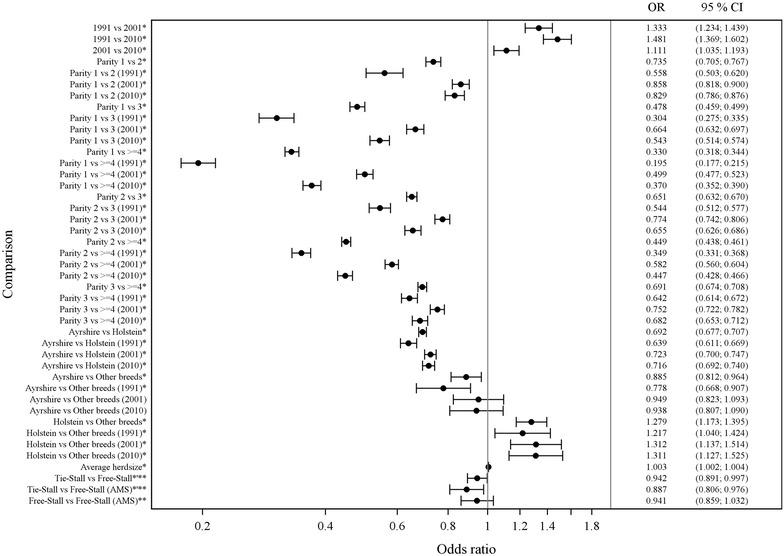
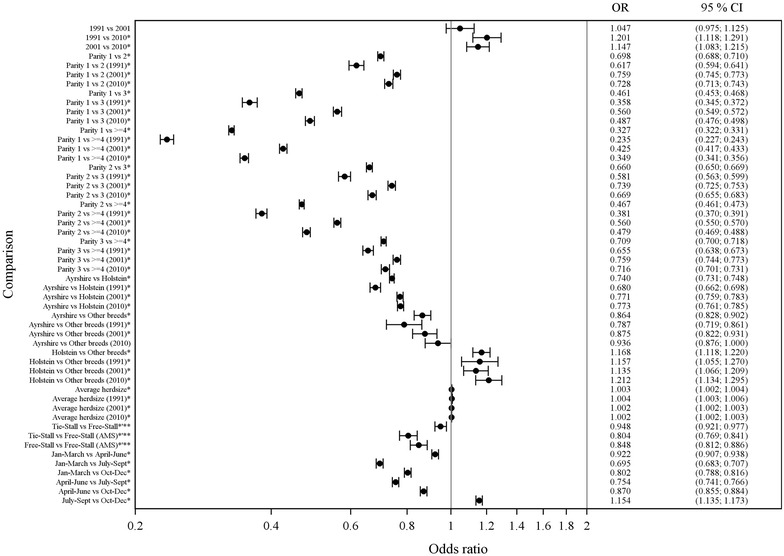
Prevalence of subclinical mastitis in Finland decreased over recent decades from 22.3% (1991) and 20.1% (2001) to 19.0% (2010). Prevalence of chronic subclinical mastitis was 20.4% in 1991, 15.5% in 2001 and 16.1% in 2010. The most significant cow and herd factors associated with subclinical mastitis or high milk SCC were increasing parity, Holstein breed, free-stalls with an automatic milking system and organic production. Milk SCC were highest from July to September. Main factors associated with chronic mastitis were increasing parity and Holstein breed.
Prevalence of subclinical mastitis in Finland decreased over recent decades, the greatest change taking place during the first decade of the study. Prevalence of chronic subclinical mastitis significantly decreased from 1991. The most significant factors associated with both types of mastitis were increasing parity and Holstein breed, and for subclinical mastitis also free-stalls with automatic milking. National surveys on mastitis prevalence should be carried out at regular intervals to monitor udder health of dairy cows and to study the impact of the ongoing structural changes in the dairy industry to enable interventions related to udder health to be made when needed.
近几十年来,随着集约化养殖的发展,乳制品行业经历了重大的结构变化。乳腺炎仍然是奶牛最常见的生产疾病。全国范围内的乳腺炎患病率调查有助于监测奶牛群的乳房健康状况,并研究结构变化对乳制品行业的影响。这项关于牛亚临床乳腺炎的调查是首次基于芬兰国家健康监测和牛奶记录数据库中的奶牛混合乳体细胞计数(SCC)数据进行的。在一年中的四次检测挤奶中,至少有一次混合乳SCC≥200,000个细胞/毫升的奶牛被认为患有亚临床乳腺炎;在一年中的三次或四次检测挤奶中,混合乳SCC≥200,000个细胞/毫升的奶牛被认为患有慢性亚临床乳腺炎。本研究的目的是确定1991年、2001年和2010年芬兰亚临床乳腺炎和慢性亚临床乳腺炎的患病率,并调查与SCC升高相关的奶牛和牛群因素。
近几十年来,芬兰亚临床乳腺炎的患病率从1991年的22.3%和2001年的20.1%下降到2010年的19.0%。慢性亚临床乳腺炎的患病率在1991年为20.4%,2001年为15.5%,2010年为16.1%。与亚临床乳腺炎或高牛奶SCC相关的最显著的奶牛和牛群因素是胎次增加、荷斯坦品种、配备自动挤奶系统的自由牛舍和有机生产。牛奶SCC在7月至9月最高。与慢性乳腺炎相关的主要因素是胎次增加和荷斯坦品种。
近几十年来芬兰亚临床乳腺炎的患病率有所下降,最大的变化发生在研究的第一个十年。慢性亚临床乳腺炎的患病率自1991年以来显著下降。与这两种类型的乳腺炎相关的最显著因素是胎次增加和荷斯坦品种,对于亚临床乳腺炎来说,配备自动挤奶的自由牛舍也是相关因素。应定期开展全国乳腺炎患病率调查,以监测奶牛的乳房健康状况,并研究乳制品行业正在进行的结构变化的影响,以便在需要时进行与乳房健康相关的干预。