Frankel A D, Chen L, Cotter R J, Pabo C O
Department of Molecular Biology and Genetics, Johns Hopkins University School of Medicine, Baltimore, MD 21205.
Proc Natl Acad Sci U S A. 1988 Sep;85(17):6297-300. doi: 10.1073/pnas.85.17.6297.
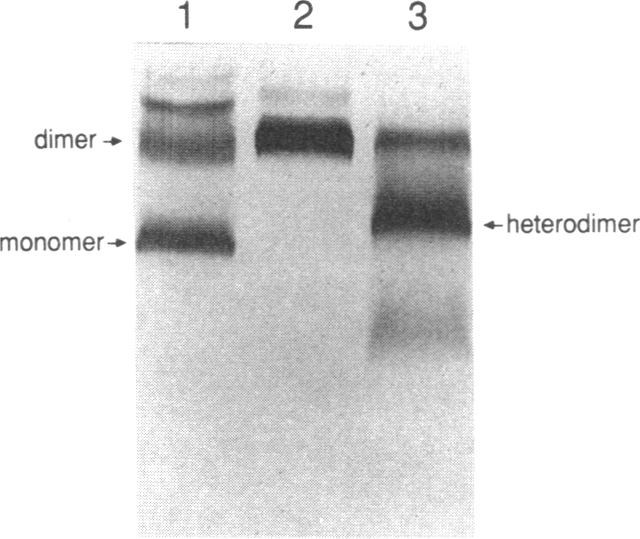
We have synthesized an 18-amino acid peptide that contains the cysteine-rich region of the tat protein from human immunodeficiency virus. Previous experiments in vitro with the intact tat protein have shown that these cysteines serve as metal ligands, causing tat to form metal-linked dimers. Ultraviolet absorption spectra show that the synthetic peptide (tat21-38) binds two Cd2+ or two Zn2+ ions per peptide monomer, and some changes in the circular dichroism spectra are seen as the metals bind. The peptide-metal complexes are completely resistant to proteolytic digestion, and mass spectrometry demonstrates that this peptide forms metal-linked dimers. The peptide can also combine with the intact tat protein to form metal-linked heterodimers. If these heterodimers are unable to trans-activate viral transcription, tat21-38 could be a lead compound for designing drugs to treat acquired immunodeficiency syndrome.
我们合成了一种18个氨基酸的肽,它包含来自人类免疫缺陷病毒的tat蛋白的富含半胱氨酸区域。先前对完整tat蛋白进行的体外实验表明,这些半胱氨酸作为金属配体,使tat形成金属连接的二聚体。紫外吸收光谱显示,合成肽(tat21 - 38)每个肽单体结合两个Cd2+或两个Zn2+离子,并且随着金属结合,圆二色光谱会出现一些变化。肽 - 金属复合物对蛋白水解消化完全抗性,质谱分析表明该肽形成金属连接的二聚体。该肽还能与完整的tat蛋白结合形成金属连接的异二聚体。如果这些异二聚体无法反式激活病毒转录,那么tat21 - 38可能是设计治疗获得性免疫缺陷综合征药物的先导化合物。