Takahashi Sadao
Division of Diabetes, Ageo Central General Hospital.
J Atheroscler Thromb. 2017 Jun 1;24(6):552-559. doi: 10.5551/jat.RV17004. Epub 2017 Apr 19.
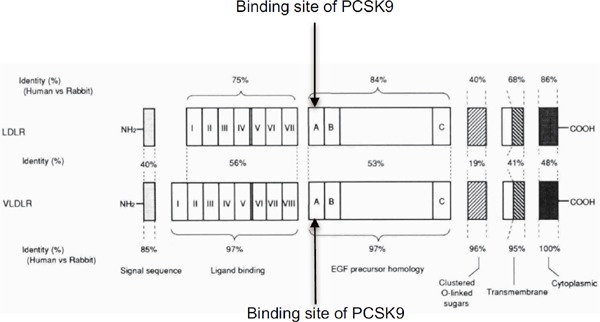
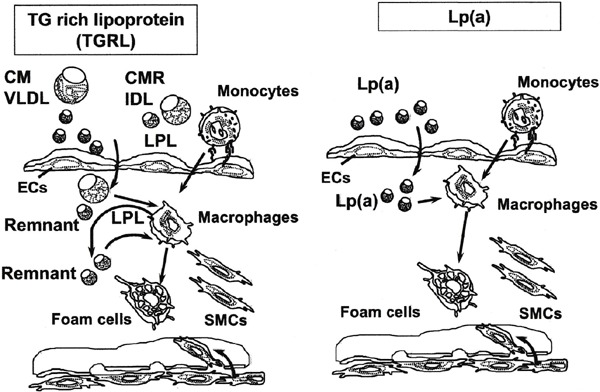
Very low-density lipoprotein (VLDL) receptor is a member of the low-density lipoprotein (LDL) receptor family. It binds triglyceride rich lipoprotein (TGRL) but not LDL, because it recognizes apolipoprotein (apo)E only but not apoB. The VLDL receptor functions as a peripheral lipoprotein receptor in concert with lipoprotein lipase (LPL) in heart, muscle, adipose tissue and macrophages. In contrast to the LDL receptor, VLDL receptor binds apo E2/2 VLDL and apoE3/3 VLDL particles, and its expression is not down-regulated by intracellular lipoproteins. It has been reported that both LDL-cholesterol (LDL-C) and postprandial triglyceride (chyromicron and VLDL remnants) are risk factors for human atherosclerotic cardiovascular disease (ASCVD). True ligands such as lipoprotein particles of the VLDL receptor are chyromicron remnant (CMR) and VLDL remnant (postprandial hyperlipidemia). Although the oxidized LDL (oxLDL)-scavenger receptors pathway is considered to be the main mechanism for macrophage foam cell formation, it seems that the TGRL-LPL-VLDL receptor pathway is also involved. Since Lp(a) is one of the ligands for the VLDL receptor, the Lp(a)-VLDL receptor pathway is another potential alternative. The expression of VLDL receptor protein in mouse macrophages is modest compared to that in rabbit and human macrophages, both in vitro and in vivo. Therefore, we need to elucidate the mechanism of human ASCVD not by using the mouse model and scavenger receptors pathway but instead using the rabbit model and VLDL receptor pathway, respectively.
极低密度脂蛋白(VLDL)受体是低密度脂蛋白(LDL)受体家族的成员。它结合富含甘油三酯的脂蛋白(TGRL)而不结合LDL,因为它仅识别载脂蛋白(apo)E而不识别apoB。VLDL受体与脂蛋白脂肪酶(LPL)协同作用,在心脏、肌肉、脂肪组织和巨噬细胞中作为外周脂蛋白受体发挥功能。与LDL受体不同,VLDL受体结合apo E2/2 VLDL和apoE3/3 VLDL颗粒,其表达不受细胞内脂蛋白的下调。据报道,LDL胆固醇(LDL-C)和餐后甘油三酯(乳糜微粒和VLDL残粒)都是人类动脉粥样硬化性心血管疾病(ASCVD)的危险因素。VLDL受体的真正配体如脂蛋白颗粒是乳糜微粒残粒(CMR)和VLDL残粒(餐后高脂血症)。尽管氧化LDL(oxLDL)-清道夫受体途径被认为是巨噬细胞泡沫细胞形成的主要机制,但TGRL-LPL-VLDL受体途径似乎也参与其中。由于Lp(a)是VLDL受体的配体之一,Lp(a)-VLDL受体途径是另一种潜在的替代途径。与兔和人巨噬细胞相比,小鼠巨噬细胞中VLDL受体蛋白的表达在体外和体内都较低。因此,我们需要分别使用兔模型和VLDL受体途径,而不是小鼠模型和清道夫受体途径来阐明人类ASCVD的机制。