Chang Yu-Hsuan A, Kemmotsu Nobuko, Leyden Kelly M, Kucukboyaci N Erkut, Iragui Vicente J, Tecoma Evelyn S, Kansal Leena, Norman Marc A, Compton Rachelle, Ehrlich Tobin J, Uttarwar Vedang S, Reyes Anny, Paul Brianna M, McDonald Carrie R
Center for Multimodal Imaging and Genetics, University of California - San Diego, 9452 Medical Center Drive, La Jolla, CA 92037, USA; Department of Psychiatry, University of California - San Diego, 9500 Gilman Drive, La Jolla, CA 92093, USA.
Department of Psychiatry, University of California - San Diego, 9500 Gilman Drive, La Jolla, CA 92093, USA.
Brain Lang. 2017 Jul;170:82-92. doi: 10.1016/j.bandl.2017.03.012. Epub 2017 Apr 20.
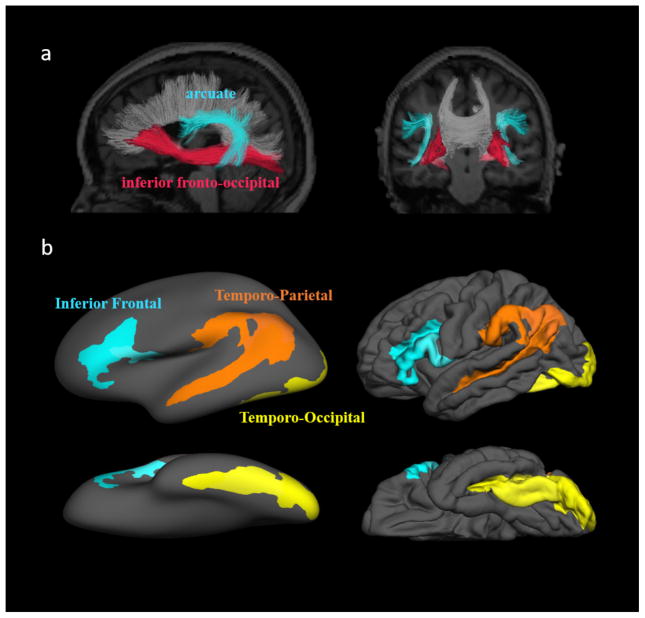
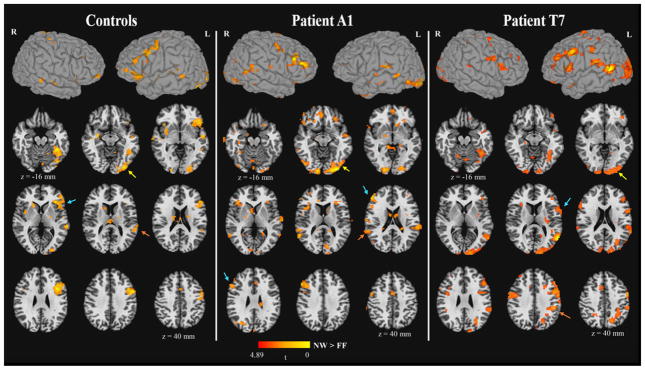
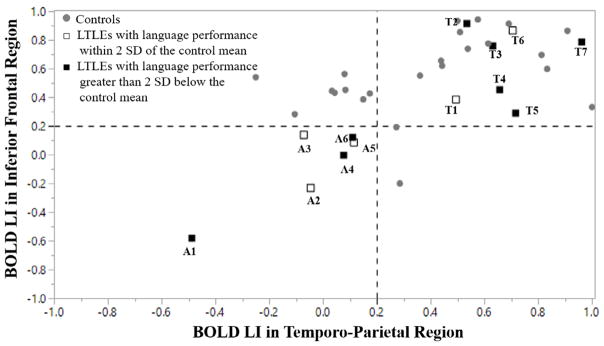
This study explored the relationships among multimodal imaging, clinical features, and language impairment in patients with left temporal lobe epilepsy (LTLE). Fourteen patients with LTLE and 26 controls underwent structural MRI, functional MRI, diffusion tensor imaging, and neuropsychological language tasks. Laterality indices were calculated for each imaging modality and a principal component (PC) was derived from language measures. Correlations were performed among imaging measures, as well as to the language PC. In controls, better language performance was associated with stronger left-lateralized temporo-parietal and temporo-occipital activations. In LTLE, better language performance was associated with stronger right-lateralized inferior frontal, temporo-parietal, and temporo-occipital activations. These right-lateralized activations in LTLE were associated with right-lateralized arcuate fasciculus fractional anisotropy. These data suggest that interhemispheric language reorganization in LTLE is associated with alterations to perisylvian white matter. These concurrent structural and functional shifts from left to right may help to mitigate language impairment in LTLE.
本研究探讨了左侧颞叶癫痫(LTLE)患者多模态成像、临床特征与语言障碍之间的关系。14例LTLE患者和26名对照者接受了结构磁共振成像(MRI)、功能MRI、弥散张量成像及神经心理学语言任务。计算每种成像模态的偏侧性指数,并从语言测量中得出主成分(PC)。对成像测量之间以及与语言PC进行相关性分析。在对照者中,较好的语言表现与更强的左侧颞顶叶和颞枕叶激活相关。在LTLE患者中,较好的语言表现与更强的右侧额下回、颞顶叶和颞枕叶激活相关。LTLE患者中这些右侧激活与右侧弓状束各向异性分数相关。这些数据表明,LTLE患者的半球间语言重组与外侧裂周围白质改变有关。这些从左到右同时发生的结构和功能变化可能有助于减轻LTLE患者的语言障碍。