Ikenoue Satoru, Waffarn Feizal, Ohashi Masanao, Sumiyoshi Kaeko, Ikenoue Chigusa, Buss Claudia, Gillen Daniel L, Simhan Hyagriv N, Entringer Sonja, Wadhwa Pathik D
Department of Pediatrics, University of California, Irvine, Irvine, CA; Development, Health and Disease Research Program, University of California, Irvine, Irvine, CA; Department of Obstetrics and Gynecology, Keio University School of Medicine, Tokyo, Japan.
Department of Pediatrics, University of California, Irvine, Irvine, CA; Development, Health and Disease Research Program, University of California, Irvine, Irvine, CA.
Am J Obstet Gynecol. 2017 Aug;217(2):204.e1-204.e8. doi: 10.1016/j.ajog.2017.04.022. Epub 2017 Apr 20.
The production of variation in adipose tissue accretion represents a key fetal adaptation to energy substrate availability during gestation. Because umbilical venous blood transports nutrient substrate from the maternal to the fetal compartment and because the fetal liver is the primary organ in which nutrient interconversion occurs, it has been proposed that variations in the relative distribution of umbilical venous blood flow shunting either through ductus venosus or perfusing the fetal liver represents a mechanism underlying this adaptation.
The objective of the present study was to determine whether fetal liver blood flow assessed before the period of maximal fetal fat deposition (ie, the third trimester of gestation) is prospectively associated with newborn adiposity.
A prospective study was conducted in a cohort of 62 uncomplicated singleton pregnancies. Fetal ultrasonography was performed at 30 weeks gestation for conventional fetal biometry and characterization of fetal liver blood flow (quantified by subtracting ductus venosus flow from umbilical vein flow). Newborn body fat percentage was quantified by dual energy X-ray absorptiometry imaging at 25.8 ± 3.3 (mean ± standard error of the mean) postnatal days. Multiple regression analysis was used to determine the proportion of variation in newborn body fat percentage explained by fetal liver blood flow. Potential confounding factors included maternal age, parity, prepregnancy body mass index, gestational weight gain, gestational age at birth, infant sex, postnatal age at dual energy X-ray absorptiometry scan, and mode of infant feeding.
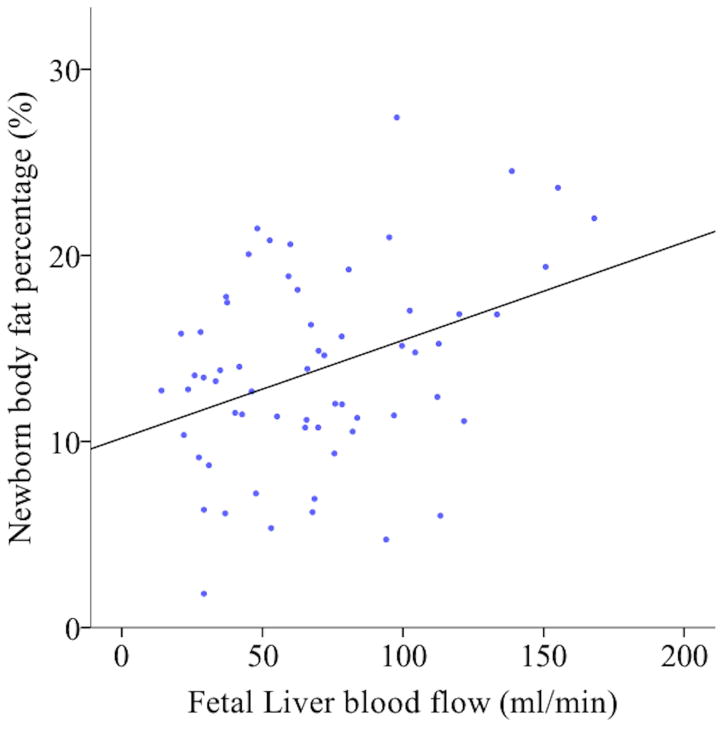
Newborn body fat percentage was 13.5% ± 2.4% (mean ± standard error of the mean). Fetal liver blood flow at 30 weeks gestation was significantly and positively associated with newborn total fat mass (r=0.397; P<.001) and body fat percentage (r=0.369; P=.004), but not with lean mass (r=0.100; P=.441). After accounting for the effects of covariates, fetal liver blood flow explained 13.5% of the variance in newborn fat mass. The magnitude of this association was pronounced particularly in nonoverweight/nonobese mothers (prepregnancy body mass index, <25 kg/m; n=36) in whom fetal liver blood flow explained 24.4% of the variation in newborn body fat percentage.
Fetal liver blood flow at the beginning of the third trimester of gestation is associated positively with newborn adiposity, particularly among nonoverweight/nonobese mothers. This finding supports the role of fetal liver blood flow as a putative fetal adaptation underlying variation in adipose tissue accretion.
脂肪组织蓄积的变化产生是胎儿在妊娠期对能量底物可利用性的一种关键适应。由于脐静脉血将营养底物从母体转运至胎儿体内,且胎儿肝脏是营养物质发生相互转化的主要器官,因此有人提出,脐静脉血流经静脉导管分流或灌注胎儿肝脏的相对分布变化是这种适应的潜在机制。
本研究的目的是确定在胎儿脂肪沉积达到最大值之前(即妊娠晚期)评估的胎儿肝脏血流是否与新生儿肥胖前瞻性相关。
对62例无并发症的单胎妊娠队列进行了一项前瞻性研究。在妊娠30周时进行胎儿超声检查,用于常规胎儿生物测量及胎儿肝脏血流特征分析(通过从脐静脉血流中减去静脉导管血流进行量化)。在出生后25.8±3.3(均值±均值标准误)天时,采用双能X线吸收法成像对新生儿体脂百分比进行量化。采用多元回归分析确定胎儿肝脏血流所解释的新生儿体脂百分比变化比例。潜在混杂因素包括产妇年龄、产次、孕前体重指数、孕期体重增加、出生时的孕周、婴儿性别、双能X线吸收法扫描时的出生后年龄以及婴儿喂养方式。
新生儿体脂百分比为13.5%±2.4%(均值±均值标准误)。妊娠30周时的胎儿肝脏血流与新生儿总脂肪量(r=0.397;P<0.001)和体脂百分比(r=0.369;P=0.004)显著正相关,但与瘦体重无关(r=0.100;P=0.441)。在考虑协变量的影响后,胎儿肝脏血流解释了新生儿脂肪量变异的13.5%。这种关联的程度在非超重/非肥胖母亲(孕前体重指数<25kg/m²;n=36)中尤为明显,其中胎儿肝脏血流解释了新生儿体脂百分比变异的24.4%。
妊娠晚期开始时的胎儿肝脏血流与新生儿肥胖呈正相关,尤其是在非超重/非肥胖母亲中。这一发现支持了胎儿肝脏血流作为脂肪组织蓄积变化潜在的胎儿适应性机制的作用。