Horikoshi Sho, Miura Itaru, Kunii Yasuto, Asano Satoko, Kanno-Nozaki Keiko, Mashiko Hirobumi, Yabe Hirooki
Department of Neuropsychiatry, Hoshi General Hospital.
Department of Neuropsychiatry, Fukushima Medical University School of Medicine.
Neuropsychiatr Dis Treat. 2017 Apr 7;13:1043-1045. doi: 10.2147/NDT.S131356. eCollection 2017.
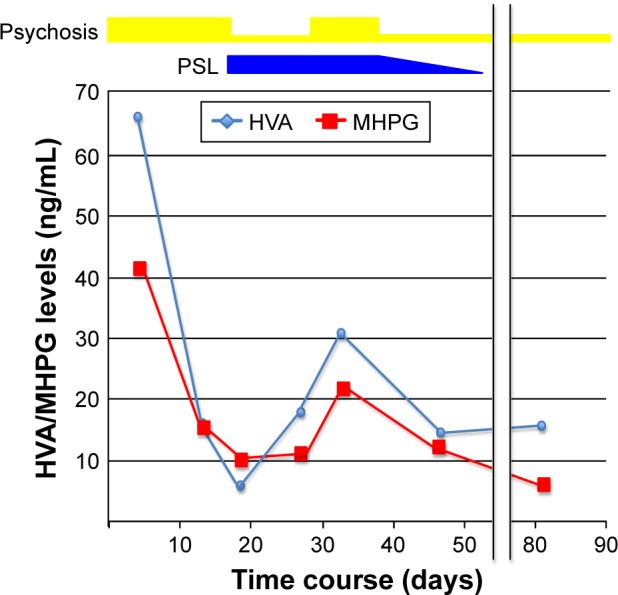
Hashimoto encephalopathy (HE) is believed to be an immune-mediated disorder associated with Hashimoto's thyroiditis. It was suggested that neuropsychiatric symptoms, the presence of antithyroid antibody, and good response to steroids were important for the diagnosis of HE. It has been reported that homovanillic acid (HVA) and 3-methoxy-4-hydroxyphenylglycol (MHPG), which are monoamine metabolites of dopamine and noradrenaline, respectively, are the possible biomarkers of neuropsychiatric diseases. We report a case of Hashimoto encephalopathy, in which we longitudinally measured the plasma levels of monoamine metabolites. A 52-year-old woman developed acute psychosis, and was admitted to the psychiatric ward of our hospital due to psychotic state, 6 days after a traffic accident. An extensive evaluation showed no remarkable findings, except an increase in antithyroglobulin antibodies. Plasma levels of HVA and MHPG were extremely high at 66.5 and 41.8 ng/mL, respectively. On day 16, 50 mg/day oral prednisolone was administered, which improved her psychotic symptoms. Plasma levels of HVA and MHPG decreased to 7.2 and 9.9 ng/mL, respectively, on day 19. After the temporary worsening of psychosis and increase in plasma levels of HVA and MHPG, the dosage of prednisolone was tapered and low-dose risperidone was started. Her psychiatric symptoms gradually improved and plasma monoamine metabolite levels decreased again (HVA: 17.9 ng/mL; MHPG: 7.7 ng/mL). Although autoimmune mechanism has been suggested to be involved in HE, neural mechanism and pathogenesis of HE remain unknown. Our findings suggest that monoaminergic neural activity might be associated with psychotic symptoms in patients with HE and plasma levels of monoamine metabolites might be useful as state markers.
桥本脑病(HE)被认为是一种与桥本甲状腺炎相关的免疫介导性疾病。有人提出神经精神症状、抗甲状腺抗体的存在以及对类固醇的良好反应对HE的诊断很重要。据报道,高香草酸(HVA)和3-甲氧基-4-羟基苯乙二醇(MHPG)分别是多巴胺和去甲肾上腺素的单胺代谢产物,可能是神经精神疾病的生物标志物。我们报告一例桥本脑病病例,在此病例中我们纵向测量了单胺代谢产物的血浆水平。一名52岁女性发生急性精神病,在交通事故6天后因精神状态被收治入我院精神科病房。全面评估未发现明显异常,仅抗甲状腺球蛋白抗体升高。HVA和MHPG的血浆水平极高,分别为66.5和41.8 ng/mL。在第16天,给予口服泼尼松龙50 mg/天,这改善了她的精神症状。在第19天,HVA和MHPG的血浆水平分别降至7.2和9.9 ng/mL。在精神病暂时加重以及HVA和MHPG血浆水平升高后,逐渐减少泼尼松龙剂量并开始使用低剂量利培酮。她的精神症状逐渐改善,血浆单胺代谢产物水平再次下降(HVA:17.9 ng/mL;MHPG:7.7 ng/mL)。虽然有人提出自身免疫机制与HE有关,但HE的神经机制和发病机制仍不清楚。我们的研究结果表明,单胺能神经活动可能与HE患者的精神症状有关,血浆单胺代谢产物水平可能作为状态标志物有用。