Smith Carly Parnitzke
Department of Psychology, University of Oregon, Eugene, OR, USA.
J Multidiscip Healthc. 2017 Apr 3;10:133-144. doi: 10.2147/JMDH.S125885. eCollection 2017.
Patients' trust in health care is increasingly recognized as important to quality care, yet questions remain about what types of health care experiences erode trust. The current study assessed the prevalence and impact of institutional betrayal on patients' trust and engagement in health care.
Participants who had sought health care in the US in October 2013 were recruited from an online marketplace, Amazon's Mechanical Turk. Participants (n = 707; 73% Caucasian; 56.8% female; 9.8% lesbian, gay, or bisexual; median age between 18 and 35 years) responded to survey questions about health care use, trust in health care providers and organizations, negative medical experiences, and institutional betrayal.
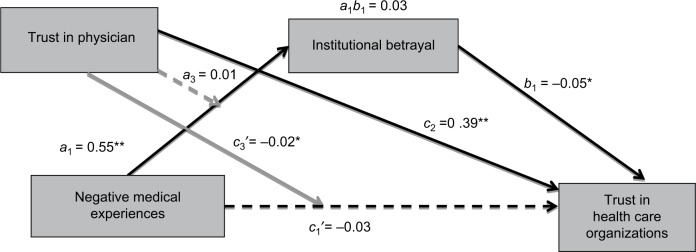
Institutional betrayal was reported by two-thirds of the participants and predicted disengagement from health care ( = 0.36, < 0.001). Mediational models (tested using bootstrapping analyses) indicated a negative, nonzero pathway between institutional betrayal and trust in health care organizations ( = -0.05, 95% confidence interval [CI] = [-0.07, -0.02]), controlling for trust in physicians and hospitalization history. These negative effects were not buffered by trust in one's own physician, but in fact patients who trusted their physician more reported lower trust in health care organizations following negative medical events (interaction = -0.02, 95%CI = [-0.03, -0.01]).
Clinical implications are discussed, concluding that institutional betrayal decreases patient trust and engagement in health care.
患者对医疗保健的信任日益被认为对优质护理很重要,但对于哪些类型的医疗保健经历会侵蚀信任仍存在疑问。当前的研究评估了机构背叛对患者医疗保健信任和参与度的发生率及影响。
2013年10月在美国寻求医疗保健的参与者是从在线市场亚马逊的土耳其机器人(Mechanical Turk)招募而来。参与者(n = 707;73%为白种人;56.8%为女性;9.8%为女同性恋、男同性恋或双性恋;年龄中位数在18至35岁之间)回答了关于医疗保健使用、对医疗保健提供者和机构的信任、负面医疗经历以及机构背叛的调查问题。
三分之二的参与者报告经历过机构背叛,且这预测了他们脱离医疗保健(β = 0.36,p < 0.001)。中介模型(使用自抽样分析进行检验)表明,在控制对医生的信任和住院史后,机构背叛与对医疗保健机构的信任之间存在一条负向且非零的路径(β = -0.05,95%置信区间[CI] = [-0.07, -0.02])。这些负面影响并未因对自己医生的信任而得到缓冲,事实上,在经历负面医疗事件后,对医生信任度更高的患者对医疗保健机构的信任度更低(交互作用β = -0.02,95%CI = [-0.03, -0.01])。
讨论了临床意义,得出机构背叛会降低患者对医疗保健的信任和参与度的结论。