Al-Rawi Natheer Hashim, Uthman Asmaa Tahseen, Sodeify Sahar M
Department Oral Health Sciences, College of Dental Medicine, University of Sharjah, Sharjah, UAE.
Department of Oral Medicine and Radiology, Gulf Medical University, Ajman, UAE.
Eur J Dent. 2017 Jan-Mar;11(1):99-105. doi: 10.4103/ejd.ejd_202_16.
The aim of the study is to investigate the condylar position and its relation to articular eminence and axial condylar angle in temporomandibular joint disorder (TMD) patients and in normal controls using cone beam computed tomography (CBCT).
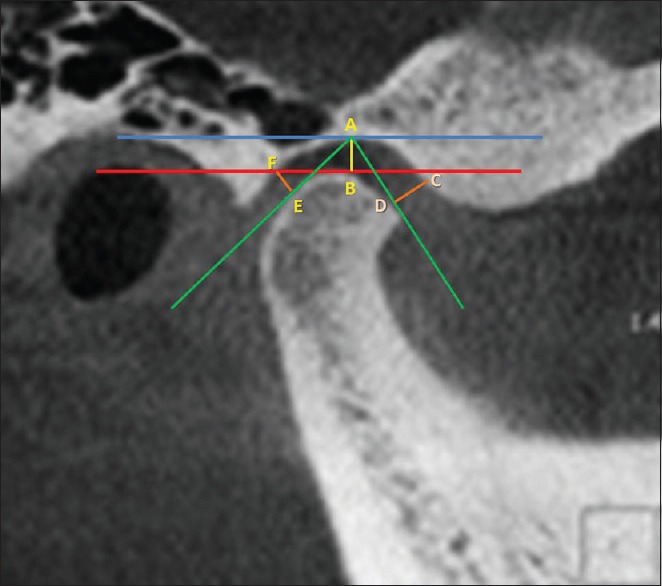
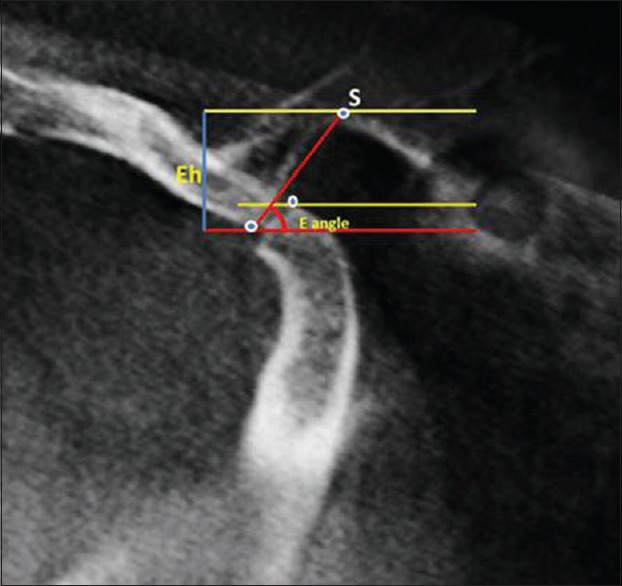
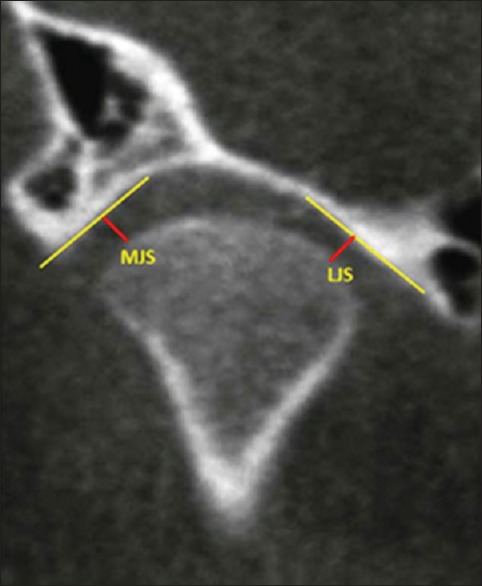
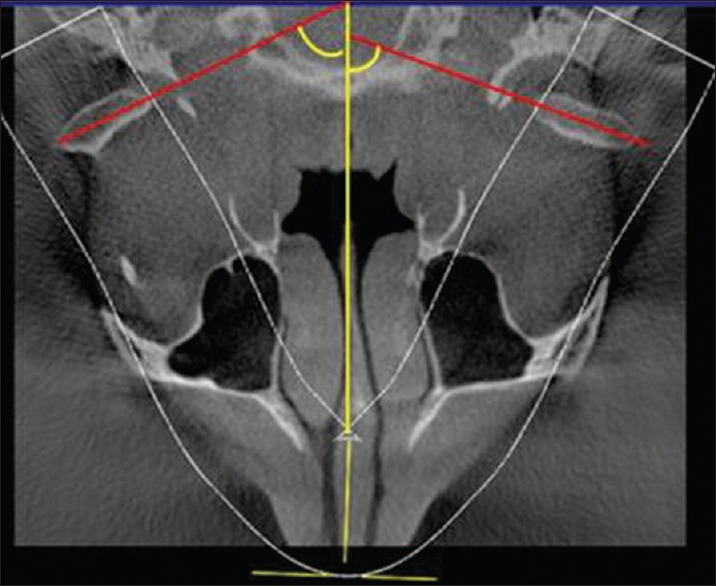
CBCT temporomandibular joint (TMJ) images of 70 participants (38 males and 32 females, mean age 26.4 years) were analyzed. They were divided into control group (including 35 subjects) and study group (including 35 subjects). Linear measurements of joint space and condyle determined the condylar position of each TMJ. Articular eminence height and inclination were also measured with axial condylar angle to determine its relation to condylar position. Independent and paired sample -test was applied to compare between the groups and TMJ sides of the same group at significance level of 0.05.
Statistical significant differences were found between males and females of both groups regarding superior joint space (SJS), lateral joint space, A-P, and M-L condyle distance ( < 0.05). SJS, medial joint space (MJS), and eminence angle were greater ( < 0.01) in male's joints with TMD with flatter axial condylar angle ( < 0.05), when compared with normal TMJ counterpart. Females TMJs showed significantly higher values of MJS of affected side when compared with normal counterpart with flatter axial condylar angle ( < 0.05).
Superior and MJS parameters were the ones that showed significant differences between affected and nonaffected joints. The mean axial condylar angle was smaller in joints with abnormal TMJ. This indicates that the condyles of the affected joints may rotate inward.
本研究旨在使用锥形束计算机断层扫描(CBCT),调查颞下颌关节紊乱病(TMD)患者和正常对照者的髁突位置及其与关节结节和髁突轴角的关系。
分析了70名参与者(38名男性和32名女性,平均年龄26.4岁)的CBCT颞下颌关节(TMJ)图像。他们被分为对照组(包括35名受试者)和研究组(包括35名受试者)。通过对关节间隙和髁突的线性测量确定每个TMJ的髁突位置。还测量了关节结节高度和倾斜度以及髁突轴角,以确定其与髁突位置的关系。采用独立样本和配对样本t检验,在0.05的显著性水平下比较两组之间以及同一组TMJ两侧之间的差异。
两组的男性和女性在关节上间隙(SJS)、外侧关节间隙、前后和内外髁突距离方面均存在统计学显著差异(P<0.05)。与正常TMJ相比,患有TMD的男性关节的SJS、内侧关节间隙(MJS)和关节结节角更大(P<0.01),髁突轴角更平坦(P<0.05)。与正常对应侧相比,女性患侧TMJ的MJS值显著更高,髁突轴角更平坦(P<0.05)。
上间隙和MJS参数在患侧和未患侧关节之间显示出显著差异。TMJ异常的关节的平均髁突轴角较小。这表明患侧关节的髁突可能向内旋转。