Sui Bing-Dong, Hu Cheng-Hu, Zheng Chen-Xi, Shuai Yi, He Xiao-Ning, Gao Ping-Ping, Zhao Pan, Li Meng, Zhang Xin-Yi, He Tao, Xuan Kun, Jin Yan
State Key Laboratory of Military Stomatology & National Clinical Research Center for Oral Diseases & Shaanxi International Joint Research Center for Oral Diseases, Center for Tissue Engineering, School of Stomatology, Fourth Military Medical University, Xi'an, Shaanxi, 710032, China.
Research and Development Center for Tissue Engineering, Fourth Military Medical University, Xi'an, Shaanxi 710032, China.
Theranostics. 2017 Mar 6;7(5):1225-1244. doi: 10.7150/thno.18181. eCollection 2017.
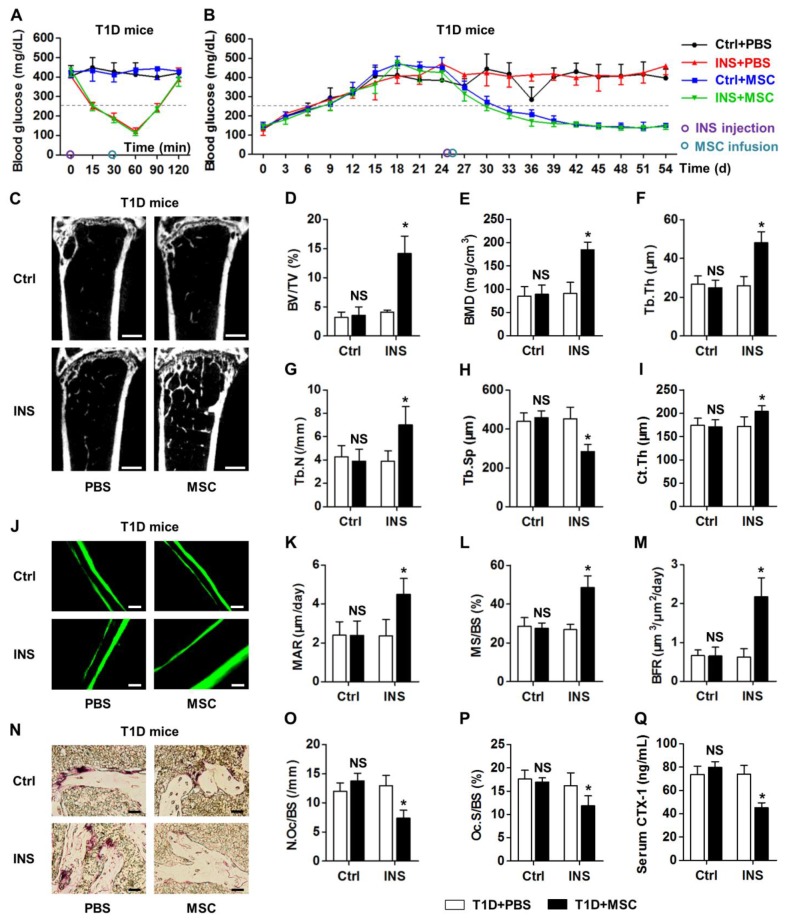
Therapeutic effects of mesenchymal stem cell (MSC) infusion have been revealed in various human disorders, but impacts of diseased micro-environments are only beginning to be noticed. Donor diabetic hyperglycemia is reported to impair therapeutic efficacy of stem cells. However, whether recipient diabetic condition also affects MSC-mediated therapy is unknown. We and others have previously shown that MSC infusion could cure osteopenia, particularly in ovariectomized (OVX) mice. Here, we discovered impaired MSC therapeutic effects on osteopenia in recipient type 1 diabetes (T1D). Through intensive glycemic control by daily insulin treatments, therapeutic effects of MSCs on osteopenia were maintained. Interestingly, by only transiently restoration of recipient euglycemia using single insulin injection, MSC infusion could also rescue T1D-induced osteopenia. Conversely, under recipient hyperglycemia induced by glucose injection in OVX mice, MSC-mediated therapeutic effects on osteopenia were diminished. Mechanistically, recipient hyperglycemic micro-environments reduce anti-inflammatory capacity of MSCs in osteoporotic therapy through suppressing MSC interaction with T cells via the Adenosine monophosphate-activated protein kinase (AMPK) pathway. We further revealed in diabetic micro-environments, double infusion of MSCs ameliorated osteopenia by anti-inflammation, attributed to the first transplanted MSCs which normalized the recipient glucose homeostasis. Collectively, our findings uncover a previously unrecognized role of recipient glycemic conditions controlling MSC-mediated therapy, and unravel that fulfillment of potent therapeutic effects of MSCs requires tight control of recipient micro-environments.
间充质干细胞(MSC)输注已在多种人类疾病中显示出治疗效果,但疾病微环境的影响才刚刚开始受到关注。据报道,供体糖尿病高血糖会损害干细胞的治疗效果。然而,受体糖尿病状态是否也会影响MSC介导的治疗尚不清楚。我们和其他人之前已经表明,MSC输注可以治愈骨质减少,特别是在去卵巢(OVX)小鼠中。在这里,我们发现MSC对受体1型糖尿病(T1D)骨质减少的治疗效果受损。通过每日胰岛素治疗进行强化血糖控制,MSC对骨质减少的治疗效果得以维持。有趣的是,仅通过单次胰岛素注射短暂恢复受体正常血糖,MSC输注也可以挽救T1D诱导的骨质减少。相反,在OVX小鼠中通过注射葡萄糖诱导受体高血糖的情况下,MSC介导的对骨质减少的治疗效果减弱。机制上,受体高血糖微环境通过抑制MSC与T细胞通过腺苷单磷酸激活蛋白激酶(AMPK)途径的相互作用,降低了MSC在骨质疏松治疗中的抗炎能力。我们进一步揭示,在糖尿病微环境中,两次输注MSC通过抗炎改善了骨质减少,这归因于首次移植的MSC使受体葡萄糖稳态正常化。总的来说,我们的发现揭示了受体血糖状况在控制MSC介导的治疗中以前未被认识的作用,并表明实现MSC的有效治疗效果需要严格控制受体微环境。