Danta M, Ghinea N
St Vincent's Clinical School, Faculty of Medicine, University of New South Wales, Sydney, Australia.
Gastroenterology and Hepatology Department, St Vincent's Hospital, Sydney, Australia.
J Virus Erad. 2017 Apr 1;3(2):77-81. doi: 10.1016/S2055-6640(20)30286-7.
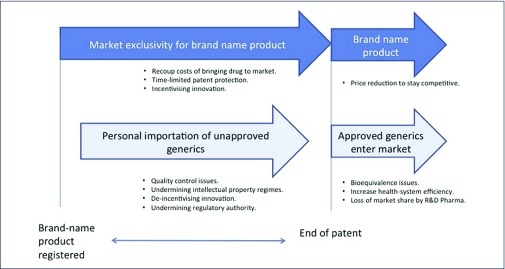
The economic impact of medications is significant, with many countries unable to afford the essential medicines listed by the WHO. Generic medications are one strategy to address this issue. Generic medications are similar to but not the same as originator medications. They have a significant cost advantage because they do not require the background research and development studies to support registration. Consequently, they are gaining increased market share in both the developed and developing world. Many new medications are now licensed to generic manufacturers in the developing world. As a result, it is possible for patients to bypass regulatory and cost barriers by importing medications directly from generic producers. Importation of the novel hepatitis C direct-acting antiviral therapy into Australia before it was registered in the country is an illustrative case study. This review will characterise generic medications and some of the legal and ethical issues around their utilisation, focusing on the relevant players, including pharma, government, patients and doctors.
药物的经济影响重大,许多国家无力负担世界卫生组织列出的基本药物。仿制药是解决这一问题的一种策略。仿制药与原创药相似但并不相同。它们具有显著的成本优势,因为无需进行支持注册所需的背景研发研究。因此,它们在发达国家和发展中国家的市场份额都在不断增加。现在,许多新药已授权发展中国家的仿制药生产商生产。结果,患者有可能通过直接从仿制药生产商进口药物来绕过监管和成本障碍。在新型丙型肝炎直接抗病毒疗法在澳大利亚注册之前就将其进口到该国,就是一个具有代表性的案例研究。本综述将对仿制药及其使用过程中涉及的一些法律和伦理问题进行描述,重点关注包括制药公司、政府、患者和医生在内的相关各方。