Martins Polyana Kelly, Nakayama Thiago Jonas, Ribeiro Ana Paula, Cunha Bárbara Andrade Dias Brito da, Nepomuceno Alexandre Lima, Harmon Frank G, Kobayashi Adilson Kenji, Molinari Hugo Bruno Correa
Genetics and Biotechnology Laboratory, Embrapa Agroenergy, Brasília, DF, Brazil.
Federal University of Viçosa (UFLA), Viçosa, MG, Brazil.
Biotechnol Rep (Amst). 2015 Mar 4;6:61-63. doi: 10.1016/j.btre.2015.02.006. eCollection 2015 Jun.
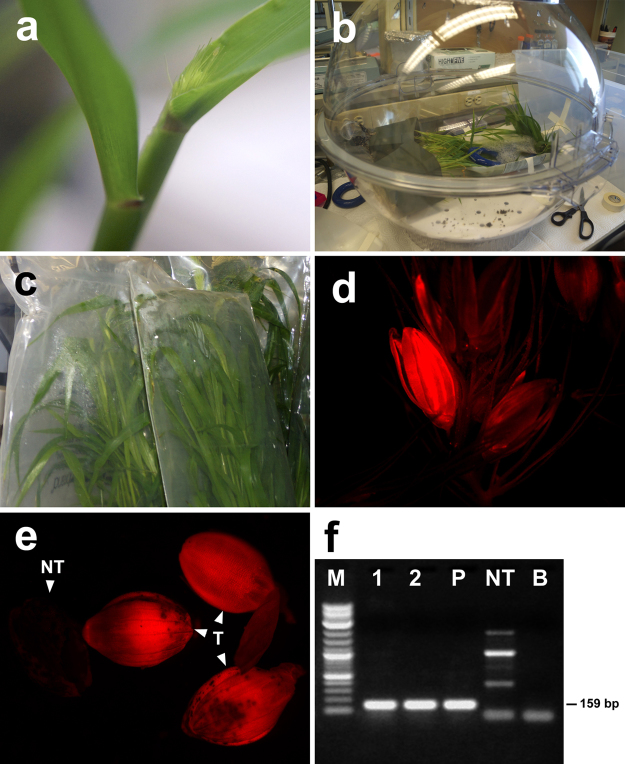
was recently described as a new monocotyledonous model species for C4 photosynthesis research and genetic transformation. It has biological attributes (rapid life cycle, small genome, diploid, short stature and simple growth requirements) that make it suitable for use as a model plant. We report an alternative method of transformation using floral dip to circumvent the necessity of tissue culture phase for transgenic plant regeneration. spikes at boot stage were selected to be immersed in suspension. seeds could be identified in 1.5-2 months after floral dipping. We demonstrated through molecular analysis and RFP expression that seeds and resulting plants from dipped inflorescences were transformed. Our results suggest the feasibility of floral dip transformation as a time-saving and cost-effective compared with traditional methods. To our knowledge, this is the first report using floral dip in as an -mediated transformation method.
最近被描述为用于C4光合作用研究和基因转化的一种新的单子叶模式物种。它具有一些生物学特性(生命周期短、基因组小、二倍体、植株矮小且生长需求简单),这些特性使其适合用作模式植物。我们报告了一种使用花浸染法的替代转化方法,以避免转基因植物再生过程中组织培养阶段的必要性。选择孕穗期的穗浸入悬浮液中。花浸染后1.5至2个月可鉴定出种子。我们通过分子分析和红色荧光蛋白(RFP)表达证明,浸染花序产生的种子和植株是转基因的。我们的结果表明,与传统方法相比,花浸染转化作为一种省时且经济高效的方法是可行的。据我们所知,这是首次报道使用花浸染法作为介导的转化方法。