Department of Civil and Environmental Engineering, Massachusetts Institute of Technology, 77 Massachusetts Avenue, Cambridge, MA 02139, USA.
Department of Biomedical Engineering, Tufts University, Medford, MA 02155, USA.
Sci Adv. 2017 Apr 5;3(4):e1601939. doi: 10.1126/sciadv.1601939. eCollection 2017 Apr.
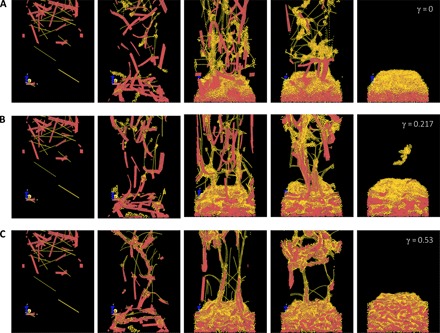
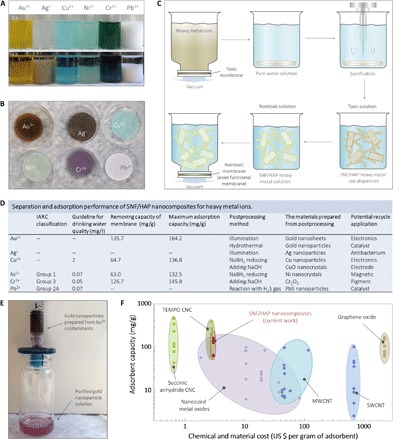
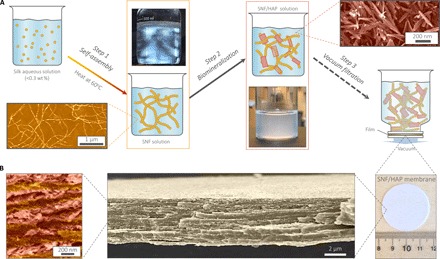
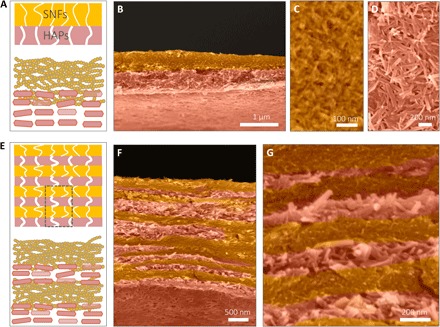
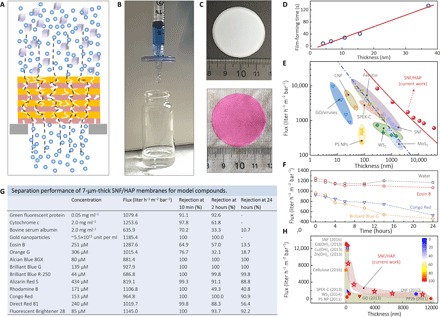
Multilayer architectures in water purification membranes enable increased water throughput, high filter efficiency, and high molecular loading capacity. However, the preparation of membranes with well-organized multilayer structures, starting from the nanoscale to maximize filtration efficiency, remains a challenge. We report a complete strategy to fully realize a novel biomaterial-based multilayer nanoporous membrane via the integration of computational simulation and experimental fabrication. Our comparative computational simulations, based on coarse-grained models of protein nanofibrils and mineral plates, reveal that the multilayer structure can only form with weak interactions between nanofibrils and mineral plates. We demonstrate experimentally that silk nanofibril (SNF) and hydroxyapatite (HAP) can be used to fabricate highly ordered multilayer membranes with nanoporous features by combining protein self-assembly and in situ biomineralization. The production is optimized to be a simple and highly repeatable process that does not require sophisticated equipment and is suitable for scaled production of low-cost water purification membranes. These membranes not only show ultrafast water penetration but also exhibit broad utility and high efficiency of removal and even reuse (in some cases) of contaminants, including heavy metal ions, dyes, proteins, and other nanoparticles in water. Our biomimetic design and synthesis of these functional SNF/HAP materials have established a paradigm that could lead to the large-scale, low-cost production of multilayer materials with broad spectrum and efficiency for water purification, with applications in wastewater treatment, biomedicine, food industry, and the life sciences.
多层架构在净水膜中可实现水通量的增加、高过滤效率和高分子负载能力。然而,从纳米尺度开始制备具有良好组织的多层结构,以最大限度地提高过滤效率,仍然是一个挑战。我们报告了一种通过计算模拟和实验制备相结合,全面实现新型基于生物材料的多层纳米多孔膜的策略。我们基于蛋白质纳米纤维和矿物质板的粗粒度模型的比较计算模拟表明,只有在纳米纤维和矿物质板之间存在弱相互作用时,多层结构才能形成。我们通过结合蛋白质自组装和原位生物矿化实验证明,丝素纳米纤维(SNF)和羟基磷灰石(HAP)可以用于制备具有纳米多孔特征的高度有序的多层膜。该生产过程经过优化,是一个简单且高度可重复的过程,不需要复杂的设备,适用于低成本净水膜的规模化生产。这些膜不仅表现出超快的水渗透性能,而且还表现出广泛的适用性和去除效率,甚至可以重复使用(在某些情况下),包括水中的重金属离子、染料、蛋白质和其他纳米颗粒。我们对这些功能性 SNF/HAP 材料的仿生设计和合成,为大规模、低成本生产具有广谱和高效净水功能的多层材料建立了一个范例,可应用于废水处理、生物医药、食品工业和生命科学领域。