Liu T, Huang W, Szatmary P, Abrams S T, Alhamdi Y, Lin Z, Greenhalf W, Wang G, Sutton R, Toh C H
Institute of Infection and Global Health, University of Liverpool, Liverpool, UK.
National Institute for Health Research (NIHR) Liverpool Pancreas Biomedical Research Unit, Royal Liverpool University Hospital, Liverpool, UK.
Br J Surg. 2017 Aug;104(9):1215-1225. doi: 10.1002/bjs.10538. Epub 2017 Apr 24.
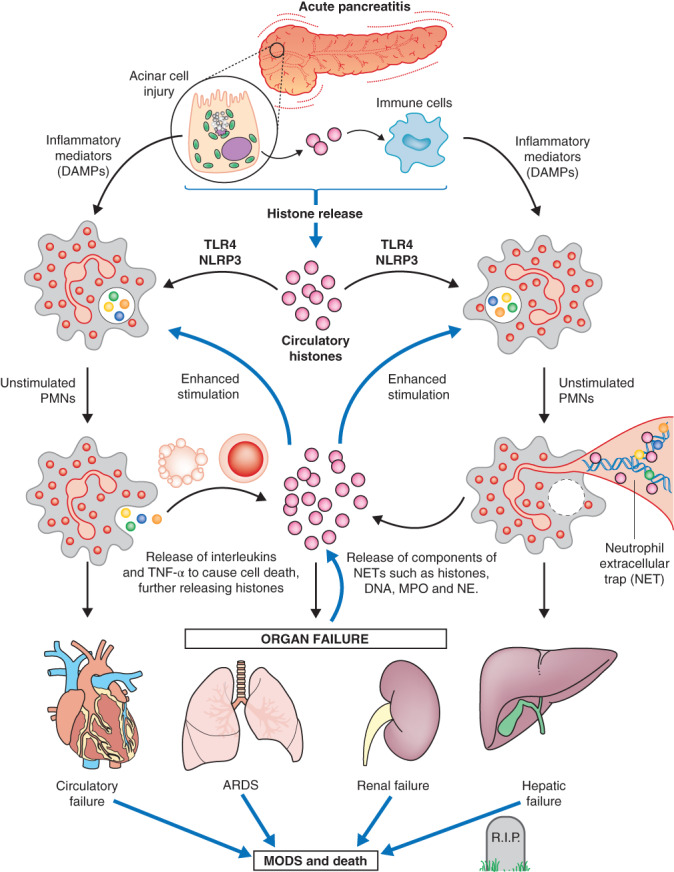
Early prediction of acute pancreatitis severity remains a challenge. Circulating levels of histones are raised early in mouse models and correlate with disease severity. It was hypothesized that circulating histones predict persistent organ failure in patients with acute pancreatitis.
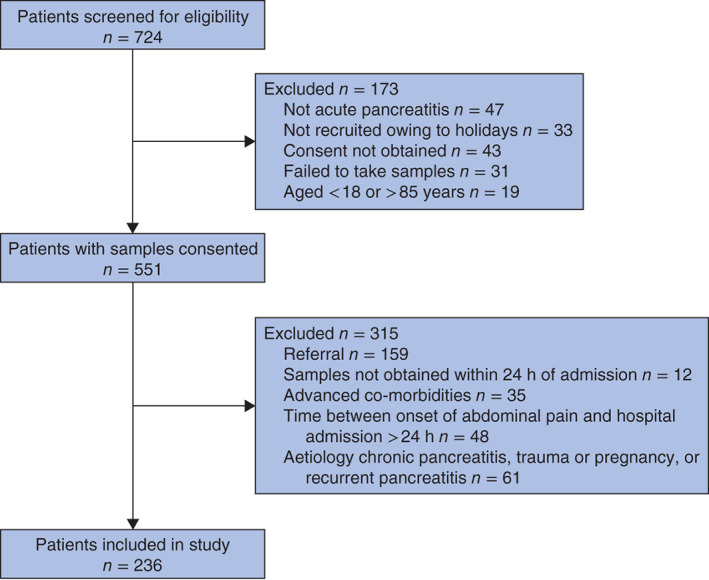
Consecutive patients with acute pancreatitis fulfilling inclusion criteria admitted to Royal Liverpool University Hospital were enrolled prospectively between June 2010 and March 2014. Blood samples were obtained within 48 h of abdominal pain onset and relevant clinical data during the hospital stay were collected. Healthy volunteers were enrolled as controls. The primary endpoint was occurrence of persistent organ failure. The predictive values of circulating histones, clinical scores and other biomarkers were determined.
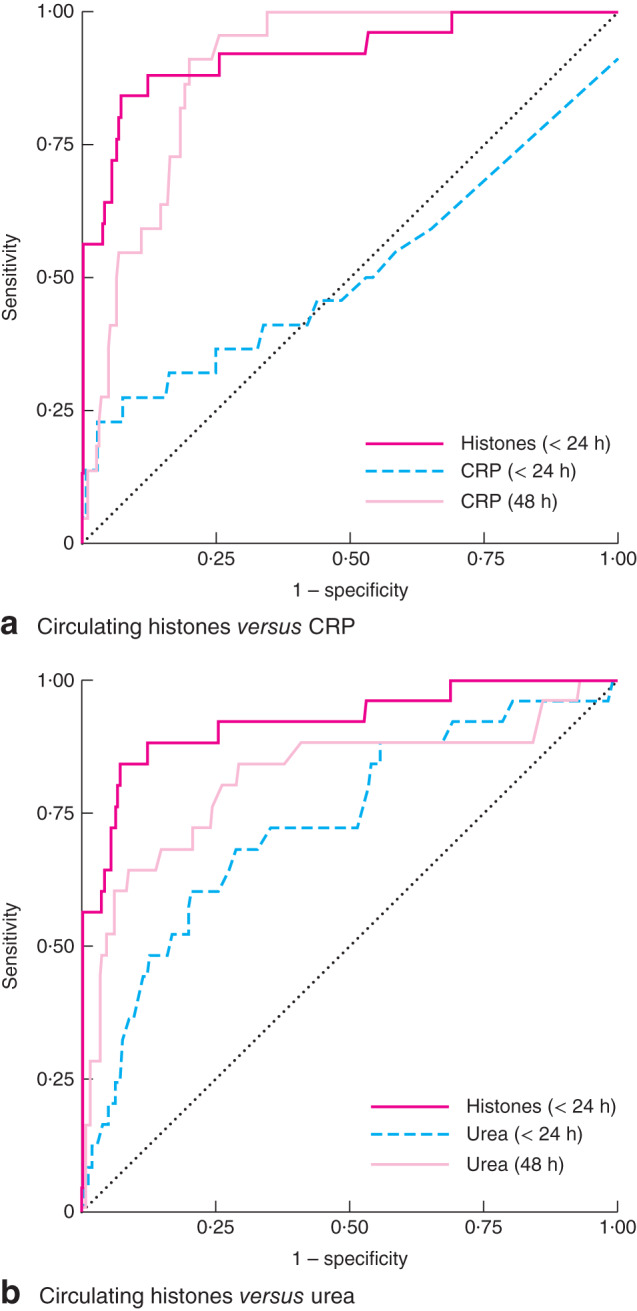
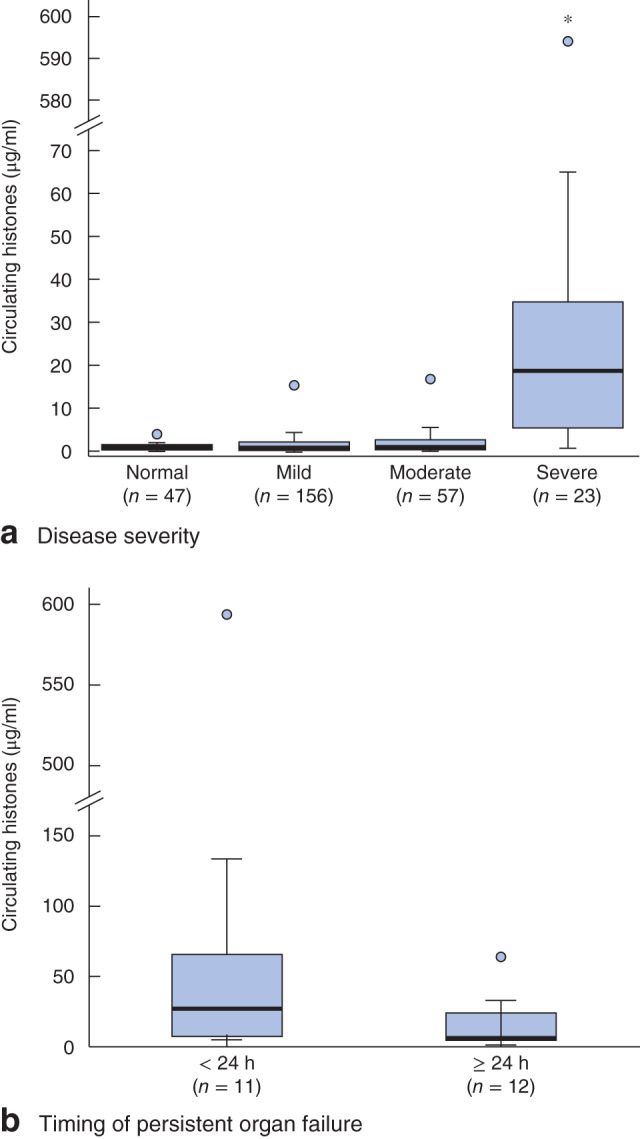
Among 236 patients with acute pancreatitis, there were 156 (66·1 per cent), 57 (24·2 per cent) and 23 (9·7 per cent) with mild, moderate and severe disease respectively, according to the revised Atlanta classification. Forty-seven healthy volunteers were included. The area under the receiver operating characteristic (ROC) curve (AUC) for circulating histones in predicting persistent organ failure and mortality was 0·92 (95 per cent c.i. 0·85 to 0·99) and 0·96 (0·92 to 1·00) respectively; histones were at least as accurate as clinical scores or biochemical markers. For infected pancreatic necrosis and/or sepsis, the AUC was 0·78 (0·62 to 0·94). Histones did not predict or correlate with local pancreatic complications, but correlated negatively with leucocyte cell viability (r = -0·511, P = 0·001).
Quantitative assessment of circulating histones in plasma within 48 h of abdominal pain onset can predict persistent organ failure and mortality in patients with acute pancreatitis. Early death of immune cells may contribute to raised circulating histone levels in acute pancreatitis.
急性胰腺炎严重程度的早期预测仍然是一项挑战。在小鼠模型中,循环组蛋白水平在早期升高,且与疾病严重程度相关。据推测,循环组蛋白可预测急性胰腺炎患者的持续性器官功能衰竭。
2010年6月至2014年3月期间,前瞻性纳入了皇家利物浦大学医院收治的符合纳入标准的连续急性胰腺炎患者。在腹痛发作48小时内采集血样,并收集住院期间的相关临床数据。纳入健康志愿者作为对照。主要终点是持续性器官功能衰竭的发生情况。测定循环组蛋白、临床评分和其他生物标志物的预测价值。
根据修订的亚特兰大分类,在236例急性胰腺炎患者中,分别有156例(66.1%)、57例(24.2%)和23例(9.7%)为轻度、中度和重度疾病。纳入了47名健康志愿者。循环组蛋白预测持续性器官功能衰竭和死亡率的受试者工作特征(ROC)曲线下面积(AUC)分别为0.92(95%置信区间0.85至0.99)和0.96(0.92至1.00);组蛋白的准确性至少与临床评分或生化标志物相当。对于感染性胰腺坏死和/或脓毒症,AUC为0.78(0.62至0.94)。组蛋白不能预测胰腺局部并发症,也与之无相关性,但与白细胞细胞活力呈负相关(r = -0.511,P = 0.001)。
腹痛发作48小时内定量评估血浆中循环组蛋白可预测急性胰腺炎患者的持续性器官功能衰竭和死亡率。免疫细胞的早期死亡可能导致急性胰腺炎患者循环组蛋白水平升高。