Stocks S Jill, Kontopantelis Evangelos, Webb Roger T, Avery Anthony J, Burns Alistair, Ashcroft Darren M
Division of Population Health, Health Services Research and Primary Care, School of Health Sciences, National Institute for Health Research Greater Manchester Primary Care Patient Safety Translational Research Centre, Centre for Primary Care, University of Manchester, Manchester, UK.
Division of Population Health, Health Services Research and Primary Care, School of Health Sciences, National Institute for Health Research School for Primary Care Research, Centre for Primary Care, University of Manchester, Manchester, UK.
Drug Saf. 2017 Aug;40(8):679-692. doi: 10.1007/s40264-017-0538-x.
Policy interventions to address inappropriate prescribing of antipsychotic drugs to older people diagnosed with dementia are commonplace. In the UK, warnings were issued by the Medicines Healthcare products Regulatory Agency in 2004, 2009 and 2012 and the National Institute for Health and Care Excellence guidance was published in 2006. It is important to evaluate the impact of such interventions.
We analysed routinely collected primary-care data from 111,346 patients attending one of 689 general practices contributing to the Clinical Practice Research Datalink to describe the temporal changes in the prescribing of antipsychotic drugs to patients aged 65 years or over diagnosed with dementia without a concomitant psychosis diagnosis from 2001 to 2014 using an interrupted time series and a before-and-after design. Logistic regression methods were used to quantify the impact of patient and practice level variables on prescribing prevalence.
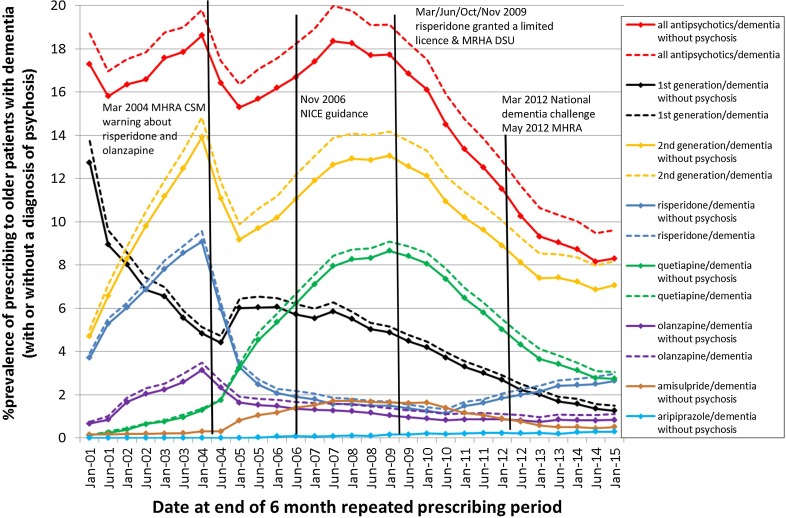
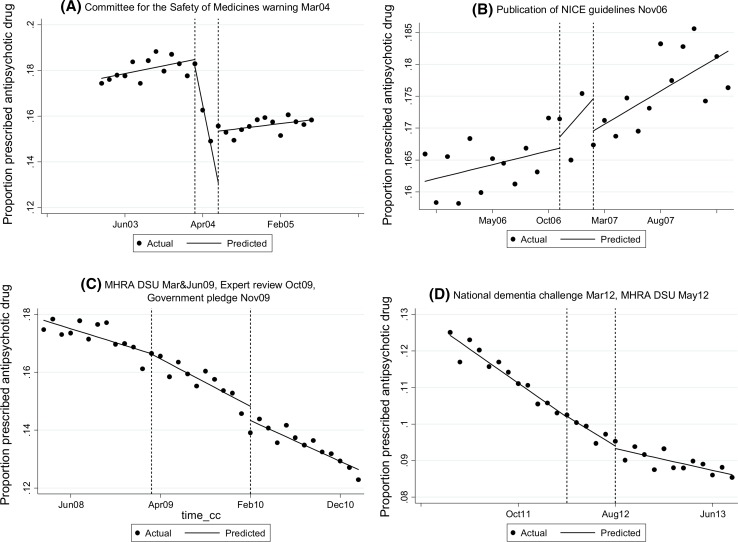
Prescribing of first-generation antipsychotic drugs reduced from 8.9% in 2001 to 1.4% in 2014 (prevalence ratio 2014/2001 adjusted for age, sex and clustering within practices (0.14, 95% confidence interval 0.12-0.16), whereas there was little change for second-generation antipsychotic drugs (1.01, confidence interval 0.94-1.17). Between 2004 and 2012, several policy interventions coincided with a pattern of ups and downs, whereas the 2006 National Institute for Health and Care Excellence guidance was followed by a gradual longer term reduction. Since 2013, the decreasing trend in second-generation antipsychotic drug prescribing has plateaued largely driven by the increasing prescribing of risperidone.
Increased surveillance and evaluation of drug safety warnings and guidance are needed to improve the impact of future interventions.
针对被诊断患有痴呆症的老年人不适当开具抗精神病药物的情况,政策干预措施很常见。在英国,药品和保健品监管局于2004年、2009年和2012年发布了警告,国家卫生与临床优化研究所的指南于2006年发布。评估此类干预措施的影响很重要。
我们分析了来自689家参与临床实践研究数据链的全科诊所之一的111346名患者的常规收集的初级保健数据,以使用中断时间序列和前后设计描述2001年至2014年期间对65岁及以上被诊断患有痴呆症且无并发精神病诊断的患者开具抗精神病药物的时间变化。使用逻辑回归方法量化患者和诊所层面变量对处方流行率的影响。
第一代抗精神病药物的处方率从2001年的8.9%降至2014年的1.4%(2014年/2001年的患病率比值经年龄、性别和诊所内聚类调整后为0.14,95%置信区间为0.12 - 0.16),而第二代抗精神病药物的变化不大(1.01,置信区间为0.94 - 1.17)。2004年至2012年期间,多项政策干预措施伴随着起伏模式,而2006年国家卫生与临床优化研究所的指南之后是逐渐的长期下降。自2013年以来,第二代抗精神病药物处方的下降趋势基本趋于平稳,主要是由于利培酮处方量的增加。
需要加强对药物安全警告和指南的监测与评估,以提高未来干预措施的效果。