Esteves Sandro C, Roque Matheus, Garrido Nicolás
ANDROFERT, Andrology and Human Reproduction Clinic, Referral Center for Male Reproduction, Av. Dr. Heitor Penteado 1464, Campinas, SP, 13075-460 Brazil.
ORIGEN, Center for Reproductive Medicine, Rio de Janeiro, Brazil.
Asian J Androl. 2018 Jan-Feb;20(1):1-8. doi: 10.4103/aja.aja_7_17.
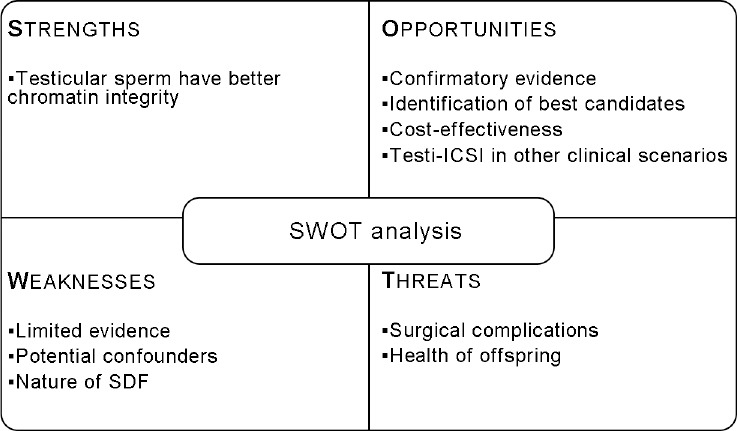
Spermatozoa retrieved from the testis of men with high levels of sperm DNA fragmentation (SDF) in the neat semen tend to have better DNA quality. Given the negative impact of SDF on the outcomes of Assisted Reproductive Technology (ART), an increased interest has emerged about the use of testicular sperm for intracytoplasmic sperm injection (Testi-ICSI). In this article, we used a SWOT (strengths, weaknesses, opportunities, and threats) analysis to summarize the advantages and drawbacks of this intervention. The rationale of Testi-ICSI is bypass posttesticular DNA fragmentation caused by oxidative stress during sperm transit through the epididymis. Hence, oocyte fertilization by genomically intact testicular spermatozoa may be optimized, thus increasing the chances of creating a normal embryonic genome and the likelihood of achieving a live birth, as recently demonstrated in men with high SDF. However, there is still limited evidence as regards the clinical efficacy of Testi-ICSI, thus creating opportunities for further confirmatory clinical research as well as investigation of Testi-ICSI in clinical scenarios other than high SDF. Furthermore, Testi-ICSI can be compared to other laboratory preparation methods for deselecting sperm with damaged DNA. At present, the available literature supports the use of testicular sperm when performing ICSI in infertile couples whose male partners have posttesticular SDF. Due to inherent risks of sperm retrieval, Testi-ICSI should be offered when less invasive treatments for alleviating DNA damage have failed. A call for continuous monitoring is nonetheless required concerning the health of generated offspring and the potential complications of sperm retrieval.
从精液中精子DNA碎片化(SDF)水平较高的男性睾丸中获取的精子往往具有更好的DNA质量。鉴于SDF对辅助生殖技术(ART)结局的负面影响,人们对使用睾丸精子进行卵胞浆内单精子注射(睾丸ICSI)的兴趣日益增加。在本文中,我们使用SWOT(优势、劣势、机会和威胁)分析来总结这种干预措施的优缺点。睾丸ICSI的基本原理是绕过精子在附睾中运输过程中由氧化应激引起的睾丸后DNA碎片化。因此,基因组完整的睾丸精子对卵母细胞的受精可能会得到优化,从而增加创建正常胚胎基因组的机会以及实现活产的可能性,最近在SDF水平较高的男性中得到了证实。然而,关于睾丸ICSI临床疗效的证据仍然有限,从而为进一步的验证性临床研究以及在除高SDF之外的临床场景中对睾丸ICSI的研究创造了机会。此外,睾丸ICSI可以与其他用于筛选出DNA受损精子的实验室制备方法进行比较。目前,现有文献支持在男性伴侣存在睾丸后SDF的不育夫妇进行ICSI时使用睾丸精子。由于取精存在固有风险,当减轻DNA损伤的侵入性较小的治疗方法失败时,应提供睾丸ICSI。然而,仍需要对所产生后代的健康以及取精的潜在并发症进行持续监测。