Yu Yongzhi, Zheng Guanzhong
Department of Cardiology, Linzi District People's Hospital, Zibo, Shandong 255400, P.R. China.
Mol Med Rep. 2017 Jun;15(6):3473-3478. doi: 10.3892/mmr.2017.6456. Epub 2017 Apr 11.
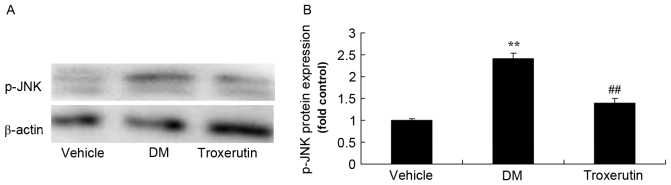
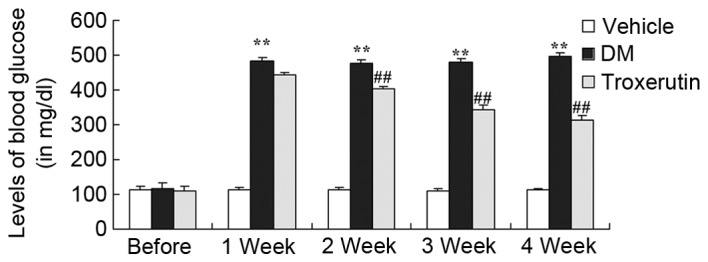
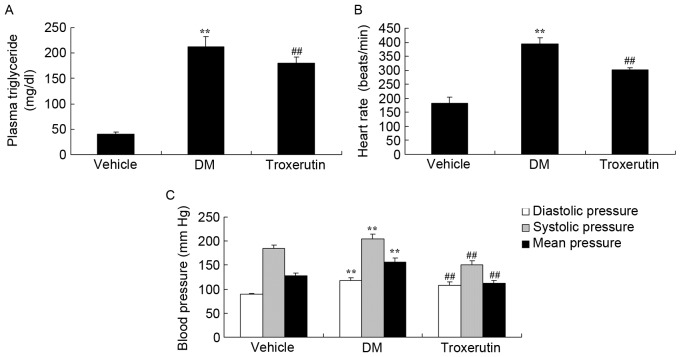
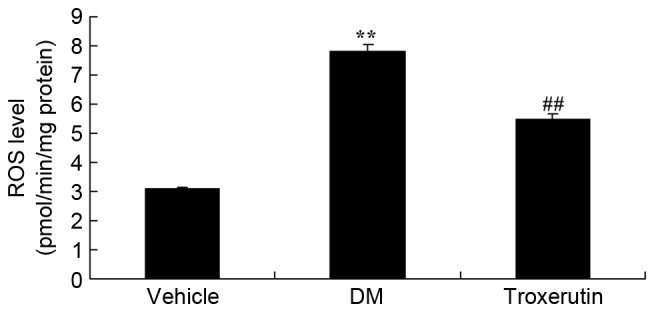
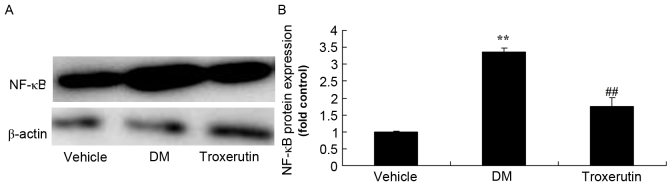
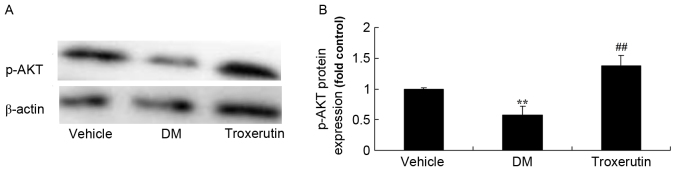
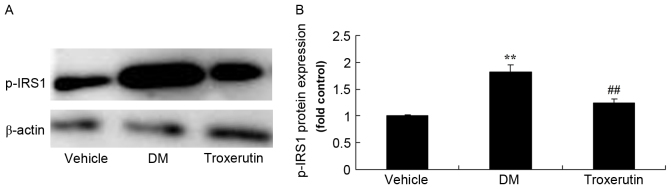
Troxerutin is a bioflavonoid, which can be used to treat venous disorders, thrombosis and cerebrovascular diseases. Recent studies have demonstrated that it may also be used to prevent edemas. However, it is not known whether troxerutin protects against the cardiomyopathic complications of diabetes. In the present study, a rat model of type 2 diabetes was used to investigate the potential for troxerutin to protect against diabetic cardiomyopathy, through changes to nuclear factor‑κB (NF‑κB) expression. Troxerutin administration significantly reduced heart rate, blood pressure, blood glucose and plasma triglyceride levels across all measured time points. Furthermore, troxerutin significantly reduced reactive oxygen species levels, NF‑κB protein expression, and suppressed the phosphorylated forms of AKT, insulin receptor substrate 1 (IRS1) and c‑Jun N‑terminal kinase (JNK). These results suggested that troxerutin protects against cardiomyopathy via alterations in NF‑κB, AKT and IRS1 signaling, in a rat model of type 2 diabetes.
曲克芦丁是一种生物类黄酮,可用于治疗静脉疾病、血栓形成和脑血管疾病。最近的研究表明,它也可用于预防水肿。然而,尚不清楚曲克芦丁是否能预防糖尿病的心肌病并发症。在本研究中,使用2型糖尿病大鼠模型,通过改变核因子-κB(NF-κB)表达,研究曲克芦丁预防糖尿病性心肌病的潜力。在所有测量时间点,给予曲克芦丁均显著降低心率、血压、血糖和血浆甘油三酯水平。此外,曲克芦丁显著降低活性氧水平、NF-κB蛋白表达,并抑制AKT、胰岛素受体底物1(IRS1)和c-Jun氨基末端激酶(JNK)的磷酸化形式。这些结果表明,在2型糖尿病大鼠模型中,曲克芦丁通过改变NF-κB、AKT和IRS1信号通路来预防心肌病。