Lin Xiao-Long, Hu Hui-Jun, Liu Yuan-Bo, Hu Xue-Mei, Fan Xiao-Juan, Zou Wei-Wen, Pan Yong-Quan, Zhou Wen-Quan, Peng Min-Wen, Gu Cai-Hong
Department of Pathology, Huizhou Third People's Hospital, Guangzhou Medical University, Huizhou, Guangdong 516002, P.R. China.
Medical Department of Neurology, The Sixth People's Hospital of Huizhou (The People's Hospital of Huiyang), Huizhou, Guangdong 516211, P.R. China.
Int J Mol Med. 2017 Jun;39(6):1452-1460. doi: 10.3892/ijmm.2017.2949. Epub 2017 Apr 11.
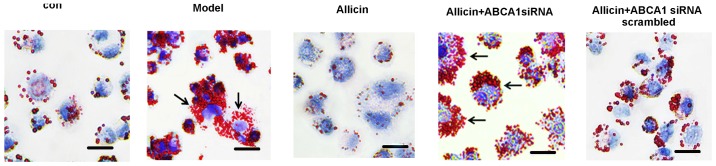
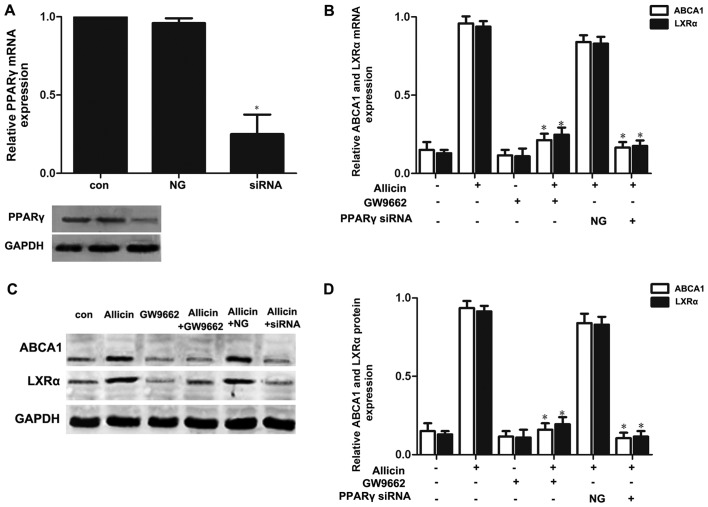
Allicin is considered anti-atherosclerotic due to its antioxidant and anti-inflammatory effects, which makes it an important drug for the prevention and treatment of atherosclerosis. However, the effects of allicin on foam cells are unclear. Thus, in this study, we examined the effects of allicin on lipid accumulation via peroxisome proliferator-activated receptor γ (PPARγ)/liver X receptor α (LXRα) in THP‑1 macrophage-derived foam cells. THP‑1 cells were exposed to 100 nM phorbol myristate acetate (PMA) for 24 h, and then to oxydized low-density lipoprotein (ox-LDL; 50 mg/ml) to induce foam cell formation. The results of Oil Red O staining and high-performance liquid chromatography (HPLC) revealed showed that pre-treatment of the foam cells with allicin decreased total cholesterol, free cholesterol (FC) and cholesterol ester levels in cells, and also decreased lipid accumulation. Moreover, allicin upregulated ATP binding cassette transporter A1 (ABCA1) expression and promoted cholesterol efflux. However, these effects were significantly abolished by transfection with siRNA targeting ABCA1. Furthermore, PPARγ/LXRα signaling was activated by allicin treatment. The allicin-induced upregulation of ABCA1 expression was also abolished by PPARγ inhibitor (GW9662) and siRNA or LXRα siRNA co-treatment. Overall, our data demonstrate that the allicin-induced upregulation of ABCA1 promotes cholesterol efflux and reduces lipid accumulation via PPARγ/LXRα signaling in THP‑1 macrophage-derived foam cells.
由于大蒜素具有抗氧化和抗炎作用,因此被认为具有抗动脉粥样硬化作用,这使其成为预防和治疗动脉粥样硬化的重要药物。然而,大蒜素对泡沫细胞的影响尚不清楚。因此,在本研究中,我们研究了大蒜素通过过氧化物酶体增殖物激活受体γ(PPARγ)/肝X受体α(LXRα)对THP-1巨噬细胞源性泡沫细胞中脂质积累的影响。将THP-1细胞暴露于100 nM佛波酯肉豆蔻酸酯乙酸盐(PMA)24小时,然后暴露于氧化低密度脂蛋白(ox-LDL;50 mg/ml)以诱导泡沫细胞形成。油红O染色和高效液相色谱(HPLC)结果显示,用大蒜素预处理泡沫细胞可降低细胞中的总胆固醇、游离胆固醇(FC)和胆固醇酯水平,并减少脂质积累。此外,大蒜素上调ATP结合盒转运蛋白A1(ABCA1)的表达并促进胆固醇流出。然而,用靶向ABCA1的siRNA转染可显著消除这些作用。此外,大蒜素处理激活了PPARγ/LXRα信号通路。PPARγ抑制剂(GW9662)以及siRNA或LXRα siRNA共同处理也消除了大蒜素诱导的ABCA1表达上调。总体而言,我们的数据表明,大蒜素诱导的ABCA1上调通过PPARγ/LXRα信号通路促进THP-1巨噬细胞源性泡沫细胞中的胆固醇流出并减少脂质积累。