
用于从水介质中去除甲基橙(MO)的多面氧化亚铜(Cu₂O)颗粒的光催化和吸附性能
Photocatalytic and Adsorption Performances of Faceted Cuprous Oxide (Cu₂O) Particles for the Removal of Methyl Orange (MO) from Aqueous Media.
作者信息
Ho Weng Chye Jeffrey, Tay Qiuling, Qi Huan, Huang Zhaohong, Li Jiao, Chen Zhong
机构信息
School of Materials Science and Engineering, Nanyang Technological University, Singapore 639798, Singapore.
Singapore Institute of Manufacturing Technology, 71 Nanyang Drive, Singapore 638075, Singapore.
出版信息
Molecules. 2017 Apr 23;22(4):677. doi: 10.3390/molecules22040677.
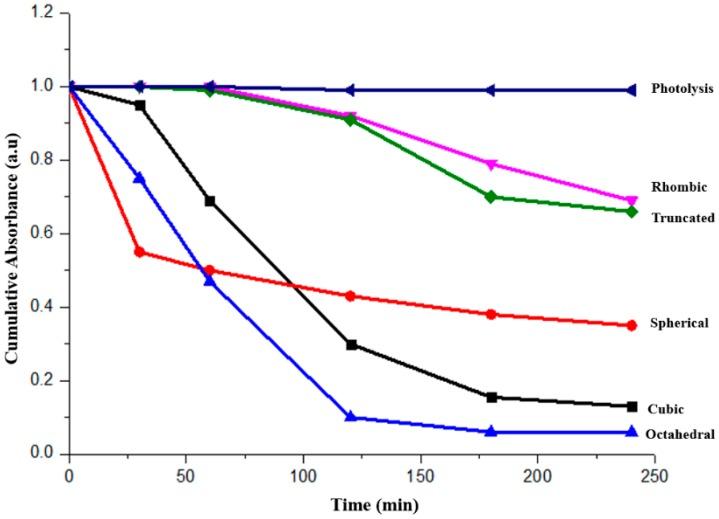
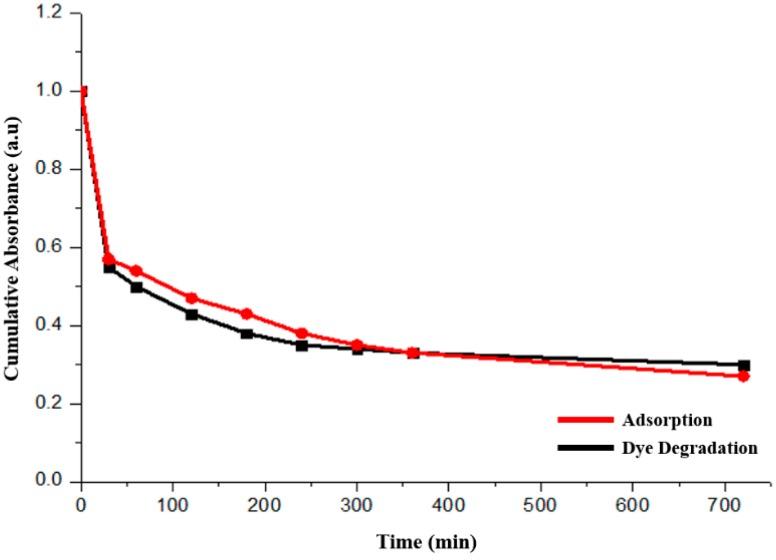
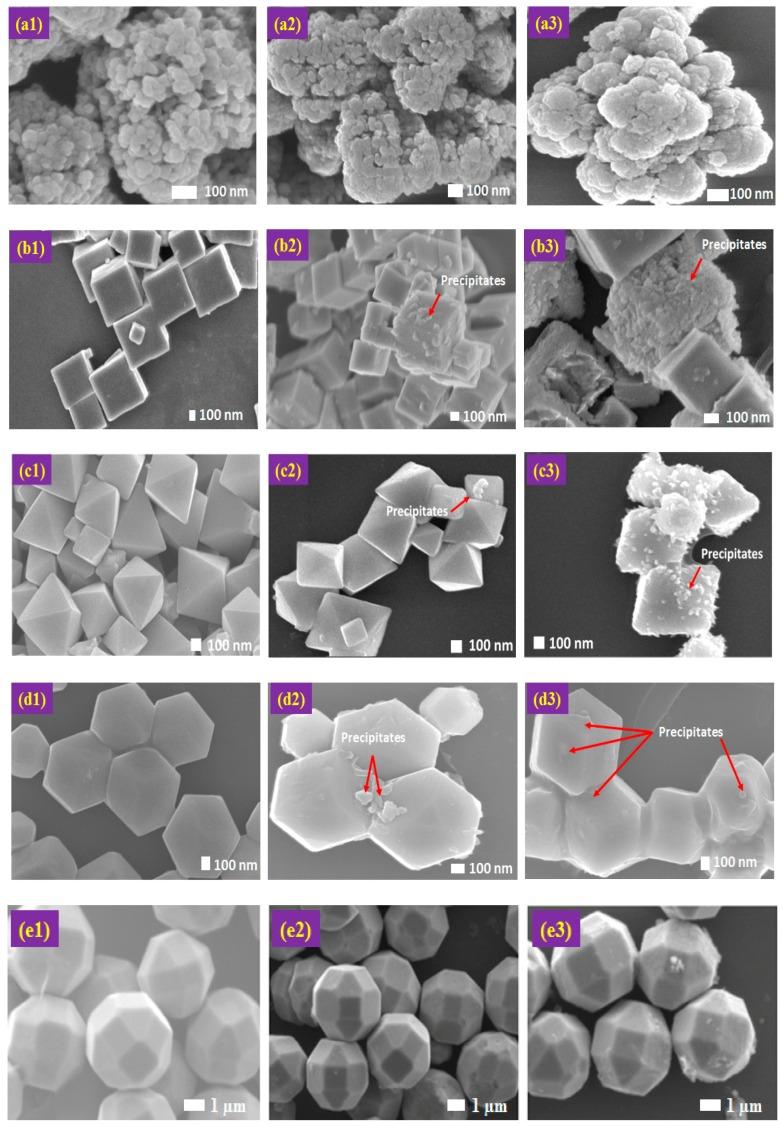
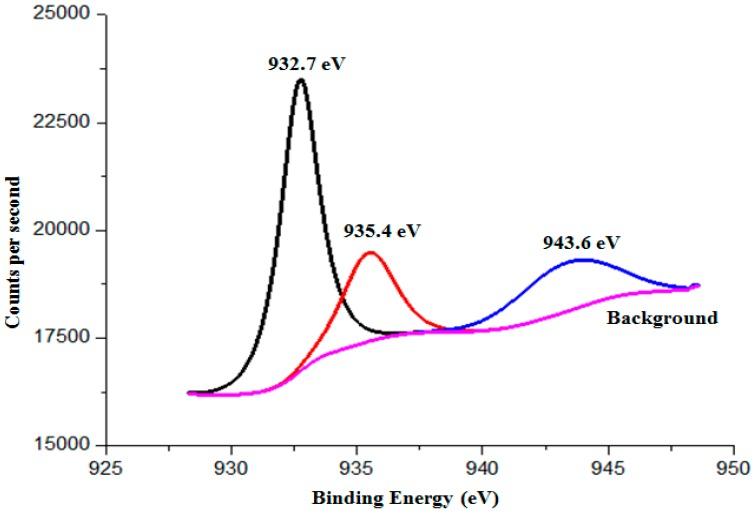
Particles of sub-micron size possess significant capacity to adsorb organic molecules from aqueous media. Semiconductor photocatalysts in particle form could potentially be utilized for dye removal through either physical adsorption or photo-induced chemical process. The photocatalytic and adsorption capabilities of Cu₂O particles with various exposed crystal facets have been studied through separate adsorption capacity test and photocatalytic degradation test. These crystals display unique cubic, octahedral, rhombic dodecahedral, and truncated polyhedral shapes due to specifically exposed crystal facet(s). For comparison, Cu₂O particles with no clear exposed facets were also prepared. The current work confirms that the surface charge critically affects the adsorption performance of the synthesized Cu₂O particles. The octahedral shaped Cu₂O particles, with exposed {111} facets, possess the best adsorption capability of methyl orange (MO) dye due to the strongest positive surface charge among the different types of particles. In addition, we also found that the adsorption of MO follows the Langmuir monolayer mechanism. The octahedral particles also performed the best in photocatalytic dye degradation of MO under visible light irradiation because of the assistance from dye absorption. On top of the photocatalytic study, the stability of these Cu₂O particles during the photocatalytic processes was also investigated. Cu(OH)₂ and CuO are the likely corrosion products found on the particle surface after the photocorrosion in MO solution. By adding hole scavengers in the solution, the photocorrosion of Cu₂O was greatly reduced. This observation confirms that the photocatalytically generated holes were responsible for the photocorrosion of Cu₂O.
亚微米尺寸的颗粒具有从水性介质中吸附有机分子的显著能力。颗粒形式的半导体光催化剂可通过物理吸附或光诱导化学过程潜在地用于去除染料。通过单独的吸附容量测试和光催化降解测试,研究了具有不同暴露晶面的Cu₂O颗粒的光催化和吸附能力。由于特定暴露的晶面,这些晶体呈现出独特的立方、八面体、菱形十二面体和截顶多面体形状。为了进行比较,还制备了没有明显暴露晶面的Cu₂O颗粒。目前的工作证实,表面电荷对合成的Cu₂O颗粒的吸附性能有至关重要的影响。具有暴露{111}晶面的八面体形状的Cu₂O颗粒,由于在不同类型的颗粒中具有最强的正表面电荷,对甲基橙(MO)染料具有最佳的吸附能力。此外,我们还发现MO的吸附遵循朗缪尔单分子层机制。由于染料吸收的辅助作用,八面体颗粒在可见光照射下对MO的光催化染料降解中也表现最佳。除了光催化研究之外,还研究了这些Cu₂O颗粒在光催化过程中的稳定性。在MO溶液中光腐蚀后,在颗粒表面发现的可能的腐蚀产物是Cu(OH)₂和CuO。通过在溶液中添加空穴清除剂,Cu₂O的光腐蚀大大降低。这一观察结果证实,光催化产生的空穴是导致Cu₂O光腐蚀的原因。






 Zotero 插件