Gazal Giath, Alharbi Rashdan, Fareed Wamiq Musheer, Omar Esam, Alolayan Albraa Badr, Al-Zoubi Hassan, Alnazzawi Ahmad A
Department of Maxillofacial Surgery, College of Dentistry, Taibah University, Al Madinah Al Munawwarah, Saudi Arabia.
Department of Orthodontics, College of Dentistry, Taibah University, Al Madinah Al Munawwarah, Saudi Arabia.
Saudi J Anaesth. 2017 Apr-Jun;11(2):152-157. doi: 10.4103/1658-354X.203017.
To investigate the speed of action and injection discomfort of 4% articaine and 2% mepivacaine for upper teeth extractions.
Forty-five patients were included in the articaine 4% group, and 45 in the mepivacaine 2% control group. After all injections, soft and hard tissue numbness was objectively gauged by dental probe at intervals of 15 s. Furthermore, the discomfort of the injections were recorded by the patients after each treatment on standard 100 mm visual analog scales, tagged at the endpoints with "no pain" (0 mm) and "unbearable pain" (100 mm).
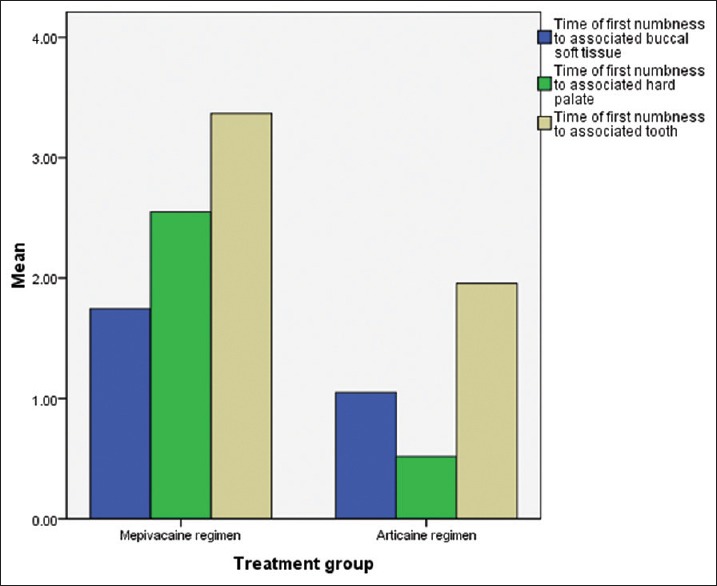
There were significant differences in the meantime of first numbness to associated palatal mucosa and tooth of patients between mepivacaine and articaine buccal infiltration (BI) groups = 0.01 and 0.01. Patients in the articaine group recorded earlier palatal mucosa and teeth numbness than those in the mepivacaine group. With regards to the discomfort of the needle injections, palatal injection was significantly more painful than BI (-test: < 0.001). Articaine buccal injection was significantly more painful than mepivacaine buccal injection (-test: <0.001). However, articaine palatal injection was less painful than articaine BI. Clinically, anesthesia onset time was faster in anterior upper teeth than upper middle and posterior teeth.
BIs with 4% articaine was faster in achieving palate and teeth anesthesia than 2% mepivacaine for extraction of upper maxillary teeth. Patients in mepivacaine BI and articaine palatal injection groups reported less pain with needle injection. Failure of anesthesia was noticeable with maxillary multiple-rooted teeth.
探讨4%阿替卡因和2%甲哌卡因用于上颌牙拔除术时的起效速度和注射不适感。
4%阿替卡因组纳入45例患者,2%甲哌卡因对照组纳入45例患者。所有注射后,每隔15秒用牙科探针客观测量软组织和硬组织的麻木情况。此外,患者在每次治疗后用标准的100毫米视觉模拟量表记录注射的不适感,量表两端分别标记为“无疼痛”(0毫米)和“难以忍受的疼痛”(100毫米)。
甲哌卡因和阿替卡因颊侧浸润(BI)组患者腭黏膜和牙齿首次麻木的时间存在显著差异(分别为P = 0.01和0.01)。阿替卡因组患者腭黏膜和牙齿的麻木时间早于甲哌卡因组。关于针头注射的不适感,腭部注射比颊侧浸润明显更痛(t检验:P < 0.001)。阿替卡因颊侧注射比甲哌卡因颊侧注射明显更痛(t检验:P <0.001)。然而,阿替卡因腭部注射比阿替卡因颊侧浸润疼痛轻。临床上,上前牙的麻醉起效时间比上颌中后牙快。
对于上颌牙拔除术,4%阿替卡因颊侧浸润比2%甲哌卡因更快实现腭部和牙齿麻醉。甲哌卡因颊侧浸润组和阿替卡因腭部注射组患者报告的针头注射疼痛较轻。上颌多根牙的麻醉失败情况较为明显。