van de Berg Raymond, Lucieer Florence, Guinand Nils, van Tongeren Joost, George Erwin, Guyot Jean-Philippe, Kingma Herman, van Hoof Marc, Temel Yasin, van Overbeeke Jacobus, Perez-Fornos Angelica, Stokroos Robert
Department of Otorhinolaryngology and Head and Neck Surgery, Maastricht University Medical Center, Maastricht, Netherlands.
Faculty of Physics, Tomsk State University, Tomsk, Russia.
Front Neurol. 2017 Apr 10;8:137. doi: 10.3389/fneur.2017.00137. eCollection 2017.
The vestibular implant seems feasible as a clinically useful device in the near future. However, hearing preservation during intralabyrinthine implantation remains a challenge. It should be preserved to be able to treat patients with bilateral vestibulopathy and (partially) intact hearing. This case study investigated the feasibility of hearing preservation during the acute phase after electrode insertion in the semicircular canals.
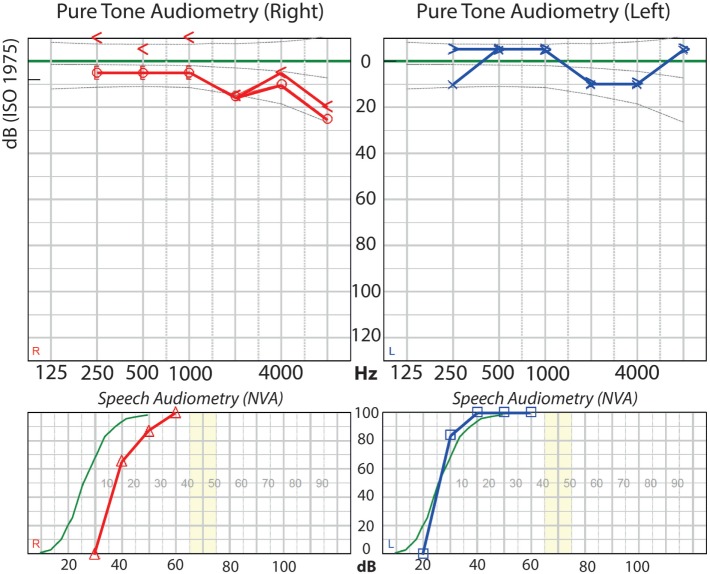
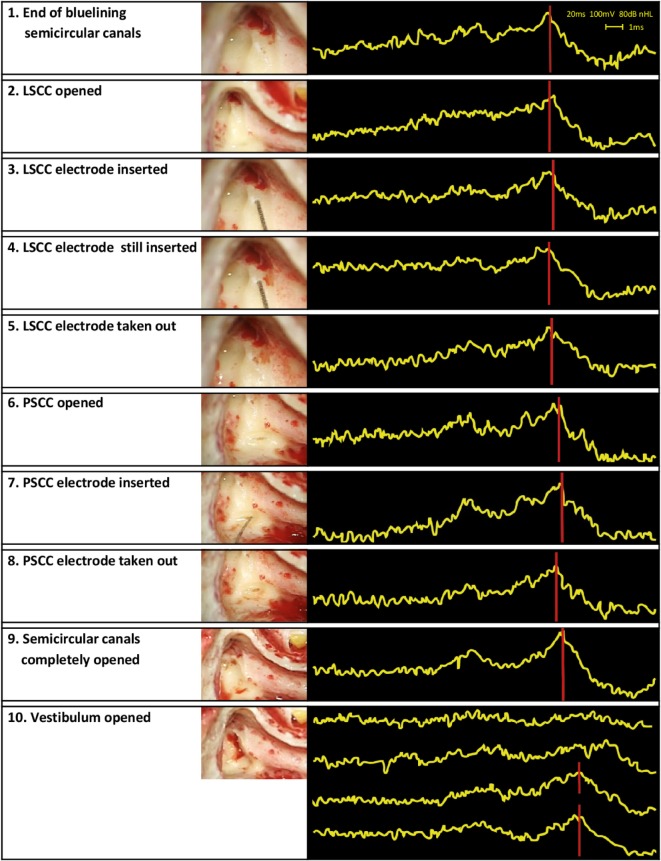
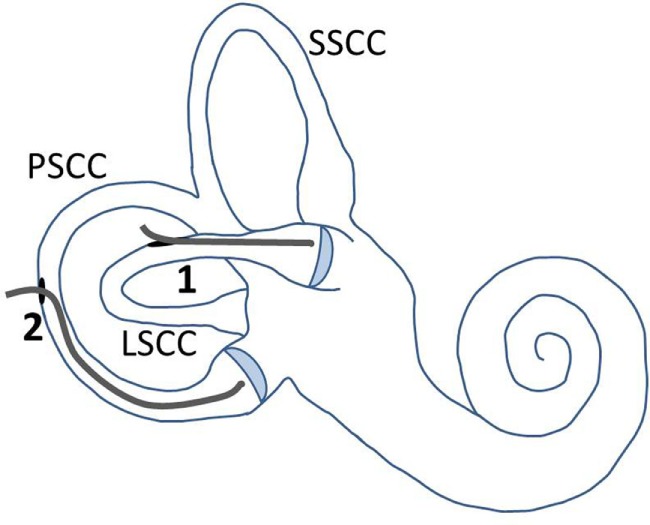
A 40-year-old woman with normal hearing underwent a translabyrinthine approach for a vestibular schwannoma Koos Grade IV. Hearing was monitored using auditory brainstem response audiometry (ABR). ABR signals were recorded synchronously to video recordings of the surgery. Following the principles of soft surgery, a conventional dummy electrode was inserted in the lateral semicircular canal for several minutes and subsequently removed. The same procedure was then applied for the posterior canal. Finally, the labyrinthectomy was completed, and the schwannoma was removed.
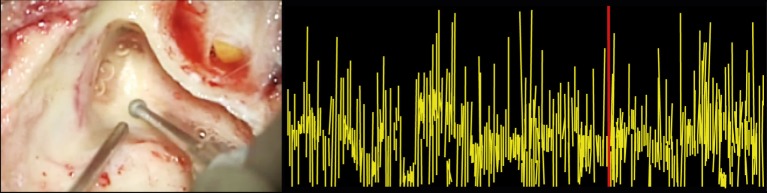
Surgery was performed without complications. No leakage of endolymph and no significant reduction of ABR response were observed during insertion and after removal of the electrodes from the semicircular canals, indicting no damage to the peripheral auditory function. The ABR response significantly changed when the semicircular canals were completely opened during the labyrinthectomy. This was indicated by a change in the morphology and latency of peak V of the ABR signal.
Electrode insertion in the semicircular canals is possible without acutely damaging the peripheral auditory function measured with ABR, as shown in this proof-of-principle clinical investigation.
前庭植入物在不久的将来似乎是一种可行的临床实用设备。然而,内耳植入过程中的听力保留仍然是一个挑战。保留听力对于治疗双侧前庭病变且(部分)听力完好的患者至关重要。本案例研究探讨了在电极插入半规管后的急性期保留听力的可行性。
一名听力正常的40岁女性因患有库斯IV级前庭神经鞘瘤接受了经迷路入路手术。使用听性脑干反应测听法(ABR)监测听力。ABR信号与手术视频同步记录。遵循轻柔手术原则,将一个传统的假电极插入外侧半规管几分钟,随后取出。然后对后半规管应用相同程序。最后,完成迷路切除术并切除神经鞘瘤。
手术无并发症发生。在电极插入半规管期间及从半规管取出后,未观察到内淋巴漏出,ABR反应也无显著降低,表明外周听觉功能未受损。在迷路切除术期间半规管完全打开时,ABR反应发生了显著变化。这通过ABR信号V波峰的形态和潜伏期变化得以体现。
如本原理验证性临床研究所示,在半规管中插入电极不会急性损害用ABR测量的外周听觉功能。