Clinic of Emergency, Tunceli State Hospital, Tunceli, Turkey.
Department of Emergency, Kocaeli University School of Medicine, Kocaeli, Turkey.
Balkan Med J. 2017 Aug 4;34(4):356-361. doi: 10.4274/balkanmedj.2016.1181. Epub 2017 Apr 6.
Despite the existence of detailed consensus guidelines, challenges remain regarding efficient, appropriate, and safe imaging methods for the diagnosis of suspected pulmonary embolism.
To investigate the role of the wedge sign, B-lines, and pleural effusion seen on bedside lung ultrasound in the diagnosis of pulmonary embolism.
Diagnostic accuracy study.
During the first evaluation of patients with suspected pulmonary embolism, bedside lung ultrasound was performed, and the B-lines, wedge sign, and pleural effusion were investigated. Computed tomography angiography was used as a confirmatory test and was compared with the lung ultrasound findings.
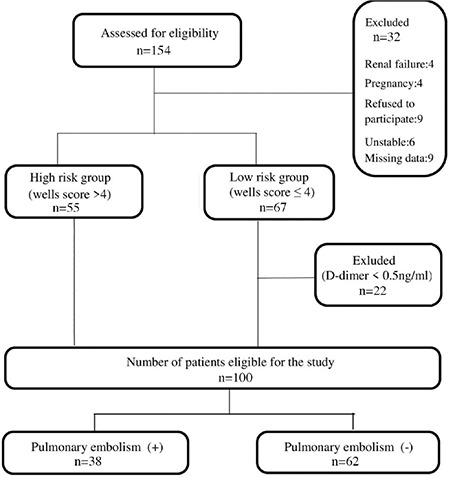
Pulmonary embolism was detected in 38 (38%) patients. In the comparison of bedside lung ultrasound results, statistically significant differences were found between the groups in terms of the B-lines and wedge sign (p=0.005 and p>0.001, respectively). There were no significant differences in terms of effusion (p=0.234). Comparison of these findings with computed tomography angiography of the chest showed weak negative correlations between the groups in terms of B-lines (r=-0297) and a moderately positive correlation in terms of the wedge sign (r=0.523). The sensitivity, specificity, and positive and negative predictive values of lung ultrasound findings alone were low. In the logistic regression analysis, the wedge sign (p>0.01, OR=69.45, 95% CI=6.94-695.17) and B-line (p=0.033, OR=1.96, 95% CI=0.41-8.40) were found to be effective in the diagnosis of pulmonary embolism.
Although the role of lung ultrasound has been increasing in the management of critically ill patients, its value is limited and cannot replace the gold standard tests in the diagnosis of pulmonary embolism.
尽管存在详细的共识指南,但在疑似肺栓塞的诊断中,仍存在有效、合适和安全的影像学方法的挑战。
探讨床边肺超声中楔形征、B 线和胸腔积液在肺栓塞诊断中的作用。
诊断准确性研究。
在疑似肺栓塞患者的首次评估中,进行床边肺超声检查,并研究 B 线、楔形征和胸腔积液。计算机断层血管造影术(CTA)作为确认试验,并与肺超声结果进行比较。
38 例(38%)患者检测到肺栓塞。在床边肺超声结果的比较中,B 线和楔形征两组之间存在统计学显著差异(p=0.005 和 p>0.001)。胸腔积液方面无显著差异(p=0.234)。与胸部 CTA 的比较显示,B 线组之间的相关性较弱(r=-0.297),楔形征组的相关性中度阳性(r=0.523)。单独使用肺超声结果的敏感性、特异性、阳性和阴性预测值均较低。在逻辑回归分析中,楔形征(p>0.01,OR=69.45,95%CI=6.94-695.17)和 B 线(p=0.033,OR=1.96,95%CI=0.41-8.40)对肺栓塞的诊断有效。
尽管床边肺超声在危重症患者管理中的作用日益增加,但它的价值有限,不能替代肺栓塞诊断的金标准试验。