Yoo Changhoon, Kang Jihoon, Kim Deokhoon, Kim Kyu-Pyo, Ryoo Baek-Yeol, Hong Seung-Mo, Hwang Jung Jin, Jeong Seong-Yun, Hwang Shin, Kim Ki-Hun, Lee Young-Joo, Hoeflich Klaus P, Schmidt-Kittler Oleg, Miller Stephen, Choi Eun Kyung
Department of Oncology, Asan Medical Center, University of Ulsan College of Medicine, Seoul, Korea.
Asan Institute for Life Science, University of Ulsan College of Medicine, Seoul, Korea.
Oncotarget. 2017 Jun 13;8(24):38592-38601. doi: 10.18632/oncotarget.16951.
The fibroblast growth factor receptor 4 (FGFR4) pathway is an essential regulatory component of bile acid synthesis, and its relationship with hepatocellular carcinoma (HCC) has been reported. We investigated the gene expression and clinical significance of FGFR4 and related pathways in intrahepatic cholangiocarcinoma (iCCA).
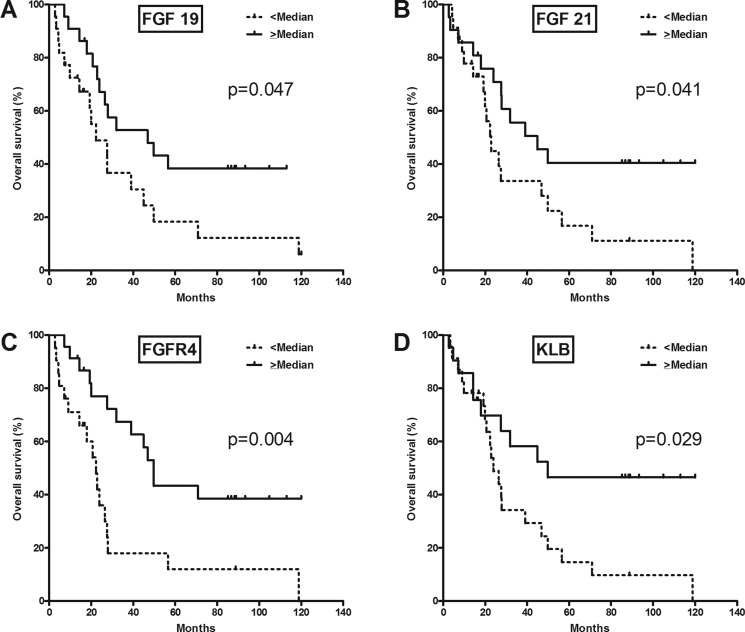
The median age was 56 years (range 30-78) and 34 patients (74%) were male. Six patients (13%) had hepatitis B virus infection, with or without liver cirrhosis. Overall survival was significantly associated with FGFR4 (p = 0.004), FGF19 (p = 0.047), FGF21 (p = 0.04), and KLB (p = 0.03) expression. In the multivariate analysis with potential prognostic factors, high expression of FGF19, FGF21, and FGFR4 was significantly associated with better survival. In the analysis using the TCGA iCCA dataset, mRNA overexpression of at least 1 of the FGFR4-related genes was significantly associated with better disease-free survival (p = 0.02).
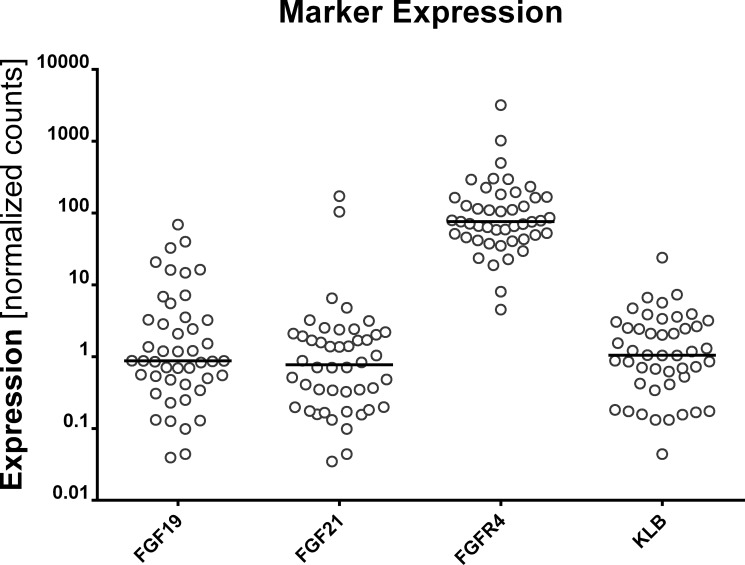
We assessed the expression of 98 genes in formalin-fixed paraffin embedded tumor tissue specimens from 46 patients with surgically resected iCCA using a NanoString platform. This included 10 FGF pathway genes (e.g. FGFR1-4, KLB, FGF3, 4, 19, 21, and 23), 19 distal marker genes (e.g. CYP7A1 and CYP17A1), 31 genes relevant to HCC and iCCA (e.g. AFP, TS), 18 copy number variation matched genes, and 20 control genes. Log-transformation of gene expression was performed for normalization and statistical analysis. Overall survival was correlated with gene expression (< median vs. ≥ median) using a log-rank test. The prognostic impact of FGFR4-related genes was validated using the public TCGA dataset for iCCA.
Our results indicate that mRNA expression of FGFR4-related genes may be a biomarker to define the distinctive molecular phenotype of iCCA. Future preclinical and clinical validation is required to define the role of the FGFR4 pathway in iCCA.
成纤维细胞生长因子受体4(FGFR4)通路是胆汁酸合成的重要调节成分,其与肝细胞癌(HCC)的关系已有报道。我们研究了FGFR4及相关通路在肝内胆管癌(iCCA)中的基因表达及临床意义。
中位年龄为56岁(范围30 - 78岁),34例患者(74%)为男性。6例患者(13%)有乙肝病毒感染,伴或不伴有肝硬化。总生存期与FGFR4(p = 0.004)、FGF19(p = 0.047)、FGF21(p = 0.04)和KLB(p = 0.03)的表达显著相关。在对潜在预后因素进行的多变量分析中,FGF19、FGF21和FGFR4的高表达与更好的生存期显著相关。在使用TCGA iCCA数据集进行的分析中,FGFR4相关基因中至少1个的mRNA过表达与更好的无病生存期显著相关(p = 0.02)。
我们使用NanoString平台评估了46例手术切除的iCCA患者福尔马林固定石蜡包埋肿瘤组织标本中98个基因的表达。这包括10个FGF通路基因(如FGFR1 - 4、KLB、FGF3、4、19、21和23)、19个远端标志物基因(如CYP7A1和CYP17A1)、31个与HCC和iCCA相关的基因(如AFP、TS)、18个拷贝数变异匹配基因和20个对照基因。对基因表达进行对数转换以进行标准化和统计分析。使用对数秩检验将总生存期与基因表达(<中位数 vs. ≥中位数)相关联。使用公开的TCGA iCCA数据集验证FGFR4相关基因的预后影响。
我们的结果表明,FGFR4相关基因的mRNA表达可能是定义iCCA独特分子表型的生物标志物。需要未来的临床前和临床验证来确定FGFR4通路在iCCA中的作用。