Zheng Weikun, Shi Haifan, Chen Yiping, Xu Zhiwei, Chen Jie, Jin Longteng
Department of Childhood Infectious Diseases, The Second Affiliated Hospital and Yuying Children's Hospital of Wenzhou Medical University, Wenzhou, Zhejiang, China.
Medicine (Baltimore). 2017 Apr;96(17):e6764. doi: 10.1097/MD.0000000000006764.
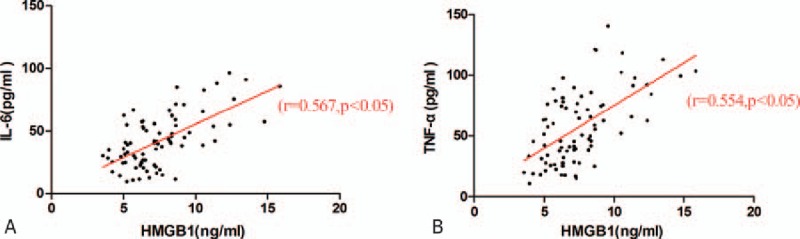
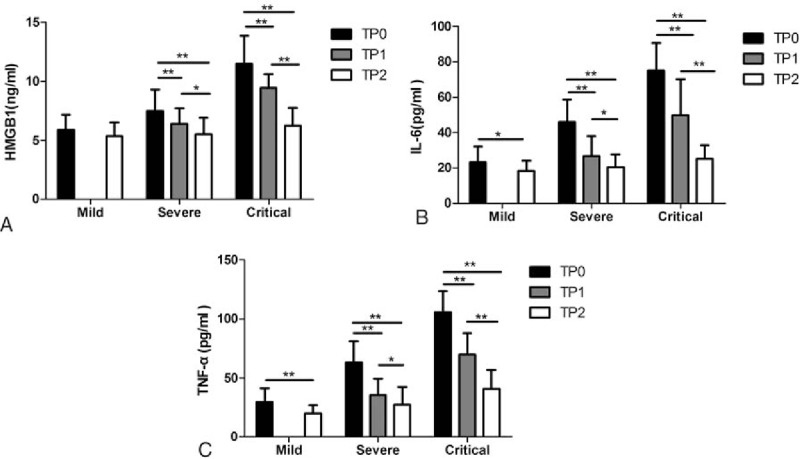
Hand, foot, and mouth disease (HFMD) is a common pediatric disease caused by enterovirus infection. It typically presents as a fever along with flat, discolored spots and bumps on the hands, feet, and mouth. Compared with other viruses, enterovirus 71 (EV71)-induced HFMD is more prone to cause severe complications in children, such as brainstem encephalitis, cardiopulmonary disorders, and even death. More in-depth studies are still necessary to understand the characteristics of EV71-induced HFMD, although some related research has been reported so far. High-mobility group box 1 (HMGB1) is an inflammatory cytokine that can upregulate other inflammatory factors through its receptors, such as Toll-like receptors and the receptor for advanced glycation endproducts.We prospectively investigated the alteration of serum HMGB1, interleukin (IL)-6, and tumor necrosis factor (TNF)-α levels before and after treatment in 82 children with HFMD.We found that the serum HMGB1, IL-6, and TNF-α levels were significantly increased in EV71-induced HFMD, and that these changes were more serious in the severe and critical HMFD groups; however, there was no significant difference in the HMGB1 level between the normal control and mild HMFD groups. Moreover, the serum HMGB1 level was positively correlated with the alteration of serum IL-6 and TNF-α concentrations.These results suggest that HMGB1 is involved in the inflammatory pathogenesis of EV71-induced HFMD and that the serum level of HMGB1 could be applied as a clinical indicator for the severity of HFMD, and also a sign for the recovery prognosis of HFMD.
手足口病(HFMD)是一种由肠道病毒感染引起的常见儿科疾病。其典型症状为发热,同时伴有手部、足部和口腔出现扁平的、颜色改变的斑点和丘疹。与其他病毒相比,肠道病毒71型(EV71)引起的手足口病更容易导致儿童出现严重并发症,如脑干脑炎、心肺功能障碍,甚至死亡。尽管目前已有一些相关研究报道,但仍需要更深入的研究来了解EV71引起的手足口病的特征。高迁移率族蛋白B1(HMGB1)是一种炎症细胞因子,它可以通过其受体(如Toll样受体和晚期糖基化终产物受体)上调其他炎症因子。我们前瞻性地研究了82例手足口病患儿治疗前后血清HMGB1、白细胞介素(IL)-6和肿瘤坏死因子(TNF)-α水平的变化。我们发现,EV71引起的手足口病患儿血清HMGB1、IL-6和TNF-α水平显著升高,且这些变化在重症和危重症手足口病组中更为严重;然而,正常对照组和轻症手足口病组之间的HMGB1水平无显著差异。此外,血清HMGB1水平与血清IL-6和TNF-α浓度的变化呈正相关。这些结果表明,HMGB1参与了EV71引起的手足口病的炎症发病机制,血清HMGB1水平可作为手足口病严重程度的临床指标,也是手足口病恢复预后的一个标志。