Dastgheib Ladan, Farahangiz Saman, Adelpour Zeinab, Salehi Alireza
1 Shiraz University of Medical Sciences, Shiraz, Iran.
J Evid Based Complementary Altern Med. 2017 Oct;22(4):731-735. doi: 10.1177/2156587217705054. Epub 2017 Apr 27.
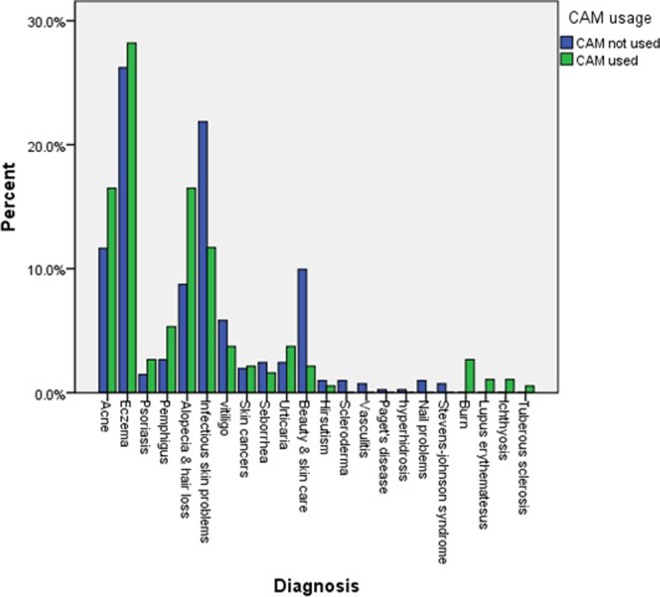
The objective of this study was to assess complementary and alternative medicine use and its related factors among Iranian dermatology outpatients. In this cross-sectional study, a self-structured questionnaire was administered to 600 dermatology outpatients. Mann-Whitney U test, chi-square test, and binary logistic regression test were used. A total of 188 (31.3%) patients had used one of complementary and alternative medicine methods. The most frequent method used was herbal medicine (89.9%). The mean years of duration of the skin condition were significantly higher in complementary and alternative medicine users compared with nonusers ( P = .037). Patients with acne and alopecia significantly used more complementary and alternative medicine (odds ratio: 2.48 and 3.19, respectively). There was a significant relationship between education and using complementary and alternative medicine ( P < .001). Complementary and alternative medicine use is prevalent among our patients and we should think of ways of educating general population about complementary and alternative medicine methods and their potential risks and benefits and encourage our health care workers to communicate these materials with their patients.
本研究的目的是评估伊朗皮肤科门诊患者使用补充和替代医学的情况及其相关因素。在这项横断面研究中,对600名皮肤科门诊患者进行了自行设计的问卷调查。采用曼-惠特尼U检验、卡方检验和二元逻辑回归检验。共有188名(31.3%)患者使用了补充和替代医学方法中的一种。最常用的方法是草药(89.9%)。与未使用者相比,补充和替代医学使用者的皮肤病平均病程显著更长(P = 0.037)。痤疮和脱发患者使用补充和替代医学的比例显著更高(优势比分别为2.48和3.19)。教育程度与使用补充和替代医学之间存在显著关系(P < 0.001)。补充和替代医学在我们的患者中很普遍,我们应该思考如何向普通人群宣传补充和替代医学方法及其潜在风险和益处,并鼓励我们的医护人员与患者交流这些信息。