Xiao Yao, Tong Man-Li, Liu Li-Li, Lin Li-Rong, Chen Mei-Jun, Zhang Hui-Lin, Zheng Wei-Hong, Li Shu-Lian, Lin Hui-Ling, Lin Zhi-Feng, Xing Hui-Qin, Niu Jian-Jun, Yang Tian-Ci
Zhongshan Hospital, Medical College of Xiamen University, Xiamen, 361004, China.
Xiamen Hospital of Traditional Chinese Medicine, Xiamen, 361009, China.
BMC Infect Dis. 2017 Apr 26;17(1):310. doi: 10.1186/s12879-017-2339-3.
Known predictors of neurosyphilis were mainly drawn from human immunodeficiency virus (HIV)-infected syphilis patients, which may not be applicable to HIV-negative populations as they have different characteristics, particularly those with neurological symptoms. This study aimed to identify novel predictors of HIV-negative symptomatic neurosyphilis (S-NS).
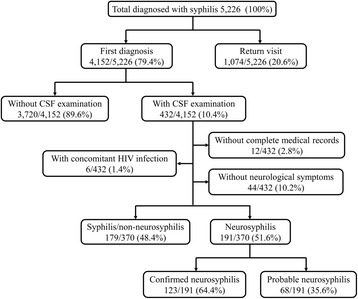
From June 2005 to June 2015, 370 HIV-negative syphilis patients with neurological symptoms were recruited, consisting of 191 S-NS patients (including 123 confirmed neurosyphilis and 68 probable neurosyphilis patients) and 179 syphilis/non-neurosyphilis (N-NS) patients. Clinical and laboratory characteristics of S-NS were compared with N-NS to identify factors predictive of S-NS. Serum rapid plasma reagin (RPR), Treponema pallidum particle agglutination (TPPA), and their parallel testing format for screening S-NS were evaluated.
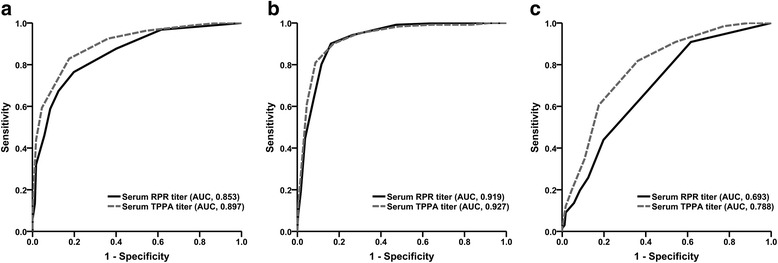
The likelihood of S-NS was positively associated with the serum RPR and TPPA titers. The serum TPPA titers performed better than the serum RPR titers in screening S-NS. The optimal cut-off points to recognize S-NS were serum RPR titer ≥1:4 and serum TPPA titer ≥1:2560 respectively. A parallel testing format of a serum RPR titer ≥1:2 and serum TPPA titer ≥1:1280 screened out 95.8% of S-NS and all confirmed cases of neurosyphilis. S-NS was independently associated with male sex, serum RPR titer ≥1:4, serum TPPA titer ≥1:2560, and elevated serum creatine kinase. Concurrence of these factors increased the likelihood of S-NS.
Quantitation of serum TPPA is worthwhile and performs better than serum RPR in screening S-NS. Serum RPR, serum TPPA, male sex, and serum creatine kinase can predict S-NS. Moreover, patients with both a serum RPR titer <1:2 and a serum TPPA titer <1:1280 have a low probability of S-NS, suggesting that it is reasonable to reduce lumbar punctures in such individuals.
已知的神经梅毒预测指标主要来自感染人类免疫缺陷病毒(HIV)的梅毒患者,由于HIV阴性人群具有不同特征,尤其是有神经症状的人群,这些指标可能不适用于他们。本研究旨在确定HIV阴性有症状神经梅毒(S-NS)的新预测指标。
2005年6月至2015年6月,招募了370例有神经症状的HIV阴性梅毒患者,其中包括191例S-NS患者(包括123例确诊神经梅毒和68例疑似神经梅毒患者)以及179例梅毒/非神经梅毒(N-NS)患者。比较S-NS与N-NS的临床和实验室特征,以确定S-NS的预测因素。评估了血清快速血浆反应素(RPR)、梅毒螺旋体颗粒凝集试验(TPPA)及其平行检测形式用于筛查S-NS的情况。
S-NS的可能性与血清RPR和TPPA滴度呈正相关。血清TPPA滴度在筛查S-NS方面比血清RPR滴度表现更好。识别S-NS的最佳截断点分别为血清RPR滴度≥1:4和血清TPPA滴度≥1:2560。血清RPR滴度≥1:2且血清TPPA滴度≥1:1280的平行检测形式筛查出了95.8%的S-NS患者以及所有确诊的神经梅毒病例。S-NS与男性、血清RPR滴度≥1:4、血清TPPA滴度≥1:2560以及血清肌酸激酶升高独立相关。这些因素同时存在会增加S-NS的可能性。
血清TPPA定量是有价值的,并且在筛查S-NS方面比血清RPR表现更好。血清RPR、血清TPPA、男性以及血清肌酸激酶可预测S-NS。此外,血清RPR滴度<1:2且血清TPPA滴度<1:1280的患者发生S-NS的概率较低,这表明在此类个体中减少腰椎穿刺是合理的。