Zou Huachun, Lu Zhen, Weng Wenjia, Yang Ligang, Yang Luoyao, Leng Xinying, Wang Junfeng, Lin Yi-Fan, Wu Jiaxin, Fu Leiwen, Zhang Xiaohui, Li Yuwei, Wang Liuyuan, Wu Xinsheng, Zhou Xinyi, Tian Tian, Huang Lixia, Marra Christina M, Yang Bin, Yang Tian-Ci, Ke Wujian
School of Public Health (Shenzhen), Sun Yat-sen University, Shenzhen, 518107, China.
Department of Dermatology, Beijing Youan Hospital, Capital Medical University, Beijing, 100012, China.
EClinicalMedicine. 2023 Jul 19;62:102080. doi: 10.1016/j.eclinm.2023.102080. eCollection 2023 Aug.
The ability to accurately identify the absolute risk of neurosyphilis diagnosis for patients with syphilis would allow preventative and therapeutic interventions to be delivered to patients at high-risk, sparing patients at low-risk from unnecessary care. We aimed to develop, validate, and evaluate the clinical utility of simplified clinical diagnostic models for neurosyphilis diagnosis in HIV-negative patients with syphilis.
We searched PubMed, China National Knowledge Infrastructure and UpToDate for publications about neurosyphilis diagnostic guidelines in English or Chinese from database inception until March 15, 2023. We developed and validated machine learning models with a uniform set of predictors based on six authoritative diagnostic guidelines across four continents to predict neurosyphilis using routinely collected data from real-world clinical practice in China and the United States (through the Dermatology Hospital of Southern Medical University in Guangzhou [659 recruited between August 2012 and March 2022, treated as Development cohort], the Beijing Youan Hospital of Capital Medical University in Beijng [480 recruited between December 2013 and April 2021, treated as External cohort 1], the Zhongshan Hospital of Xiamen University in Xiamen [493 recruited between November 2005 and November 2021, treated as External cohort 2] from China, and University of Washington School of Medicine in Seattle [16 recruited between September 2002 and April 2014, treated as External cohort 3] from United States). We included all these patients with syphilis into our analysis, and no patients were further excluded. We trained eXtreme gradient boosting (XGBoost) models to predict the diagnostic outcome of neurosyphilis according to each diagnostic guideline in two scenarios, respectively. Model performance was measured through both internal and external validation in terms of discrimination and calibration, and clinical utility was evaluated using decision curve analysis.
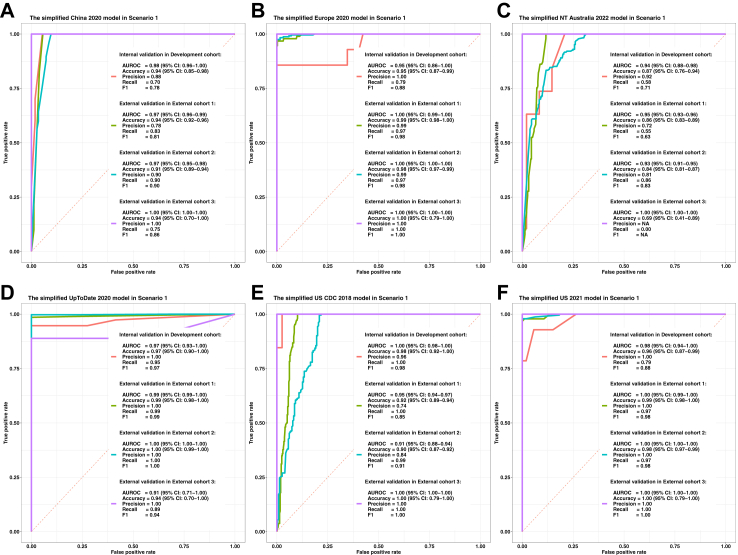
The final simplified clinical diagnostic models included neurological symptoms, cerebrospinal fluid (CSF) protein, CSF white blood cell, and CSF venereal disease research laboratory test/rapid plasma reagin. The models showed good calibration with rescaled Brier score of 0.99 (95% CI 0.98-1.00) and excellent discrimination (the minimum value of area under the receiver operating characteristic curve, 0.84; 95% CI 0.81-0.88) when externally validated. Decision curve analysis demonstrated that the models were useful across a range of neurosyphilis probability thresholds between 0.33 and 0.66 compared to the alternatives of managing all patients with syphilis as if they do or do not have neurosyphilis.
The simplified clinical diagnostic models comprised of readily available data show good performance, are generalisable across clinical settings, and have clinical utility over a broad range of probability thresholds. The models with a uniform set of predictors can simplify the sophisticated clinical diagnosis of neurosyphilis, and guide decisions on delivery of neurosyphilis health-care, ultimately, support accurate diagnosis and necessary treatment.
The Natural Science Foundation of China General Program, Health Appropriate Technology Promotion Project of Guangdong Medical Research Foundation, Department of Science and technology of Guangdong Province Xinjiang Rural Science and Technology(Special Commissioner)Project, Southern Medical University Clinical Research Nursery Garden Project, Beijing Municipal Administration of Hospitals Incubating Program.
准确识别梅毒患者神经梅毒诊断的绝对风险,有助于对高危患者进行预防和治疗干预,避免低风险患者接受不必要的治疗。我们旨在开发、验证和评估用于梅毒HIV阴性患者神经梅毒诊断的简化临床诊断模型的临床实用性。
我们检索了PubMed、中国知网和UpToDate,查找从数据库建立至2023年3月15日期间以英文或中文发表的关于神经梅毒诊断指南的文献。我们基于来自四大洲的六项权威诊断指南,使用统一的预测指标集开发并验证了机器学习模型,以利用在中国和美国真实世界临床实践中常规收集的数据预测神经梅毒(通过广州南方医科大学皮肤病医院[2012年8月至2022年3月招募659例,作为开发队列]、北京首都医科大学附属北京佑安医院[2013年12月至2021年4月招募480例,作为外部队列1]、厦门大学附属中山医院[2005年11月至2021年11月招募493例,作为外部队列2]以及美国西雅图华盛顿大学医学院[2002年9月至2014年4月招募16例,作为外部队列3])。我们将所有这些梅毒患者纳入分析,未进一步排除任何患者。我们分别在两种情况下根据每个诊断指南训练极端梯度提升(XGBoost)模型来预测神经梅毒的诊断结果。通过内部和外部验证,从区分度和校准度方面衡量模型性能,并使用决策曲线分析评估临床实用性。
最终的简化临床诊断模型包括神经症状、脑脊液(CSF)蛋白、CSF白细胞以及CSF性病研究实验室试验/快速血浆反应素。外部验证时,模型校准良好,重新调整后的Brier评分为0.99(95%CI 0.98 - 1.00),区分度出色(受试者工作特征曲线下面积最小值为0.84;95%CI 0.81 - 0.88)。决策曲线分析表明,与将所有梅毒患者都视为患有或未患有神经梅毒的替代方案相比,该模型在神经梅毒概率阈值介于0.33至0.66的范围内均有用。
由易于获取的数据组成的简化临床诊断模型表现良好,可在不同临床环境中推广,且在广泛的概率阈值范围内具有临床实用性。具有统一预测指标集的模型能够简化复杂的神经梅毒临床诊断,并指导神经梅毒医疗服务的决策,最终支持准确诊断和必要治疗。
国家自然科学基金面上项目、广东省医学科研基金卫生适宜技术推广项目、广东省科学技术厅新疆农村科技(特派员)项目、南方医科大学临床研究苗圃项目、北京市医院管理局孵化项目。