Jung Su Yon, Sobel Eric M, Papp Jeanette C, Zhang Zuo-Feng
Translational Sciences Section, Jonsson Comprehensive Cancer Center, School of Nursing, University of California Los Angeles, 700 Tiverton Ave, 3-264 Factor Building, Los Angeles, CA, 90095, USA.
Department of Human Genetics, David Geffen School of Medicine, University of California Los Angeles, Los Angeles, CA, USA.
BMC Cancer. 2017 Apr 26;17(1):290. doi: 10.1186/s12885-017-3284-7.
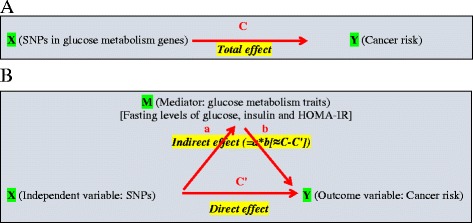
Impaired glucose metabolism-related genetic variants and traits likely interact with obesity and related lifestyle factors, influencing postmenopausal breast and colorectal cancer (CRC), but their interconnected pathways are not fully understood. By stratifying via obesity and lifestyles, we partitioned the total effect of glucose metabolism genetic variants on cancer risk into two putative mechanisms: 1) indirect (risk-associated glucose metabolism genetic variants mediated by glucose metabolism traits) and 2) direct (risk-associated glucose metabolism genetic variants through pathways other than glucose metabolism traits) effects.
Using 16 single-nucleotide polymorphisms (SNPs) associated with glucose metabolism and data from 5379 postmenopausal women in the Women's Health Initiative Harmonized and Imputed Genome-Wide Association Studies, we retrospectively assessed the indirect and direct effects of glucose metabolism-traits (fasting glucose, insulin, and homeostatic model assessment-insulin resistance [HOMA-IR]) using two quantitative tests.
Several SNPs were associated with breast cancer and CRC risk, and these SNP-cancer associations differed between non-obese and obese women. In both strata, the direct effect of cancer risk associated with the SNP accounted for the majority of the total effect for most SNPs, with roughly 10% of cancer risk due to the SNP that was from an indirect effect mediated by glucose metabolism traits. No apparent differences in the indirect (glucose metabolism-mediated) effects were seen between non-obese and obese women. It is notable that among obese women, 50% of cancer risk was mediated via glucose metabolism trait, owing to two SNPs: in breast cancer, in relation to GCKR through glucose, and in CRC, in relation to DGKB/TMEM195 through HOMA-IR.
Our findings suggest that glucose metabolism genetic variants interact with obesity, resulting in altered cancer risk through pathways other than those mediated by glucose metabolism traits.
与葡萄糖代谢受损相关的基因变异和特征可能与肥胖及相关生活方式因素相互作用,影响绝经后乳腺癌和结直肠癌(CRC),但其相互关联的途径尚未完全明确。通过根据肥胖和生活方式进行分层,我们将葡萄糖代谢基因变异对癌症风险的总体影响分为两种假定机制:1)间接(由葡萄糖代谢特征介导的与风险相关的葡萄糖代谢基因变异)和2)直接(通过葡萄糖代谢特征以外的途径与风险相关的葡萄糖代谢基因变异)效应。
利用与葡萄糖代谢相关的16个单核苷酸多态性(SNP)以及来自女性健康倡议协调和推算全基因组关联研究中5379名绝经后女性的数据,我们使用两种定量测试回顾性评估了葡萄糖代谢特征(空腹血糖、胰岛素和稳态模型评估-胰岛素抵抗[HOMA-IR])的间接和直接效应。
几个SNP与乳腺癌和CRC风险相关,且这些SNP与癌症的关联在非肥胖和肥胖女性中有所不同。在两个分层中,与SNP相关的癌症风险直接效应在大多数SNP的总效应中占主导,约10%的癌症风险是由葡萄糖代谢特征介导的间接效应导致的SNP引起的。非肥胖和肥胖女性之间在间接(葡萄糖代谢介导)效应方面未观察到明显差异。值得注意的是,在肥胖女性中,50%的癌症风险是通过葡萄糖代谢特征介导的,这归因于两个SNP:在乳腺癌中,通过葡萄糖与GCKR相关;在CRC中,通过HOMA-IR与DGKB/TMEM195相关。
我们的研究结果表明,葡萄糖代谢基因变异与肥胖相互作用,通过葡萄糖代谢特征以外的途径导致癌症风险改变。