Ho Jean K, Nation Daniel A
Department of Psychology, University of Southern California, 3620 South McClintock Avenue, SGM 1010, Los Angeles, CA, 90089-1061, USA.
Alzheimers Res Ther. 2017 Apr 26;9(1):33. doi: 10.1186/s13195-017-0255-9.
Prior work suggests that some but not all antihypertensive treatments may benefit cognition and risk for Alzheimer's disease, independent of stroke. Angiotensin II receptor blockers (ARBs) have been highlighted as one antihypertensive drug class that may confer greatest benefit.
The participants comprised 1626 nondemented adults, aged 55-91 years, recruited from Alzheimer's Disease Neuroimaging Initiative sites. Three groups were compared: ARB users (HTN-ARBs), other antihypertensive drug users (HTN-Other), and normotensives. In post hoc analyses, we also examined (1) users of ARBs and angiotensin-converting enzyme inhibitors (ACEIs), (2) users of blood-brain barrier (BBB)-crossing ARBs and users of non-BBB-crossing ARBs, and (3) users of BBB-crossing ARBs and ACEIs (BBB crossers) and users of non-BBB-crossing ARBs and ACEIs (BBB noncrossers). Groups were compared regarding cognition and magnetic resonance imaging measures of brain volume and white matter hyperintensities (WMH), using analysis of covariance and multilevel models.
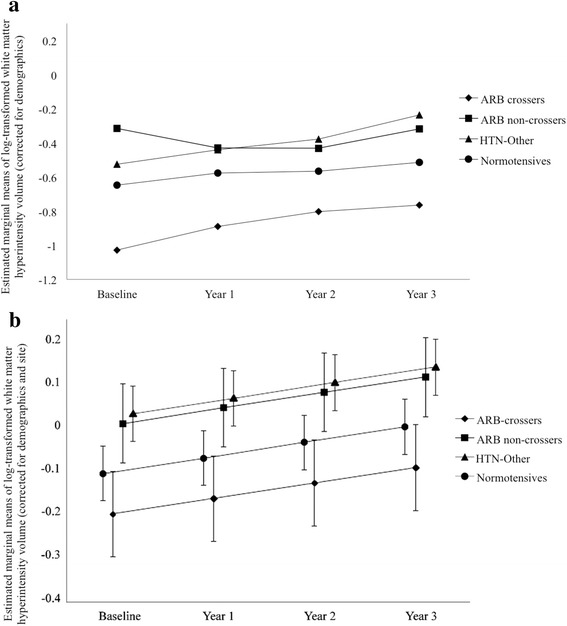
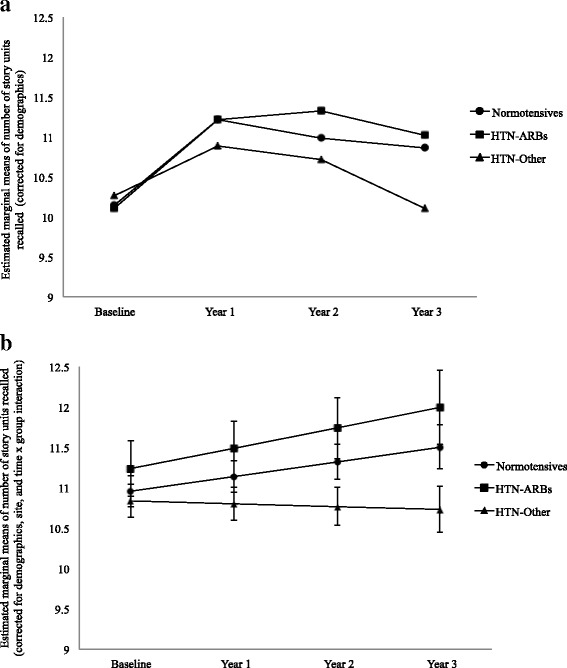
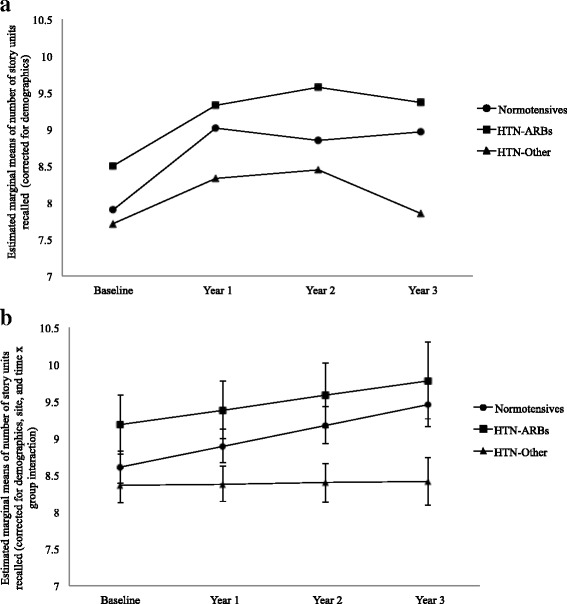
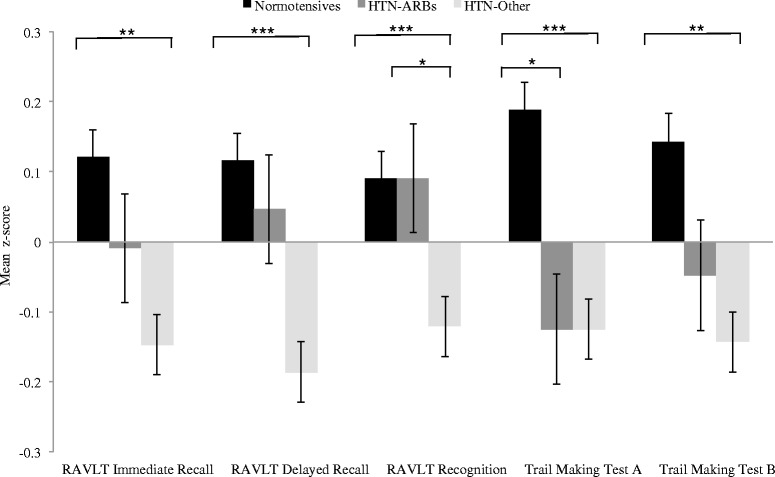
At baseline, the HTN-Other group performed worse than normotensives on Rey Auditory Verbal Learning Test (RAVLT) Immediate Recall (p = 0.002), Delayed Recall (p < 0.001), Recognition Memory (p = 0.001), and Trails A (p < 0.001) and B (p = 0.01). ARB users performed better than the HTN-Other group on Recognition Memory (p = 0.04) and worse than normotensives on Trails A (p = 0.04). The HTN-Other group performed worse than normotensives on Logical Memory Immediate (p = 0.02) and Delayed Recall over the 3-year follow-up (p = 0.007). Over the follow-up period, those taking BBB-crossing ARBs performed better than the HTN-Other group on AVLT Delayed Recall (p = 0.04), Logical Memory Immediate (p = 0.02), and Delayed Recall (p = 0.05). They also had fewer WMH than the HTN-Other group (p = 0.008) and those taking non-BBB-crossing ARBs (p = 0.05). There were no group differences in brain volume. Users of BBB-crossing medications (ARBs or ACEIs) showed better performance on AVLT Delayed Recall over time than all other groups, including normotensives (all p < 0.01), and had less WMH volume over time than the BBB noncrossers group (p = 0.03), although they had more WMH volume than normotensives (p = 0.01). The BBB noncrossers group performed worse than normotensives on Logical Memory Delayed Recall over time (p = 0.01), but the BBB crossers group was not significantly different (p = 0.13).
Hypertensive participants demonstrated worse baseline memory and executive function, as well as greater memory decline, over the 3-year follow-up than normotensives, unless they were ARB users, who showed preserved memory compared with those taking other antihypertensive drugs. Users of BBB-crossing ARBs showed superior memory performance over time compared with other antihypertensive drug users and had less WMH volume. Users of BBB-crossing medications (ARBs or ACEIs) showed better list-learning memory performance over time than all other groups, including normotensives, and had less WMH volume over time than users of non-BBB-crossing medications. These findings demonstrate that ARBs, especially those of the BBB-crossing variety, are associated with greater memory preservation and less WMH volume than other antihypertensive medications.
先前的研究表明,部分但并非所有的降压治疗可能有益于认知功能,并降低患阿尔茨海默病的风险,且与中风无关。血管紧张素II受体阻滞剂(ARB)被视为可能带来最大益处的一类降压药物。
研究参与者为1626名年龄在55 - 91岁之间的非痴呆成年人,他们来自阿尔茨海默病神经影像学倡议项目的各个站点。研究比较了三组人群:ARB使用者(高血压 - ARB组)、其他降压药物使用者(高血压 - 其他组)和血压正常者。在事后分析中,我们还考察了:(1)ARB和血管紧张素转换酶抑制剂(ACEI)的使用者;(2)可穿越血脑屏障(BBB)的ARB使用者和不可穿越血脑屏障的ARB使用者;(3)可穿越血脑屏障的ARB和ACEI使用者(BBB穿越者)以及不可穿越血脑屏障的ARB和ACEI使用者(BBB非穿越者)。通过协方差分析和多水平模型,比较了各组在认知功能以及脑容量和白质高信号(WMH)的磁共振成像测量方面的差异。
在基线时,高血压 - 其他组在雷伊听觉词语学习测验(RAVLT)的即时回忆(p = 0.002)、延迟回忆(p < 0.001)、识别记忆(p = 0.001)以及连线测验A(p < 0.001)和B(p = 0.01)上的表现均不如血压正常者。ARB使用者在识别记忆方面的表现优于高血压 - 其他组(p = 0.04),而在连线测验A上的表现比血压正常者差(p = 0.04)。在为期3年的随访中,高血压 - 其他组在逻辑记忆即时回忆(p = 0.02)和延迟回忆(p = 0.007)方面的表现不如血压正常者。在随访期间,服用可穿越血脑屏障的ARB的人群在AVLT延迟回忆(p = 0.04)、逻辑记忆即时回忆(p = 0.02)和延迟回忆(p = 0.05)方面的表现优于高血压 - 其他组。他们的WMH也比高血压 - 其他组(p = 0.008)和服用不可穿越血脑屏障的ARB的人群(p = 0.05)少。各组在脑容量方面无差异。随着时间推移,服用可穿越血脑屏障药物(ARB或ACEI)的人群在AVLT延迟回忆方面的表现优于包括血压正常者在内的所有其他组(所有p < 0.01),且随着时间推移,其WMH体积比BBB非穿越者组少(p = 0.03),尽管他们的WMH体积比血压正常者多(p = 0.01)。随着时间推移,BBB非穿越者组在逻辑记忆延迟回忆方面的表现比血压正常者差(p = 0.01),但BBB穿越者组无显著差异(p = 0.13)。
高血压参与者在基线时的记忆和执行功能较差,且在为期3年的随访中,其记忆衰退程度比血压正常者更严重,除非他们是ARB使用者,与服用其他降压药物的人群相比,ARB使用者的记忆功能得以保留。与其他降压药物使用者相比,服用可穿越血脑屏障的ARB的人群随着时间推移表现出更优的记忆性能,且WMH体积更小。随着时间推移,服用可穿越血脑屏障药物(ARB或ACEI)的人群在列表学习记忆方面的表现优于包括血压正常者在内的所有其他组,且随着时间推移,其WMH体积比服用不可穿越血脑屏障药物的人群少。这些发现表明,与其他降压药物相比,ARB,尤其是可穿越血脑屏障的ARB,与更好的记忆保留和更少的WMH体积相关。