Zinsou Cyprien, Cherifath Adjibabi Bello
Association Beninoise pour le Marketing Social, Lot 919 Immeuble Montcho, Sikecodji, Cotonou, Republic of Benin.
Programme National de Lutte contre le Paludisme, Ministère de la Santé, Cotonou, Benin.
Malar J. 2017 Apr 26;16(1):174. doi: 10.1186/s12936-017-1808-x.
Since 2004, artemisinin-based combination therapy (ACT) has been the first-line treatment for uncomplicated malaria in Benin. In 2016, a medicine outlet survey was implemented to investigate the availability, price, and market share of anti-malarial treatment and malaria diagnostics. Results provide a timely and important benchmark to measure future interventions aimed at increasing access to quality malaria case management services.
Between July 5th to August 6th 2016, a cross sectional, nationally-representative malaria outlet survey was conducted in Benin. A census of all public and private outlets with potential to distribute malaria testing and/or treatment was implemented among 30 clusters (arrondissements). Outlets were eligible for inclusion in the study if they met at least one of three study criteria: (1) one or more anti-malarials reportedly in stock on the day of the survey; (2) one or more anti-malarials reportedly in stock within the 3 months preceding the survey; and/or (3) provided malaria blood testing. An audit was completed for all anti-malarials, malaria rapid diagnostic tests (RDT) and microscopy.
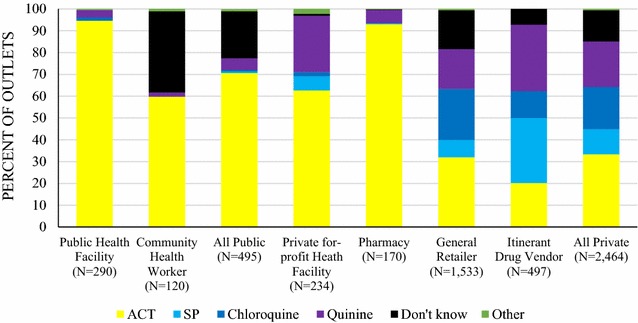
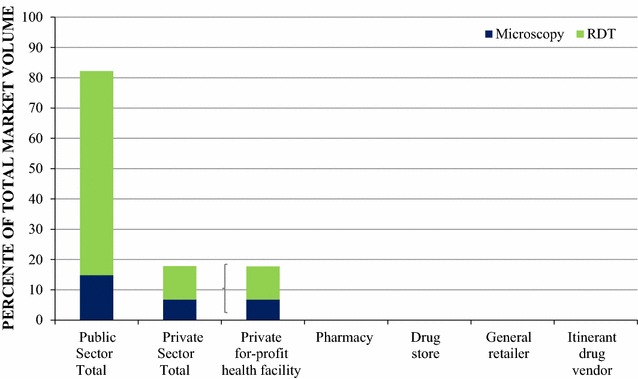
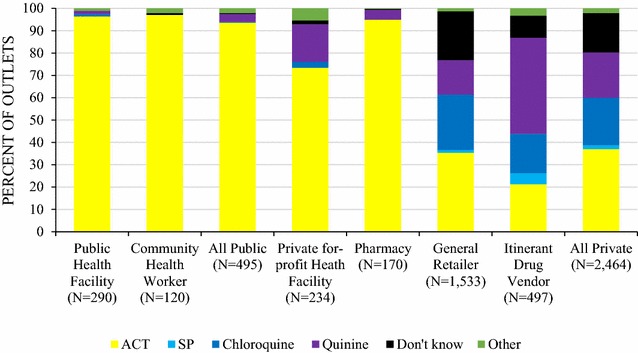
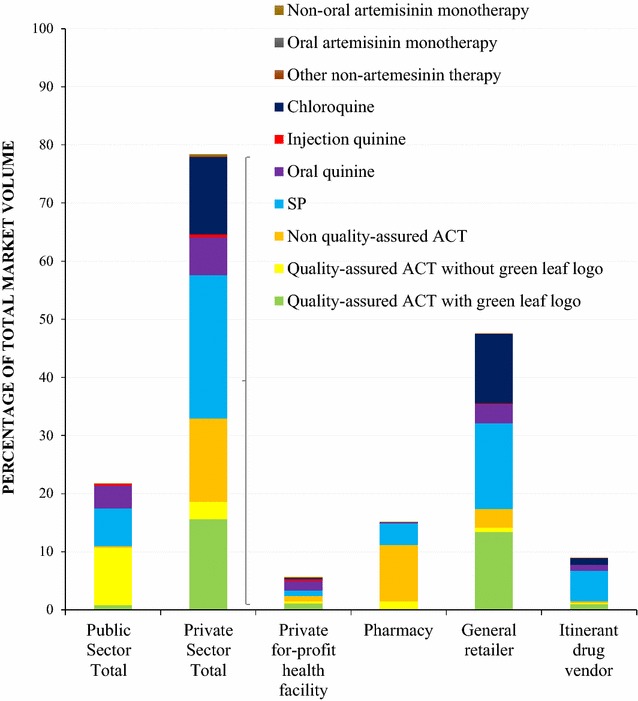
7260 outlets with the potential to sell or distribute anti-malarials were included in the census and 2966 were eligible and interviewed. A total of 17,669 anti-malarial and 494 RDT products were audited. Quality-assured ACT was available in 95.0% of all screened public health facilities and 59.4% of community health workers (CHW), and availability of malaria blood testing was 94.7 and 68.4% respectively. Sulfadoxine-pyrimethamine (SP) was available in 73.9% of public health facilities and not found among CHWs. Among private-sector outlets stocking at least one anti-malarial, non-artemisinin therapies were most commonly available (94.0% of outlets) as compared to quality-assured ACT (36.1%). 31.3% of the ACTs were marked with a "green leaf" logo, suggesting leakage of a co-paid ACT into Benin's unsubsidized ACT market from another country. 78.5% of the anti-malarials distributed were through the private sector, typically through general retailers (47.6% of all anti-malarial distribution). ACT comprised 44% of the private anti-malarial market share. Private-sector price of quality-assured ACT ($1.35) was three times more expensive than SP ($0.42) or chloroquine ($0.41). Non-artemisinin therapies were cited as the most effective treatment for uncomplicated malaria among general retailers and itinerant drug vendors.
The ACTwatch data has shown the importance of the private sector in terms of access to malaria treatment for the majority of the population in Benin. These findings highlight the need for increased engagement with the private sector to improve malaria case management and an immediate need for a national ACT subsidy.
自2004年以来,以青蒿素为基础的联合疗法(ACT)一直是贝宁单纯性疟疾的一线治疗方法。2016年,开展了一项药品销售点调查,以调查抗疟治疗药物和疟疾诊断检测的可及性、价格及市场份额。研究结果为衡量未来旨在增加优质疟疾病例管理服务可及性的干预措施提供了及时且重要的基准。
2016年7月5日至8月6日,在贝宁开展了一项具有全国代表性的疟疾销售点横断面调查。在30个行政区对所有有潜力分发疟疾检测和/或治疗药物 的公共和私人销售点进行普查统计。若销售点符合以下三项研究标准中的至少一项,则有资格纳入研究:(1)据报告在调查当天有 一种或多种抗疟药库存;(2)据报告在调查前3个月内有 一种或多种抗疟药库存;和/或(3)提供疟疾血液检测服务。对所有抗疟药、疟疾快速诊断检测试剂(RDT)和显微镜进行了审查。
普查统计了7260个有潜力销售或分发抗疟药的销售点,其中2966个符合条件并接受了访谈。共审查了17669种抗疟药和494种RDT产品。在所有筛查的公共卫生机构中,95.0% 可提供质量有保证的ACT,社区卫生工作者中有59.4% 可提供;疟疾血液检测服务的可及率分别为94.7% 和68.4%。73.9% 的公共卫生机构有磺胺多辛-乙胺嘧啶(SP),社区卫生工作者处未发现。在至少储备了一种抗疟药的私营销售点中,非青蒿素疗法最为常见(占销售点的94.0%),而质量有保证的ACT占36.1%。31.3% 的ACT标有“绿叶”标志,这表明有共同支付的ACT从另一个国家流入贝宁未获补贴的ACT市场。分发的抗疟药中有78.5% 通过私营部门,通常是通过普通零售商(占所有抗疟药分发的47.6%)。ACT占私营抗疟药市场份额的44%。质量有保证的ACT在私营部门的价格(1.35美元)是SP(0.42美元)或氯喹(0.41美元)的三倍。普通零售商和流动药贩认为非青蒿素疗法是治疗单纯性疟疾最有效的方法。
ACTwatch数据表明,私营部门在贝宁大多数人口获取疟疾治疗方面具有重要意义。这些发现凸显了加强与私营部门合作以改善疟疾病例管理的必要性,以及立即实施国家ACT补贴的紧迫性。