Titre-Johnson Siobhan, Schoeler Natasha, Eltze Christin, Williams Ruth, Vezyroglou Katharina, McCullagh Helen, Freemantle Nick, Heales Simon, Kneen Rachel, Marston Louise, Martland Tim, Nazareth Irwin, Neal Elizabeth, Lux Andrew, Parker Alasdair, Agrawal Shakti, Fallon Penny, Cross J Helen
UCL Great Ormond Street Institute of Child Health, London, UK.
Great Ormond Street Hospital, London, UK.
Trials. 2017 Apr 26;18(1):195. doi: 10.1186/s13063-017-1918-3.
The incidence of epilepsy is greatest in the first 2 years of life, an age group where there is generally a poor prognosis for both seizure control and neurodevelopmental outcome. Early control of seizures can be associated with better developmental outcome but many of the epilepsies presenting in infancy are poorly responsive to antiepileptic medication. The ketogenic diet (KD) is a high-fat, low-carbohydrate diet designed to mimic the effects of starvation on the body. Dietary fat is converted into ketones in the body and used as an energy source by the brain. The KD has been shown to be successful in controlling seizures in many observational studies, and in two randomised controlled trials (RCTs) in older children. However, little evidence is available in the very young.
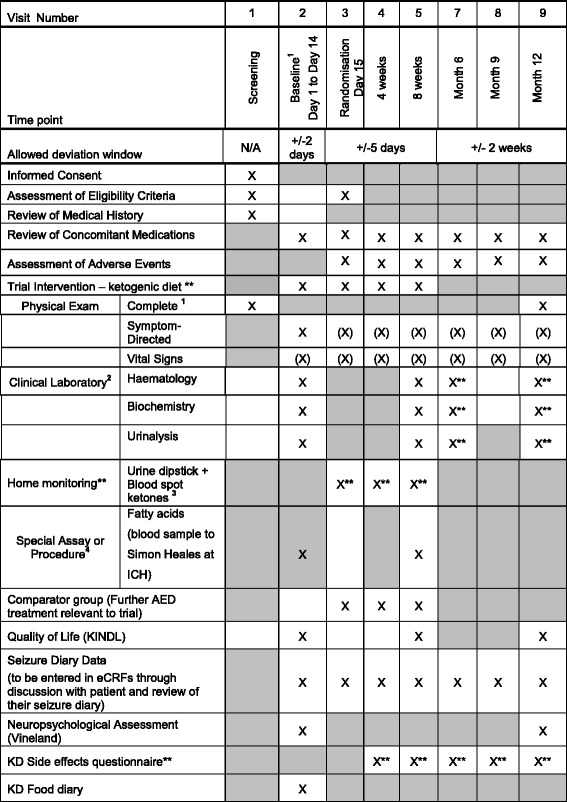
METHODS/DESIGN: An open-label RCT where eligible children (age 3 months to 2 years with epilepsy who have failed two antiepileptic drugs (AEDs)) undergo baseline assessment, including medical and seizure history. Participants then start an observation period (7 or 14 days) with documentation of seizure frequency. Randomisation will occur on day 8 or day 15 to receive the KD or a further AED; the allocated treatment will commence on day 15, with instruction and training. A second assessment (4 weeks after start of treatment) will include a clinical review and tolerability questionnaire (modified Hague Scale of Side Effects - for those allocated to the KD group). Assessments will be repeated at 8 weeks after the start of treatment including biochemical investigations, after which, according to patient response, KD (diet group) or AED (standard AED group) will then be continued or changed. Those in the AED group who have failed to achieve seizure control at the 8-week assessment will then be offered KD outside the context of the trial. Those in the KD arm who fail to achieve seizure control will be changed to standard clinical management. All patients will be followed up for 12 months from randomisation for retention, seizure outcome, quality of life and neurodevelopmental status.
The slow rate of recruitment is an ongoing practical issue. There is a limitation to the number of eligible patients compared to what was predicted, mainly due to the nature of this patient group. After a substantial amendment to widen inclusion criteria and reduce the baseline period to 7 days for patients with a high seizure burden, the rate of recruitment steadily increased. A number of operational concerns regarding dietetic time were also highlighted impacting on the recruitment rate. However, the combination of a low dropout rate and the opening of further centres, the trial should successfully meet the final recruitment target. All nine centres are now recruiting and we hope to open further centres within the UK.
ClinicalTrials.gov, identifier: NCT02205931 . Registered on 16 December 2013.
癫痫发病率在生命的头两年最高,而这个年龄组在癫痫发作控制和神经发育结局方面总体预后较差。早期控制癫痫发作可能与更好的发育结局相关,但许多婴儿期出现的癫痫对抗癫痫药物反应不佳。生酮饮食(KD)是一种高脂肪、低碳水化合物饮食,旨在模拟饥饿对身体的影响。膳食脂肪在体内转化为酮,被大脑用作能量来源。在许多观察性研究以及两项针对大龄儿童的随机对照试验(RCT)中,生酮饮食已被证明能成功控制癫痫发作。然而,对于非常年幼的儿童,相关证据很少。
方法/设计:一项开放标签的随机对照试验,符合条件的儿童(年龄3个月至2岁,患有癫痫且两种抗癫痫药物(AEDs)治疗失败)接受基线评估,包括病史和癫痫发作史。参与者随后开始为期7或14天的观察期,记录癫痫发作频率。在第8天或第15天进行随机分组,以接受生酮饮食或另一种抗癫痫药物;分配的治疗将在第15天开始,并给予指导和培训。第二次评估(治疗开始后4周)将包括临床复查和耐受性问卷(改良的海牙副作用量表 - 适用于分配到生酮饮食组的患者)。在治疗开始后8周重复评估,包括生化检查,之后根据患者反应,生酮饮食组(饮食组)或抗癫痫药物组(标准抗癫痫药物组)将继续治疗或更换治疗方案。在8周评估时未实现癫痫发作控制的抗癫痫药物组患者将在试验范围外接受生酮饮食。生酮饮食组中未实现癫痫发作控制的患者将改为标准临床管理。所有患者将从随机分组开始随访12个月,以了解留存情况、癫痫发作结局、生活质量和神经发育状况。
招募速度缓慢是一个持续存在的实际问题。与预期相比,符合条件的患者数量有限,主要是由于该患者群体的性质。在大幅修订以扩大纳入标准并将癫痫发作负担高的患者的基线期缩短至7天后,招募速度稳步提高。还强调了一些与饮食时间有关的操作问题,这些问题影响了招募速度。然而,由于低退出率以及更多中心的开放,该试验应能成功达到最终招募目标。所有九个中心目前都在招募患者,我们希望在英国境内开设更多中心。
ClinicalTrials.gov,标识符:NCT02205931。于2013年12月16日注册。