
血糖波动平均幅度及血管内皮功能障碍对非糖尿病冠心病患者心血管事件的影响
Effects of the Mean Amplitude of Glycemic Excursions and Vascular Endothelial Dysfunction on Cardiovascular Events in Nondiabetic Patients With Coronary Artery Disease.
作者信息
Akasaka Tomonori, Sueta Daisuke, Tabata Noriaki, Takashio Seiji, Yamamoto Eiichiro, Izumiya Yasuhiro, Tsujita Kenichi, Kojima Sunao, Kaikita Koichi, Matsui Kunihiko, Hokimoto Seiji
机构信息
Department of Cardiovascular Medicine, Graduate School of Medical Sciences, Kumamoto University, Kumamoto, Japan.
Department of Cardiovascular Medicine, Graduate School of Medical Sciences, Kumamoto University, Kumamoto, Japan
出版信息
J Am Heart Assoc. 2017 Apr 26;6(5):e004841. doi: 10.1161/JAHA.116.004841.
BACKGROUND
Mean amplitude of glycemic excursion (MAGE) is commonly used to gauge the degree of glucose level fluctuations. MAGE plays a significant role in vascular endothelial dysfunction and cardiovascular events in patients with diabetes mellitus (DM), but its significance is not clear in non-DM patients. Thus, we examined the impact of MAGE and vascular endothelial dysfunction on clinical outcomes in non-DM patients with coronary artery disease.
METHODS AND RESULTS
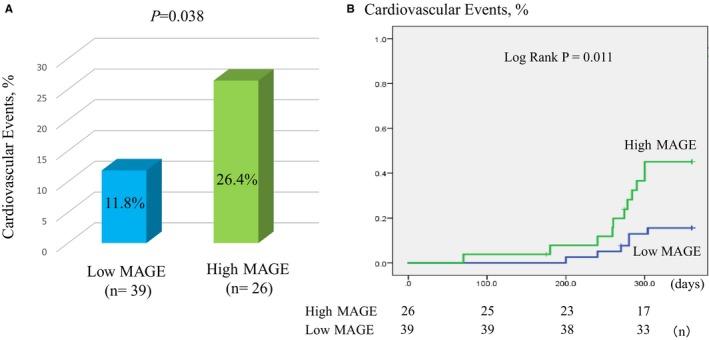
We followed non-DM patients (n=65) for 12 months who underwent percutaneous coronary intervention and assessed the relationship among MAGE, reactive hyperemia index (RHI) measured by reactive hyperemia peripheral arterial tonometry as endothelial function, and cardiovascular events. Cardiovascular events analyzed were cardiovascular death, myocardial infarction, unstable angina, and revascularizations. Compared with patients with MAGE <65 mg/dL (normal glycemic excursions), the group with MAGE ≥65 mg/dL (high glycemic excursions) had significantly higher high-sensitivity C-reactive protein (0.10±0.11 mg/dL versus 0.18±0.13 mg/dL, =0.006) and lower RHI (0.64±0.21 versus 0.51±0.22, =0.035). The multivariable analysis identified high MAGE and low RHI (≤0.56) as risk factors associated with cardiovascular events (hazard ratio, 5.6; 95% RI, 1.72-18.4 [=0.004] versus hazard ratio, 4.5; 95% RI, 1.37-14.9 [=0.013]). When the prognosis was classified by combination with MAGE and RHI, the incidence of cardiovascular events was 46.7% (high MAGE+low RHI), 26.7% (high MAGE+high RHI), 20.0% (low MAGE+low RHI), and 6.6% (low MAGE+high RHI) in descending order (=0.014). Receiver operating characteristic curve analysis revealed that MAGE, RHI, and MAGE+RHI were each associated with cardiovascular events (area under the curve 0.780, 0.727, and 0.796, respectively).
CONCLUSIONS
MAGE was associated with cardiovascular events in non-DM patients with coronary artery disease. Furthermore, the combination with MAGE and RHI was useful for further subdivision of the risk of cardiovascular events.
背景
血糖波动幅度均值(MAGE)常用于衡量血糖水平波动程度。MAGE在糖尿病(DM)患者的血管内皮功能障碍和心血管事件中起重要作用,但在非DM患者中的意义尚不清楚。因此,我们研究了MAGE和血管内皮功能障碍对非DM冠心病患者临床结局的影响。
方法与结果
我们对65例接受经皮冠状动脉介入治疗的非DM患者进行了12个月的随访,评估了MAGE、通过反应性充血外周动脉张力测定法测量的反应性充血指数(RHI)作为内皮功能以及心血管事件之间的关系。分析的心血管事件包括心血管死亡、心肌梗死、不稳定型心绞痛和血运重建。与MAGE<65mg/dL(正常血糖波动)的患者相比,MAGE≥65mg/dL(高血糖波动)组的高敏C反应蛋白显著更高(0.10±0.11mg/dL对0.18±0.13mg/dL,P=0.006),RHI更低(0.64±0.21对0.51±0.22,P=0.035)。多变量分析确定高MAGE和低RHI(≤0.56)是与心血管事件相关的危险因素(风险比,5.6;95%置信区间,1.72-18.4[P=0.004],而风险比,4.5;95%置信区间,1.37-14.9[P=0.013])。当根据MAGE和RHI的组合对预后进行分类时,心血管事件的发生率按降序排列分别为46.7%(高MAGE+低RHI)、26.7%(高MAGE+高RHI)、20.0%(低MAGE+低RHI)和6.6%(低MAGE+高RHI)(P=0.014)。受试者工作特征曲线分析显示,MAGE、RHI和MAGE+RHI均与心血管事件相关(曲线下面积分别为0.780、0.727和0.796)。
结论
MAGE与非DM冠心病患者的心血管事件相关。此外,MAGE和RHI的组合有助于进一步细分心血管事件风险。



 Zotero 插件