Community Environmental Health Program, College of Pharmacy, University of New Mexico Health Sciences Center, 1000 Stanford Drive NE, MSC095360, Albuquerque, NM, 87131-0001, USA.
Curr Environ Health Rep. 2017 Jun;4(2):130-141. doi: 10.1007/s40572-017-0140-5.
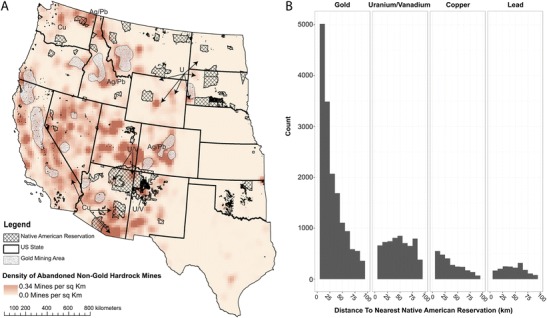
More than a century of hard rock mining has left a legacy of >160,000 abandoned mines in the Western USA that are home to the majority of Native American lands. This article describes how abrogation of treaty rights, ineffective policies, lack of infrastructure, and a lack of research in Native communities converge to create chronic exposure, ill-defined risks, and tribal health concerns.
Recent results show that Native Americans living near abandoned uranium mines have an increased likelihood for kidney disease and hypertension, and an increased likelihood of developing multiple chronic diseases linked to their proximity to the mine waste and activities bringing them in contact with the waste. Biomonitoring confirms higher than expected exposure to uranium and associated metals in the waste in adults, neonates, and children in these communities. These sites will not be cleaned up for many generations making it critical to understand and prioritize exposure-toxicity relationships in Native populations to appropriately allocate limited resources to protect health. Recent initiatives, in partnership with Native communities, recognize these needs and support development of tribal research capacity to ensure that research respectful of tribal culture and policies can address concerns in the future. In addition, recognition of the risks posed by these abandoned sites should inform policy change to protect community health in the future.
综述目的: 一个多世纪以来的硬岩采矿在美西地区留下了超过 16 万座废弃矿山,而这些矿山主要位于美国原住民土地上。本文描述了如何通过废弃条约权利、无效政策、缺乏基础设施以及原住民社区缺乏研究等因素,导致慢性暴露、风险界定不清以及部落健康问题。
最新发现: 最近的研究结果表明,生活在废弃铀矿附近的美国原住民患肾病和高血压的可能性更高,而且由于接近矿渣和与之接触的活动,他们患多种与矿渣相关的慢性疾病的可能性也更高。生物监测证实,这些社区的成年人、新生儿和儿童的尿液中铀和相关金属的暴露水平高于预期。这些矿渣在未来数代人都不会得到清理,因此,了解和优先考虑原住民群体中的暴露-毒性关系,以适当分配有限的资源来保护健康,这一点至关重要。最近的一些举措与原住民社区合作,承认了这些需求,并支持部落研究能力的发展,以确保未来的研究能够尊重部落文化和政策,解决相关问题。此外,认识到这些废弃场所带来的风险,应该为未来的社区健康政策变化提供信息。