Medical Research Council Population Health Research Unit, Nuffield Department of Population Health, University of Oxford, Oxford, UK.
Clinical Trial Service Unit and Epidemiological Studies Unit, Nuffield Department of Population Health, University of Oxford, Oxford, UK.
Int J Epidemiol. 2017 Oct 1;46(5):1444-1455. doi: 10.1093/ije/dyx042.
Higher fruit consumption is associated with lower risk of cardiovascular disease (CVD). Substantial uncertainties remain, however, about the associations of fruit consumption with all-cause mortality and mortality from subtypes of CVD and major non-vascular diseases, especially in China.
In 2004-08, the nationwide China Kadoorie Biobank Study recruited > 0.5 million adults aged 30-79 years from 10 diverse localities in China. Fresh fruit consumption was estimated using an interviewer-administered electronic questionnaire, and mortality data were collected from death registries. Among the 462 342 participants who were free of major chronic diseases at baseline, 17 894 deaths were recorded during ∼ 7 years of follow-up. Cox regression yielded adjusted rate ratios (RRs) for all-cause and cause-specific mortality associated with fruit consumption.
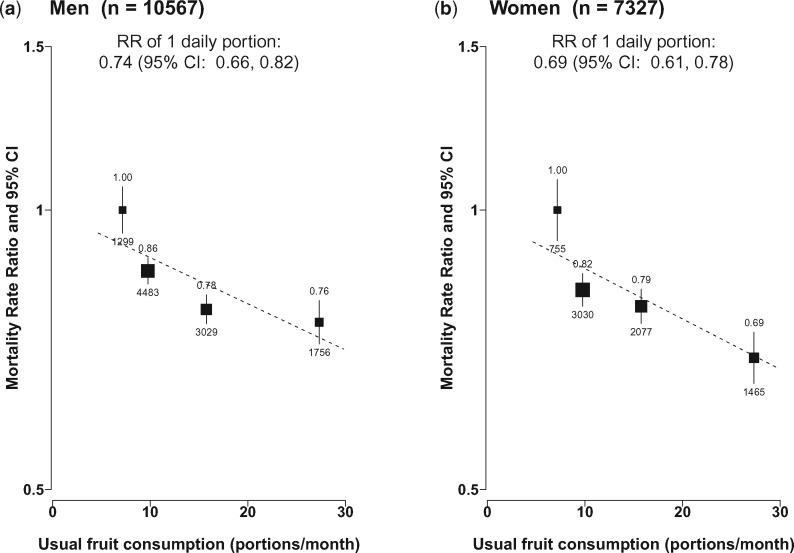
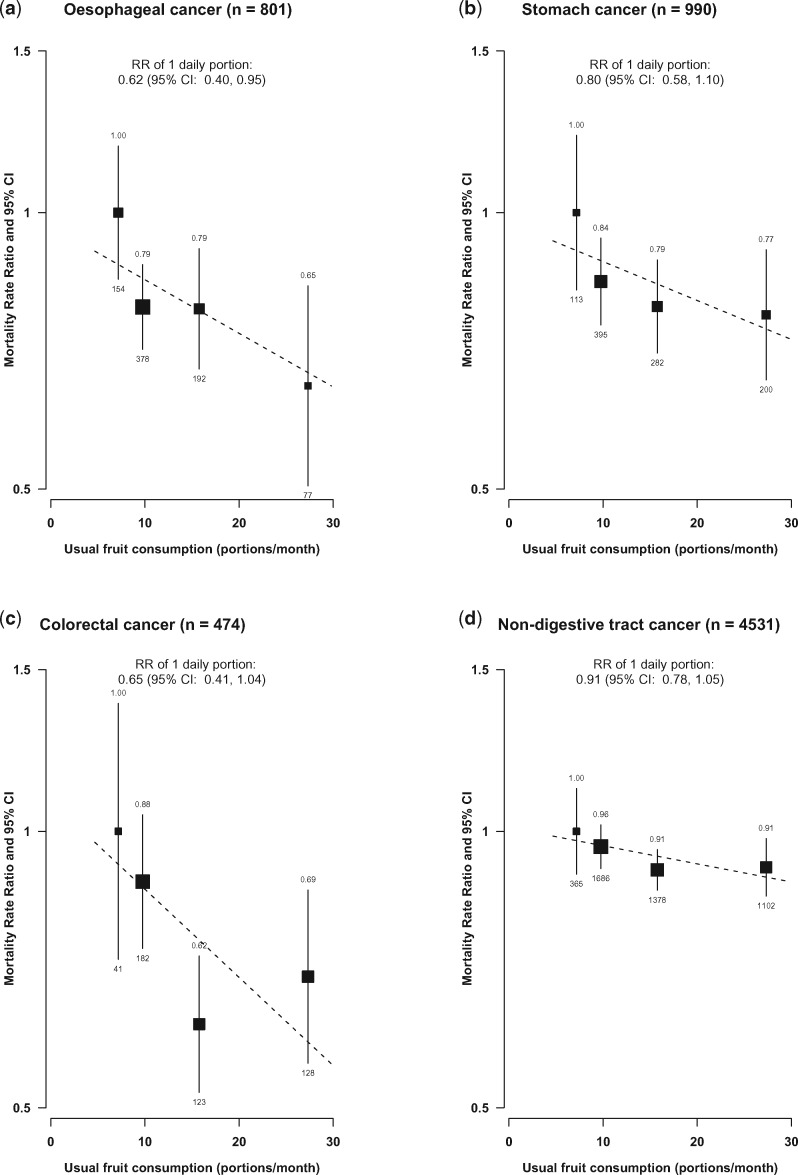
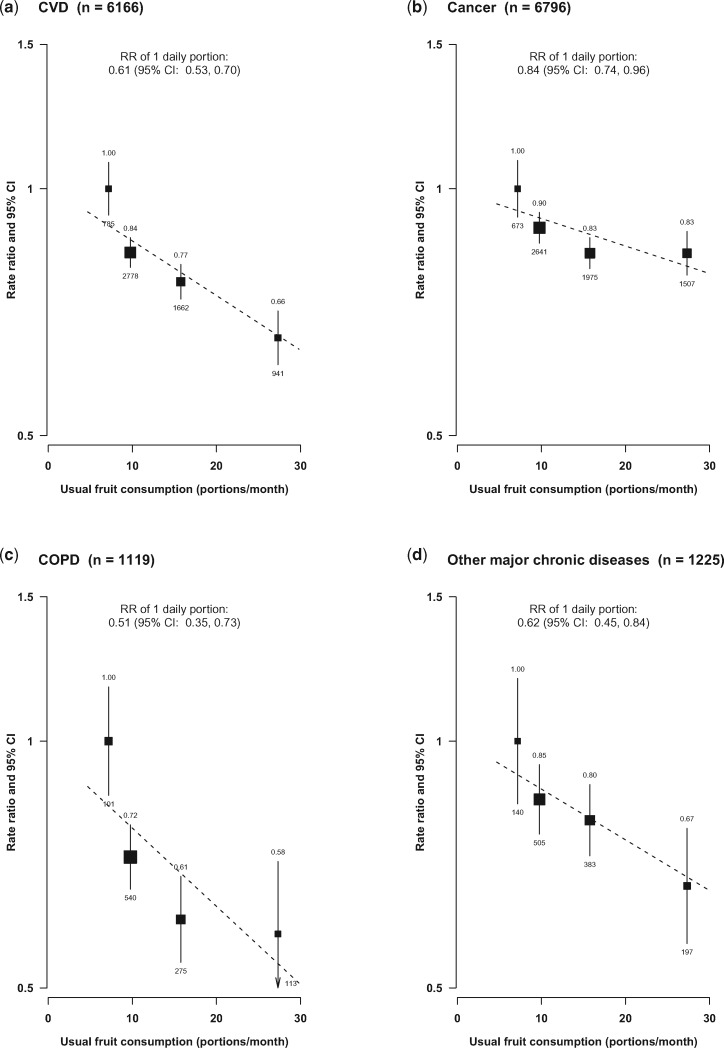
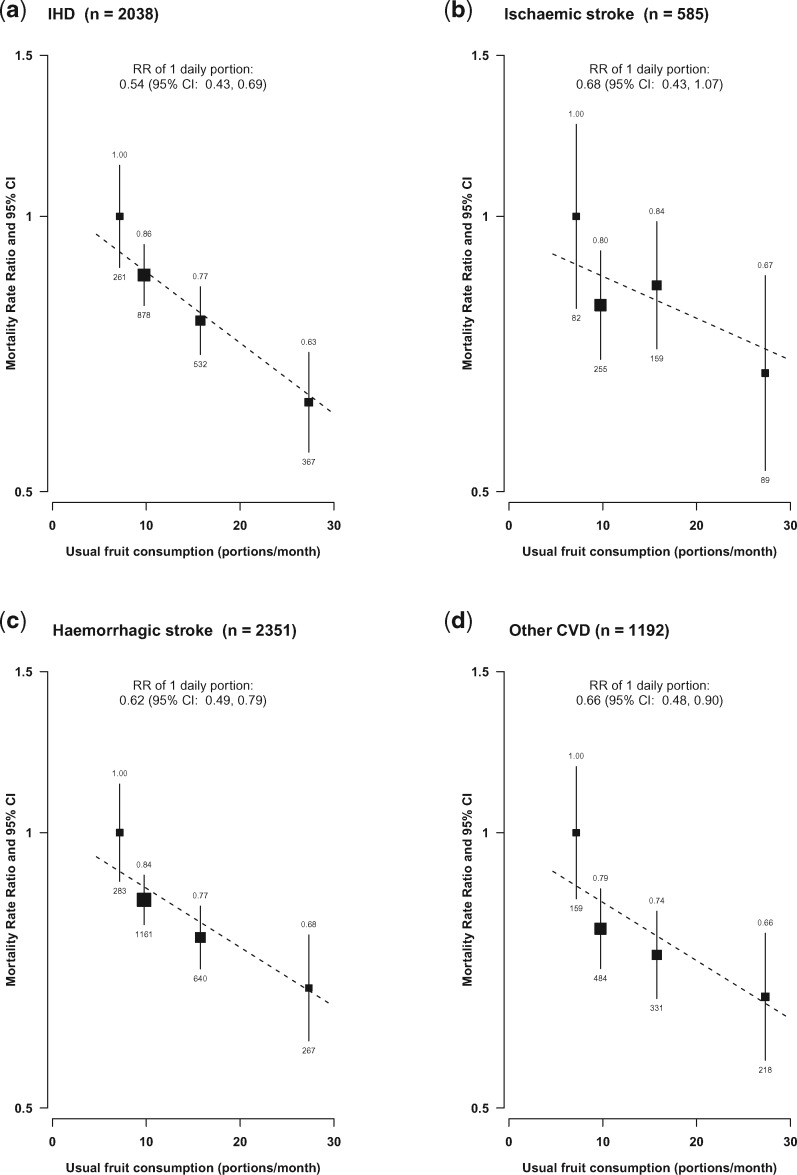
At baseline, 28% of participants reported consuming fruit ≥ 4 days/week (regular consumers) and 6% reported never/rarely consuming fruit (non-consumers). Compared with non-consumers, regular consumers had 27% [RR = 0.73, 95% confidence interval (CI) 0.70-0.76] lower all-cause mortality, 34% lower CVD mortality (n = 6166; RR = 0.66, 0.61-0.71), 17% lower cancer mortality (n = 6796; RR = 0.83, 0.78-0.89) and 42% lower mortality from chronic obstructive pulmonary disease (COPD) (n = 1119; RR = 0.58, 0.47-0.71). For each of the above, there was an approximately log-linear dose-response relationship with amount consumed. For mortality from site-specific cancers, fruit consumption was inversely associated with digestive tract cancer (n = 2265; RR = 0.72, 0.64-0.81), particularly oesophageal cancer (n = 801; RR = 0.65, 0.50-0.83), but not with cancer of lung or liver.
Among Chinese adults, higher fresh fruit consumption was associated with significantly lower mortality from several major vascular and non-vascular diseases. Given the current low population level of fruit consumption, substantial health benefits could be gained from increased fruit consumption in China.
较高的水果摄入量与较低的心血管疾病(CVD)风险相关。然而,关于水果摄入量与全因死亡率以及 CVD 和主要非血管疾病亚型死亡率之间的关联,仍存在很大的不确定性,尤其是在中国。
在 2004-08 年,全国性的中国慢性病前瞻性研究(CKB)从中国 10 个不同地区招募了 50 多万名 30-79 岁的成年人。使用访谈者管理的电子问卷估计新鲜水果的摄入量,并且通过死亡登记收集死亡率数据。在 462342 名基线时无主要慢性疾病的参与者中,有 17894 人在约 7 年的随访期间死亡。Cox 回归得出了与水果摄入量相关的全因和特定病因死亡率的调整后率比值(RR)。
基线时,28%的参与者报告每周至少食用水果 4 天(规律食用者),6%的参与者报告从不/很少食用水果(不食用者)。与不食用者相比,规律食用者的全因死亡率低 27%[RR=0.73,95%置信区间(CI)0.70-0.76],CVD 死亡率低 34%(n=6166;RR=0.66,0.61-0.71),癌症死亡率低 17%(n=6796;RR=0.83,0.78-0.89),慢性阻塞性肺疾病(COPD)死亡率低 42%(n=1119;RR=0.58,0.47-0.71)。对于上述每一种疾病,其与摄入量之间都存在近似的对数线性剂量反应关系。对于特定部位癌症的死亡率,水果摄入与消化道癌症呈负相关(n=2265;RR=0.72,0.64-0.81),尤其是食道癌(n=801;RR=0.65,0.50-0.83),但与肺癌或肝癌无关。
在中国成年人中,较高的新鲜水果摄入量与几种主要的血管和非血管疾病的死亡率显著降低有关。考虑到目前中国人群水果摄入量较低,如果增加水果摄入量,可能会带来巨大的健康益处。