Saito Hiroto, Fushida Sachio, Miyashita Tomoharu, Oyama Katsunobu, Yamaguchi Takahisa, Tsukada Tomoya, Kinoshita Jun, Tajima Hidehiro, Ninomiya Itasu, Ohta Tetsuo
Department of Gastroenterological Surgery, Division of Cancer Medicine, Graduate School of Medical Science, Kanazawa University, 13-1 Takara-machi, Kanazawa, Ishikawa, 920-8641, Japan.
BMC Cancer. 2017 Apr 27;17(1):294. doi: 10.1186/s12885-017-3279-4.
The theory of extravasated platelet aggregation in cancer lesions was recently introduced. We investigated the association of platelet aggregation in gastric cancer stroma with clinicopathological features, chemotherapeutic response, pathological response, and survival.
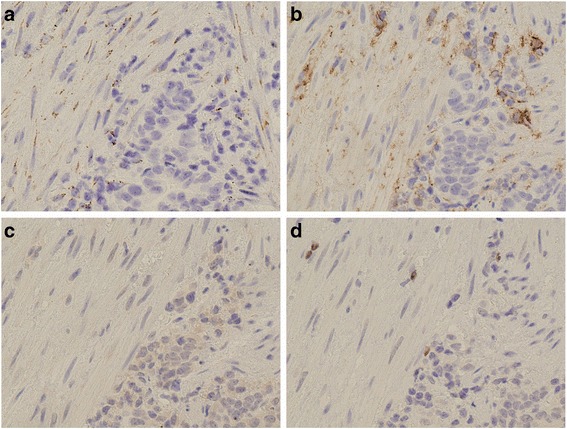
The study comprised 78 patients with advanced gastric cancer who had undergone gastrectomy with or without combination of docetaxel, cisplatin and S-1 (DCS) as preoperative chemotherapy between 2005 and 2014. The patients were divided into two groups: patients who had received preoperative DCS therapy forming the p-DCS group and patients who had not received preoperative DCS therapy forming the control group. The 39 patients in the control group had received gastrectomy and postoperative chemotherapy of S-1 alone. Platelet aggregation in biopsy specimens before preoperative DCS therapy in the p-DCS group and at the time of diagnosis in the control group were evaluated using CD42b immunohistochemical staining.
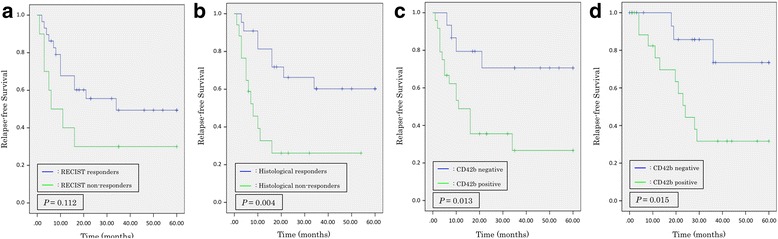
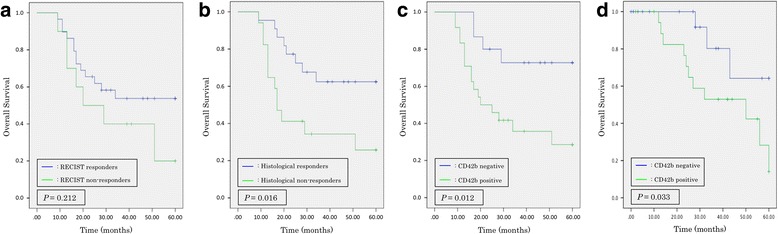
Twenty-four patients in the p-DCS group and 19 in the control group were found to have platelet aggregation in their cancer stroma. Patients with histologically confirmed platelet aggregation had significantly higher rates of chemoresistance (58.3%) than those without platelet aggregation (20.0%) (P = 0.019). According to multivariate analysis, CD42b expression (odds ratio: 5.102, 95% confidence interval: 1.039-25.00, P = 0.045) was correlated with chemoresistance. CD42b expression and histological non-responder status were both significantly correlated with poor overall survival (OS) (P = 0.012, P = 0.016); however, RECIST was not correlated with OS. In the control group, CD42b expression was also significantly correlated with poor overall survival (OS) (P = 0.033). In the p-DCS group, according to multivariate analysis, male sex (hazard ratio: 0.281, 95% confidence interval: 0.093-0.846, P = 0.024) was correlated with good prognosis and CD42b expression (hazard ratio: 4.406, 95% confidence interval: 1.325-14.65, P = 0.016) with poor prognosis.
This study suggests that platelets in gastric cancer stroma may create a favorable microenvironment for chemoresistance. CD42b immunohistochemical staining of biopsy specimens is a promising candidate for being a prognostic marker in patients with gastric cancer.
最近提出了癌症病灶中血小板外渗聚集的理论。我们研究了胃癌基质中血小板聚集与临床病理特征、化疗反应、病理反应及生存率之间的关系。
本研究纳入了78例晚期胃癌患者,这些患者在2005年至2014年间接受了胃切除术,部分患者术前接受了多西他赛、顺铂和S-1(DCS)联合化疗。患者分为两组:接受术前DCS治疗的患者组成p-DCS组,未接受术前DCS治疗的患者组成对照组。对照组的39例患者接受了胃切除术及术后单纯S-1化疗。使用CD42b免疫组化染色评估p-DCS组术前DCS治疗前活检标本及对照组诊断时活检标本中的血小板聚集情况。
p-DCS组有24例患者、对照组有19例患者的癌基质中存在血小板聚集。组织学证实有血小板聚集的患者化疗耐药率(58.3%)显著高于无血小板聚集的患者(20.0%)(P = 0.019)。多因素分析显示,CD42b表达(比值比:5.102,95%置信区间:1.039 - 25.00,P = 0.045)与化疗耐药相关。CD42b表达及组织学无反应状态均与总生存期(OS)较差显著相关(P = 0.012,P = 0.016);然而,实体瘤疗效评价标准(RECIST)与OS无关。在对照组中,CD42b表达也与总生存期(OS)较差显著相关(P = 0.033)。在p-DCS组中,多因素分析显示,男性(风险比:0.281,95%置信区间:0.093 - 0.846,P = 0.024)与预后良好相关,而CD42b表达(风险比:4.406,95%置信区间:1.325 - 14.65,P = 0.016)与预后不良相关。
本研究表明,胃癌基质中的血小板可能为化疗耐药创造有利的微环境。活检标本的CD42b免疫组化染色有望成为胃癌患者的预后标志物。