Yu Liuting, Guo Yao, Chang Zhiguang, Zhang Dengyang, Zhang Shiqiang, Pei Hanzhong, Pang Jun, Zhao Zhizhuang Joe, Chen Yun
Edmond H. Fischer Translational Medical Research Laboratory, Scientific Research Center, The Seventh Affiliated Hospital, Sun Yat-Sen University, Shenzhen, China.
Department of Urology, The Seventh Affiliated Hospital, Sun Yat-sen University, Shenzhen, China.
Front Oncol. 2021 Oct 14;11:764119. doi: 10.3389/fonc.2021.764119. eCollection 2021.
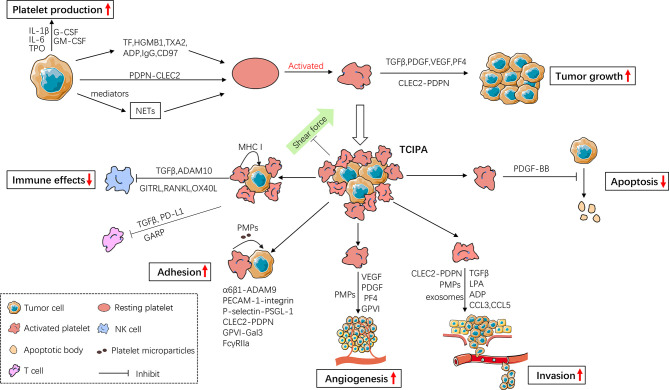
Platelets are essential components in the tumor microenvironment. For decades, clinical data have demonstrated that cancer patients have a high risk of thrombosis that is associated with adverse prognosis and decreased survival, indicating the involvement of platelets in cancer progression. Increasing evidence confirms that cancer cells are able to induce production and activation of platelets. Once activated, platelets serve as allies of cancer cells in tumor growth and metastasis. They can protect circulating tumor cells (CTCs) against the immune system and detachment-induced apoptosis while facilitating angiogenesis and tumor cell adhesion and invasion. Therefore, antiplatelet agents and platelet-based therapies should be developed for cancer treatment. Here, we discuss the mechanisms underlying the bidirectional cancer-platelet crosstalk and platelet-based therapeutic approaches.
血小板是肿瘤微环境中的重要组成部分。几十年来,临床数据表明癌症患者有很高的血栓形成风险,这与不良预后和生存率降低相关,表明血小板参与了癌症进展。越来越多的证据证实癌细胞能够诱导血小板的产生和激活。一旦被激活,血小板在肿瘤生长和转移中就成为癌细胞的同盟。它们可以保护循环肿瘤细胞(CTC)免受免疫系统攻击以及脱离诱导的凋亡,同时促进血管生成以及肿瘤细胞的黏附和侵袭。因此,应开发抗血小板药物和基于血小板的疗法用于癌症治疗。在此,我们讨论癌症与血小板双向相互作用的潜在机制以及基于血小板的治疗方法。