Birkeland Marianne Skogbrott, Nielsen Morten Birkeland, Hansen Marianne Bang, Knardahl Stein, Heir Trond
Norwegian Centre for Violence and Traumatic Stress Studies, Oslo, Norway.
National Institute of Occupational Health, Oslo, Norway.
Eur J Psychotraumatol. 2017 Mar 20;8(1):1302692. doi: 10.1080/20008198.2017.1302692. eCollection 2017.
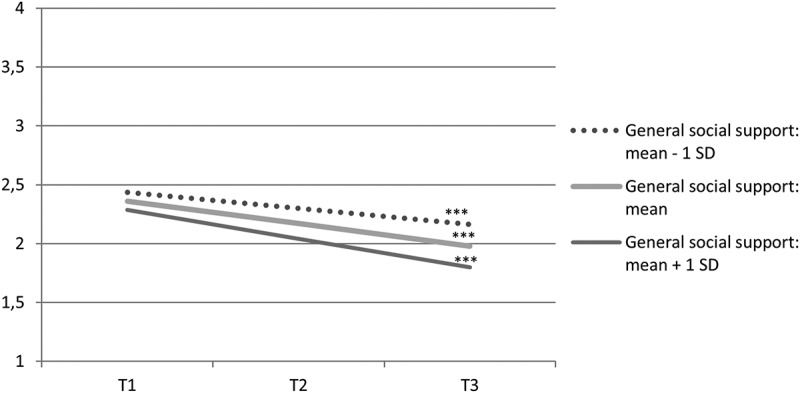
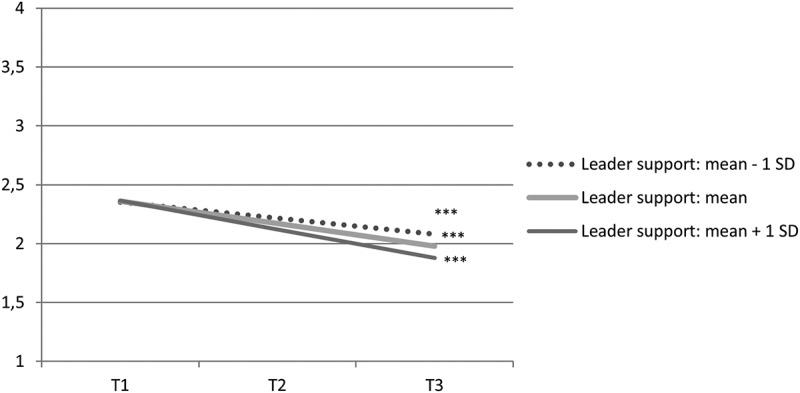
: Whereas the association between social support and psychological distress has been well-established through both cross-sectional and longitudinal studies, less is known about whether social support influences rate of change in psychological distress over time. Nor is it clear whether social support predicts baseline psychological distress, or, more importantly, whether social support may contribute to more rapid recovery following trauma exposure. : This study aimed to determine the extent to which social support contributed to the recovery process among individuals with psychological distress after being exposed to trauma. : Prospective survey data from ministry employees were collected 10, 22, and 34 months after the 2011 Oslo bombing that targeted the governmental quarters. We explored recovery in a clinical subsample (N = 238) of individuals with elevated levels of psychological distress (defined as mean 10-item Hopkins symptom checklist score > 1.85) one year after the event. A linear latent growth curve of psychological distress with general social support from friends and family, colleague support, and leader support as predictors was examined. : High levels of general social support and leader support were independently associated with a more rapid decline in psychological distress over time. : General social support, as well as support from a leader in one's working life, may facilitate recovery from psychological distress after exposure to a traumatic event. Enhancing social support from family and friends, as well as in work settings, may benefit those with psychological distress following a traumatic workplace event.
尽管通过横断面研究和纵向研究都已充分证实社会支持与心理困扰之间的关联,但对于社会支持是否会影响心理困扰随时间的变化率,人们了解得较少。同样不清楚的是,社会支持能否预测基线心理困扰,或者更重要的是,社会支持是否有助于在经历创伤后更快恢复。
本研究旨在确定社会支持在多大程度上有助于遭受创伤后出现心理困扰的个体的恢复过程。
收集了2011年针对政府办公区的奥斯陆爆炸事件发生后10个月、22个月和34个月时来自政府部门员工的前瞻性调查数据。我们在事件发生一年后,对心理困扰水平较高(定义为10项霍普金斯症状清单平均得分>1.85)的个体的临床子样本(N = 238)进行了恢复情况的探究。研究了以朋友和家人的一般社会支持、同事支持以及领导支持作为预测因素的心理困扰线性潜在增长曲线。
高水平的一般社会支持和领导支持分别与心理困扰随时间更快下降相关。
一般社会支持以及工作中领导的支持可能有助于在经历创伤事件后从心理困扰中恢复。加强来自家人和朋友以及工作场所的社会支持可能会使遭受创伤性工作事件后出现心理困扰的人受益。