Rochefort Coralie, Walters-Stewart Coren, Aglipay Mary, Barrowman Nick, Zemek Roger, Sveistrup Heidi
School of Human Kinetics, Faculty of Health Sciences, University of Ottawa, Ottawa, Ontario, Canada.
Children's Hospital of Eastern Ontario Research Institute, Ottawa, Ontario, Canada.
Orthop J Sports Med. 2017 Mar 17;5(3):2325967117695507. doi: 10.1177/2325967117695507. eCollection 2017 Mar.
The Balance Error Scoring System (BESS) shows that balance tends to recover within days after a concussion, whereas measures of the movement of the center of pressure (COP) show that balance deficits can persist up to 1 month after concussion. While approximately 30% of adolescents suffering concussion have functional consequences including balance deficits, evidence of the use of different balance assessments for concussion is limited within this population.
To compare performance on a series of balance assessments between adolescents with a diagnosed concussion at 1 month postinjury and noninjured control participants within the same age distribution.
Cross-sectional study; Level of evidence, 3.
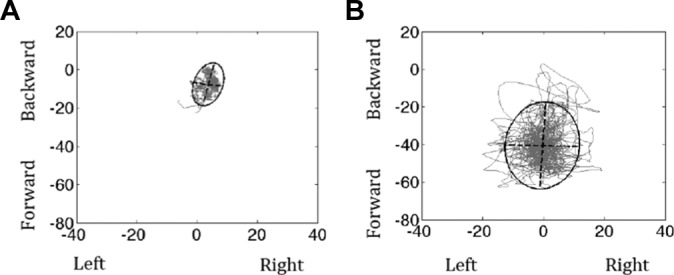
Thirty-three adolescents 1 month postconcussion and 33 control participants completed the BESS followed by two, 2-minute trials standing on a Nintendo Wii Balance Board (WBB), during which the COP under their feet was recorded using 2 testing protocols: (1) double-leg stance, eyes open (EO) and (2) double-leg stance, eyes closed (EC). Participants then completed a dual-task condition (DT) with eyes open combining a double-leg stance and a Stroop color and word test while standing on the WBB. Three commonly used COP variables, anterior-posterior (A/P) and mediolateral (M/L) velocity and 95% ellipse, were computed for each condition performed on the WBB.
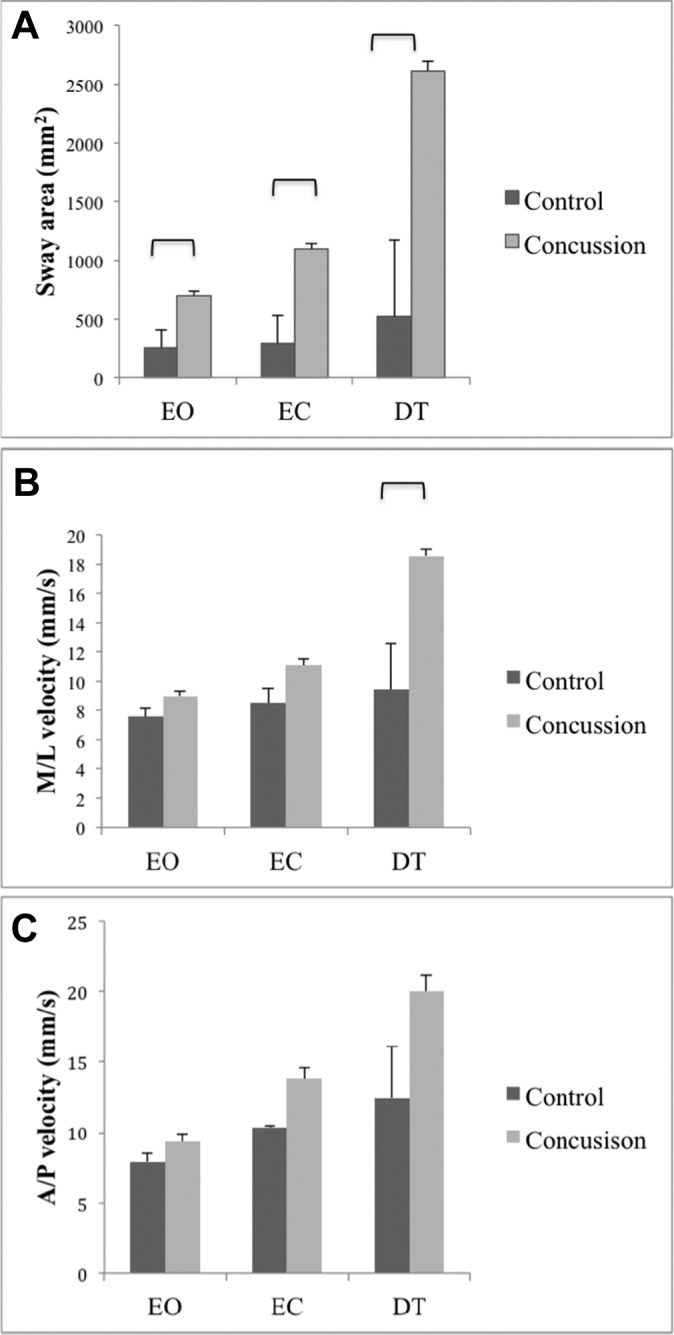
Participants postconcussion swayed over a significantly larger ellipse area compared with the control group in the EO ( = .008), EC ( = .002), and DT ( = .003) conditions and also performed the DT condition with faster COP velocity in the M/L direction ( = .007). No significant group difference was identified for BESS total score.
At 1 month postconcussion, participants continued to demonstrate balance deficits in COP control despite scoring similar to controls on the BESS. Simple COP measures of balance may identify subtle impairments not captured by the BESS.
平衡误差评分系统(BESS)显示,脑震荡后数天内平衡功能往往会恢复,而压力中心(COP)移动的测量结果表明,脑震荡后平衡缺陷可持续长达1个月。虽然约30%遭受脑震荡的青少年存在包括平衡缺陷在内的功能后果,但在这一人群中,使用不同平衡评估方法诊断脑震荡的证据有限。
比较受伤后1个月被诊断为脑震荡的青少年与年龄分布相同的未受伤对照参与者在一系列平衡评估中的表现。
横断面研究;证据水平为3级。
33名脑震荡后1个月的青少年和33名对照参与者完成了BESS测试,随后在任天堂Wii平衡板(WBB)上进行两次2分钟的站立试验,在此期间,使用两种测试方案记录他们脚下的COP:(1)双腿站立,睁眼(EO);(2)双腿站立,闭眼(EC)。参与者随后在睁眼状态下完成一项双任务条件(DT),即在站在WBB上时结合双腿站立和Stroop颜色和单词测试。针对在WBB上进行的每种条件,计算三个常用的COP变量,前后(A/P)和内外侧(M/L)速度以及95%椭圆面积。
与对照组相比,脑震荡后参与者在EO(P = 0.008)、EC(P = 0.002)和DT(P = 0.003)条件下的椭圆面积摆动明显更大,并且在DT条件下M/L方向的COP速度也更快(P = 0.007)。BESS总分未发现显著的组间差异。
在脑震荡后1个月,尽管参与者在BESS上的得分与对照组相似,但他们在COP控制方面仍表现出平衡缺陷。简单的COP平衡测量可能会识别出BESS未捕捉到的细微损伤。