Gurzkowska Beata, Kułaga Zbigniew, Grajda Aneta, Góźdź Magdalena, Wojtyło Małgorzata, Litwin Mieczysław
Public Health Department, The Children's Memorial Health Institute, al. Dzieci Polskich 20, 04-730, Warsaw, Poland.
Department of Nephrology and Arterial Hypertension, The Children's Memorial Health Institute, al. Dzieci Polskich 20, 04-730, Warsaw, Poland.
Eur J Pediatr. 2017 Jun;176(6):797-806. doi: 10.1007/s00431-017-2912-1. Epub 2017 Apr 28.
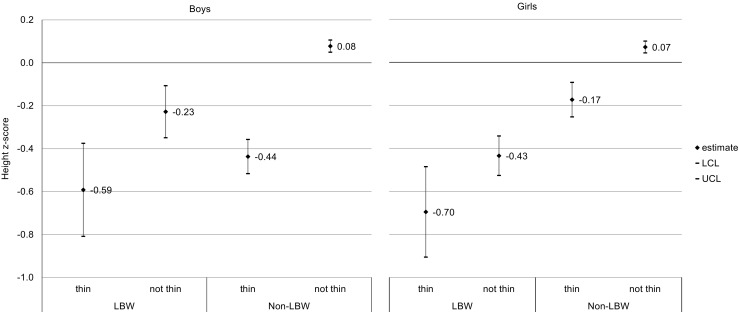
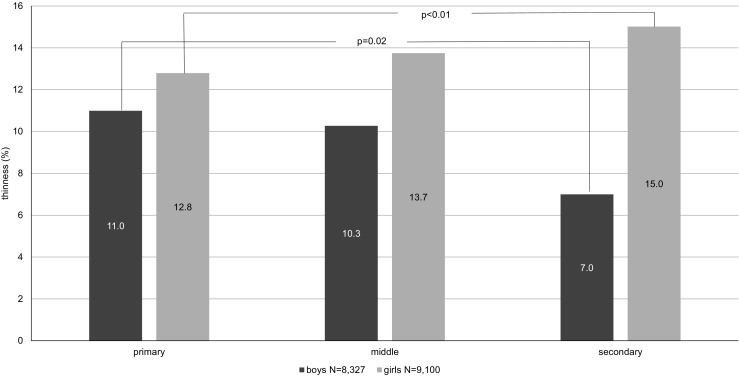
The analysis was performed on a database including 17,427 records of subjects aged 7-18 years, randomly sampled from a population of Polish students. Thinness was determined using international cut-off points, defined to pass through body mass index of 18.5 kg/m at the age of 18. The weighted prevalence of thinness and odds ratios with 95% confidence interval were estimated for gender, birth weight, level of schooling and school location, gross domestic product (GDP) per inhabitant, family income and maternal education. Body height was analysed according to body mass and birth weight categories. The prevalence of thinness was higher among children with low birth weight and among girls. The prevalence of thinness decreased with increasing GDP per inhabitant. In analysis by level of schooling: primary-middle-secondary, prevalence of thinness decreased among boys and increased among girls. Thin students were significantly shorter than other students, and thin girls less likely participated in physical education.
Gender and socioeconomic factors are important determinants of thinness among Polish children and adolescents. Public health strategies should address family eating practices to prevent negative effects of weight deficit, especially among girls/children from low GDP regions. What is Known: • Socioeconomic factors and gender influence weight status of children and adolescents. What is New: • The first time the prevalence and determinants of thinness based on data from a nationally representative, weighted sample of Polish children aged 7-18 years were presented. • The analysis shows how gender and socioeconomics determinants influence the prevalence of thinness among children and adolescent in post-transformation country and can be used to international comparisons.
该分析是在一个包含17427条7至18岁受试者记录的数据库上进行的,这些记录是从波兰学生群体中随机抽取的。消瘦是根据国际临界值确定的,该临界值定义为18岁时体重指数为18.5kg/m²。估计了消瘦的加权患病率以及按性别、出生体重、教育程度和学校所在地、人均国内生产总值(GDP)、家庭收入和母亲教育程度划分的95%置信区间的比值比。根据体重和出生体重类别对身高进行了分析。低出生体重儿童和女孩中消瘦的患病率较高。消瘦的患病率随着人均GDP的增加而降低。在按教育程度(小学-初中-高中)进行的分析中:消瘦的患病率在男孩中降低,在女孩中升高。消瘦的学生明显比其他学生矮,而且消瘦的女孩参加体育教育的可能性较小。
性别和社会经济因素是波兰儿童和青少年消瘦的重要决定因素。公共卫生策略应关注家庭饮食习惯,以预防体重不足的负面影响,尤其是在来自低GDP地区的女孩/儿童中。已知信息:• 社会经济因素和性别会影响儿童和青少年的体重状况。新发现:• 首次基于波兰7至18岁儿童具有全国代表性的加权样本数据呈现了消瘦的患病率及其决定因素。• 该分析展示了性别和社会经济决定因素如何影响转型后国家儿童和青少年中消瘦的患病率,并可用于国际比较。