Joustra Monica L, Minovic Isidor, Janssens Karin A M, Bakker Stephan J L, Rosmalen Judith G M
Interdisciplinary Center Psychopathology and Emotion regulation, University Medical Center Groningen, University of Groningen, Groningen, the Netherlands.
Department of Nephrology, University Medical Center Groningen, University of Groningen, Groningen, the Netherlands.
PLoS One. 2017 Apr 28;12(4):e0176631. doi: 10.1371/journal.pone.0176631. eCollection 2017.
Many chronic fatigue syndrome (CFS) and fibromyalgia syndrome (FMS) patients (35-68%) use nutritional supplements, while it is unclear whether deficiencies in vitamins and minerals contribute to symptoms in these patients. Objectives were (1) to determine vitamin and mineral status in CFS and FMS patients as compared to healthy controls; (2) to investigate the association between vitamin and mineral status and clinical parameters, including symptom severity and quality of life; and (3) to determine the effect of supplementation on clinical parameters.
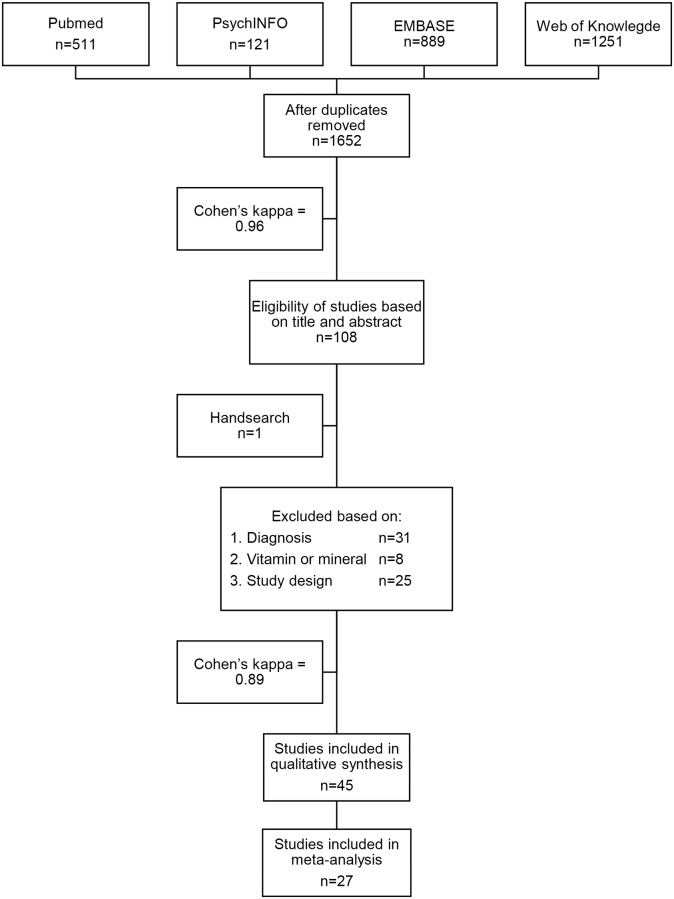
The databases PubMed, EMBASE, Web of Knowledge, and PsycINFO were searched for eligible studies. Articles published from January 1st 1994 for CFS patients and 1990 for FMS patients till March 1st 2017 were included. Articles were included if the status of one or more vitamins or minerals were reported, or an intervention concerning vitamins or minerals was performed. Two reviewers independently extracted data and assessed the risk of bias.
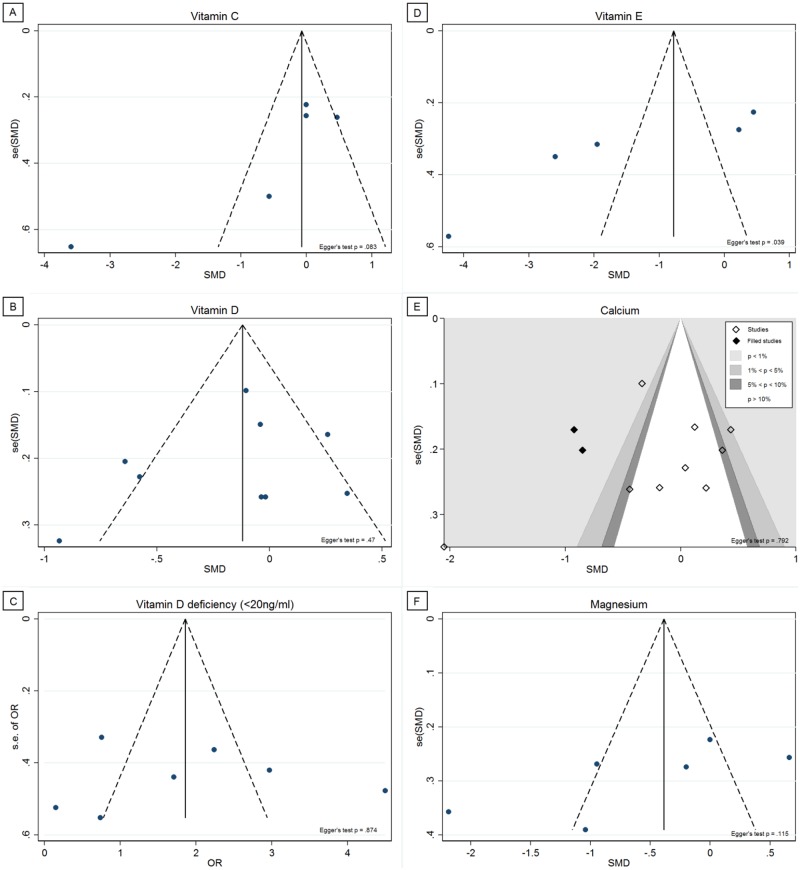
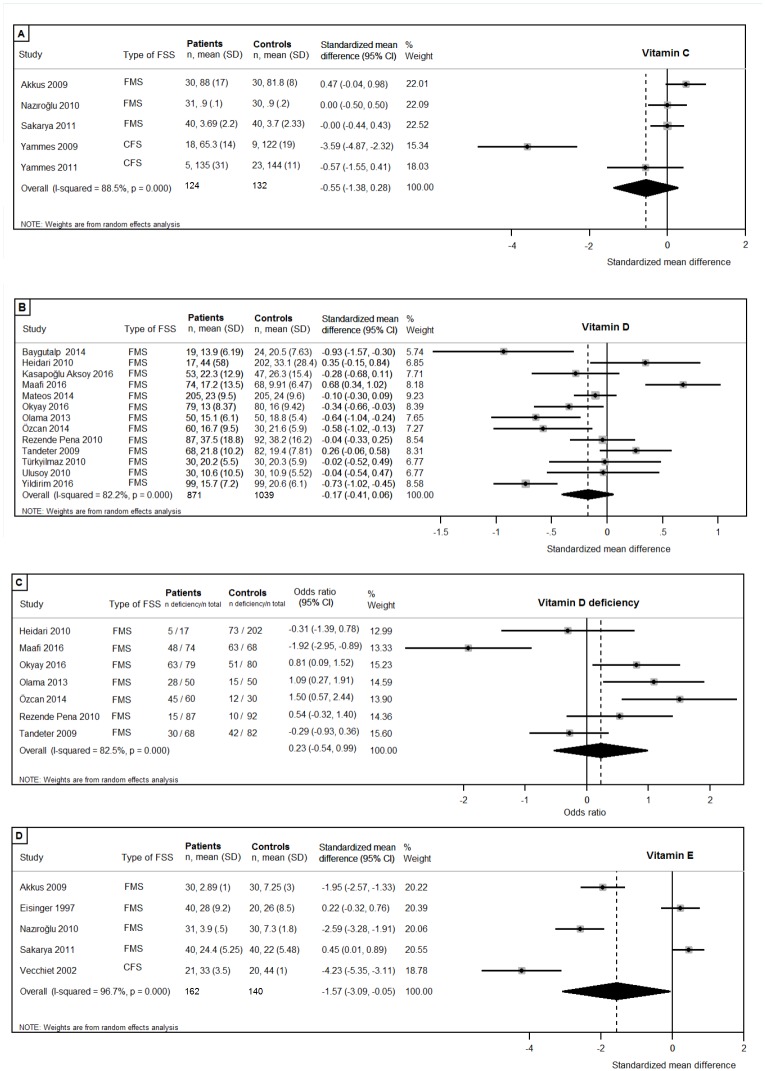
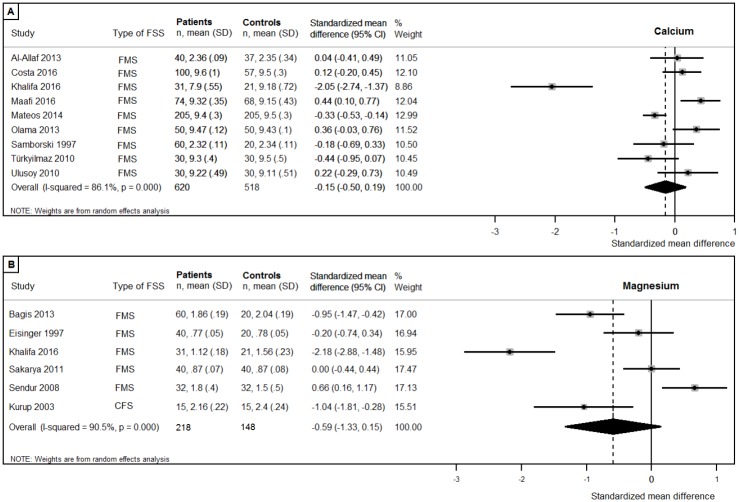
A total of 5 RCTs and 40 observational studies were included in the qualitative synthesis, of which 27 studies were included in the meta-analyses. Circulating concentrations of vitamin E were lower in patients compared to controls (pooled standardized mean difference (SMD): -1.57, 95%CI: -3.09, -0.05; p = .042). However, this difference was not present when restricting the analyses to the subgroup of studies with high quality scores. Poor study quality and a substantial heterogeneity in most studies was found. No vitamins or minerals have been repeatedly or consistently linked to clinical parameters. In addition, RCTs testing supplements containing these vitamins and/or minerals did not result in clinical improvements.
Little evidence was found to support the hypothesis that vitamin and mineral deficiencies play a role in the pathophysiology of CFS and FMS, and that the use of supplements is effective in these patients.
Study methods were documented in an international prospective register of systematic reviews (PROSPERO) protocol, registration number: http://www.crd.york.ac.uk/PROSPERO/display_record.asp?ID=CRD42015032528.
许多慢性疲劳综合征(CFS)和纤维肌痛综合征(FMS)患者(35%-68%)使用营养补充剂,然而目前尚不清楚维生素和矿物质缺乏是否会导致这些患者出现症状。本研究的目的是:(1)确定CFS和FMS患者与健康对照者相比的维生素和矿物质状态;(2)研究维生素和矿物质状态与临床参数之间的关联,包括症状严重程度和生活质量;(3)确定补充剂对临床参数的影响。
检索PubMed、EMBASE、Web of Knowledge和PsycINFO数据库以查找符合条件的研究。纳入1994年1月1日起发表的关于CFS患者以及1990年起发表的关于FMS患者直至2017年3月1日的文章。如果报告了一种或多种维生素或矿物质的状态,或者进行了有关维生素或矿物质的干预,则纳入该文章。两名评审员独立提取数据并评估偏倚风险。
定性综合分析共纳入5项随机对照试验(RCT)和40项观察性研究,其中27项研究纳入荟萃分析。与对照组相比,患者体内维生素E的循环浓度较低(合并标准化均数差(SMD):-1.57,95%置信区间:-3.09,-0.05;p = 0.042)。然而,当将分析限制在高质量评分的研究亚组时,这种差异并不存在。研究质量较差,且大多数研究存在显著异质性。没有维生素或矿物质被反复或持续地与临床参数联系起来。此外,测试含有这些维生素和/或矿物质的补充剂的随机对照试验并未带来临床改善。
几乎没有证据支持维生素和矿物质缺乏在CFS和FMS的病理生理学中起作用以及补充剂对这些患者有效的假设。
研究方法记录在国际前瞻性系统评价注册库(PROSPERO)方案中,注册号:http://www.crd.york.ac.uk/PROSPERO/display_record.asp?ID=CRD42015032528 。